Day01 - 初识项目
1.1 项目介绍
1.1.1 功能演示
天机学堂是一个基于微服务架构的生产级在线教育项目。项目源码:https://gitee.com/yaoyu_turin/tj-exam。
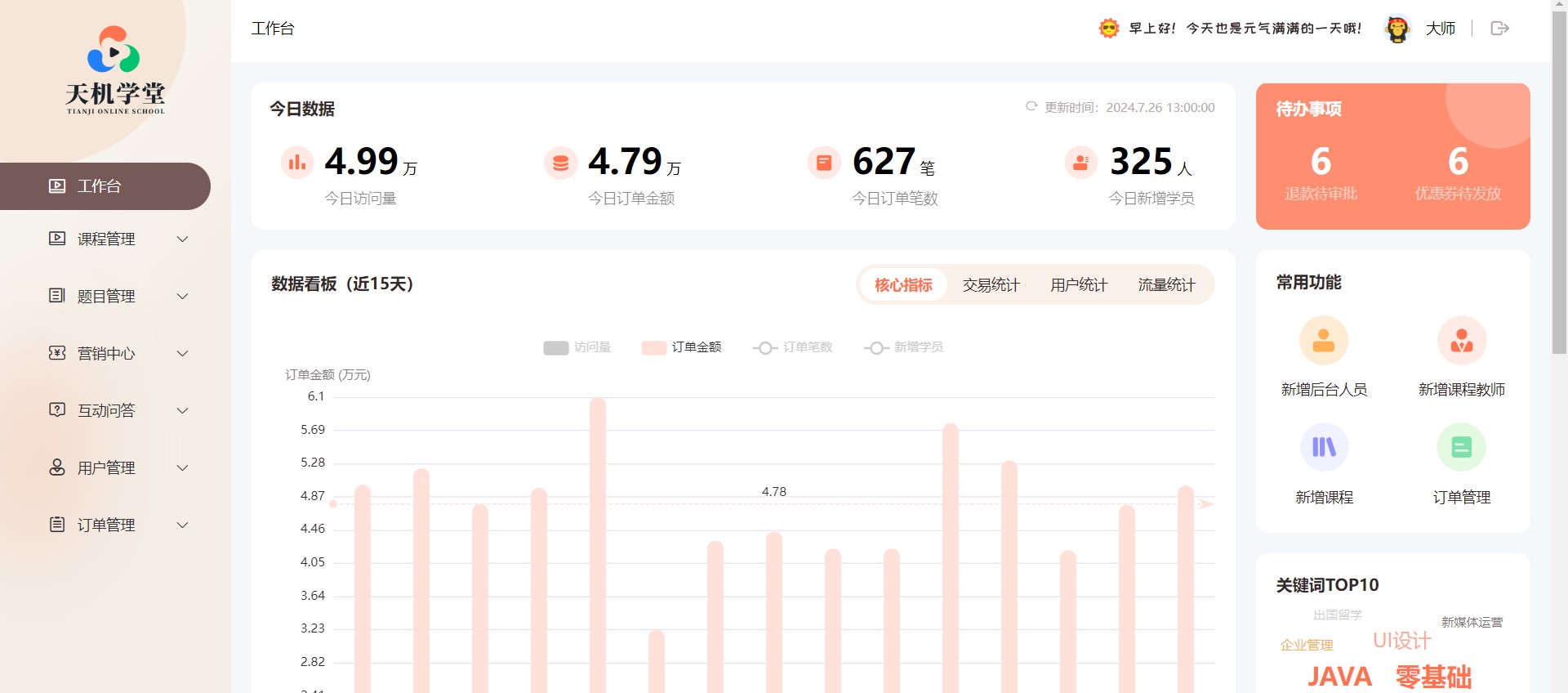
管理端(B端):
演示地址:https://tjxt-admin.itheima.net/#/main/index,账号:12088888888,密码:888itcast.CN764%...
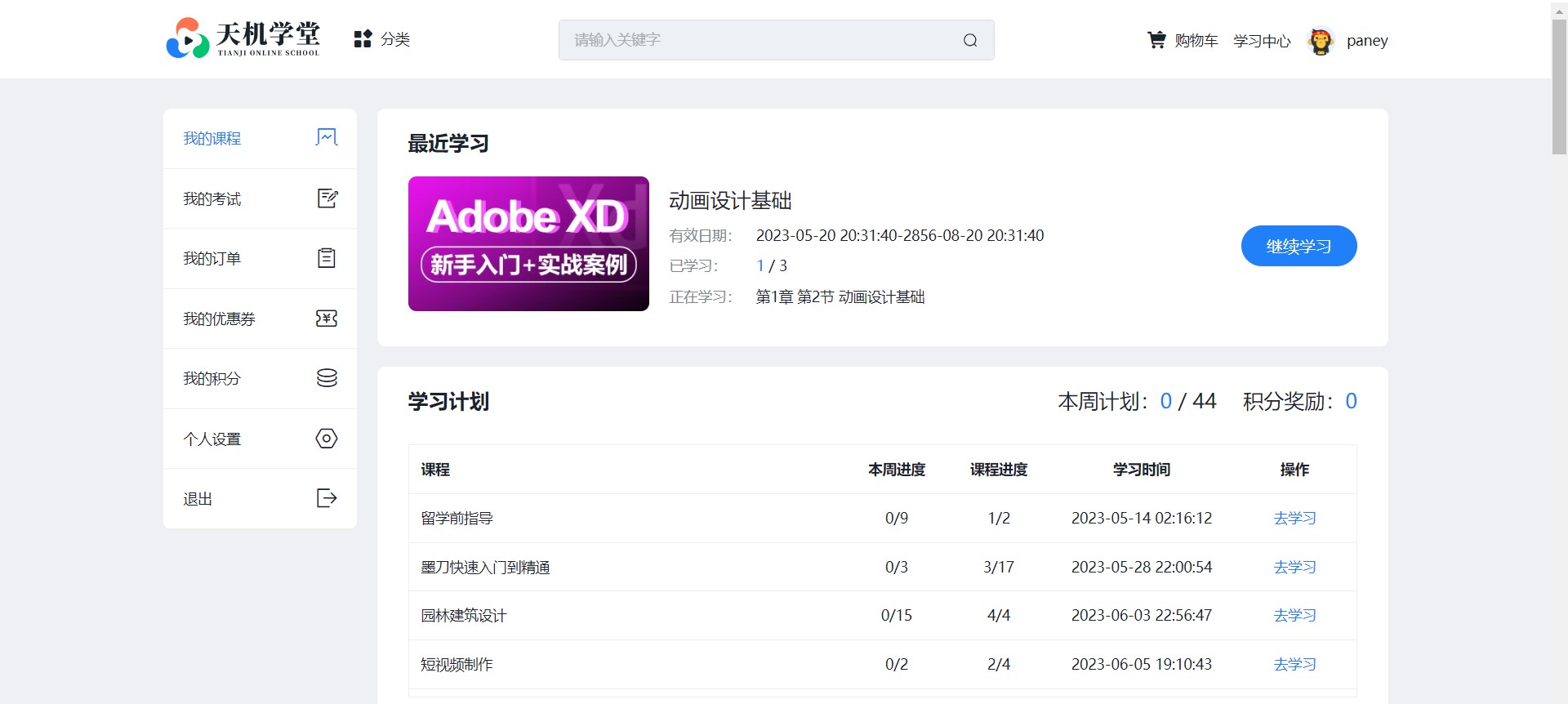
学生端(C端):
演示地址:https://tjxt-user.itheima.net/#/main/index,账号:12077777777,密码:888itcast.CN764%...
1.1.2 项目亮点
项目亮点:

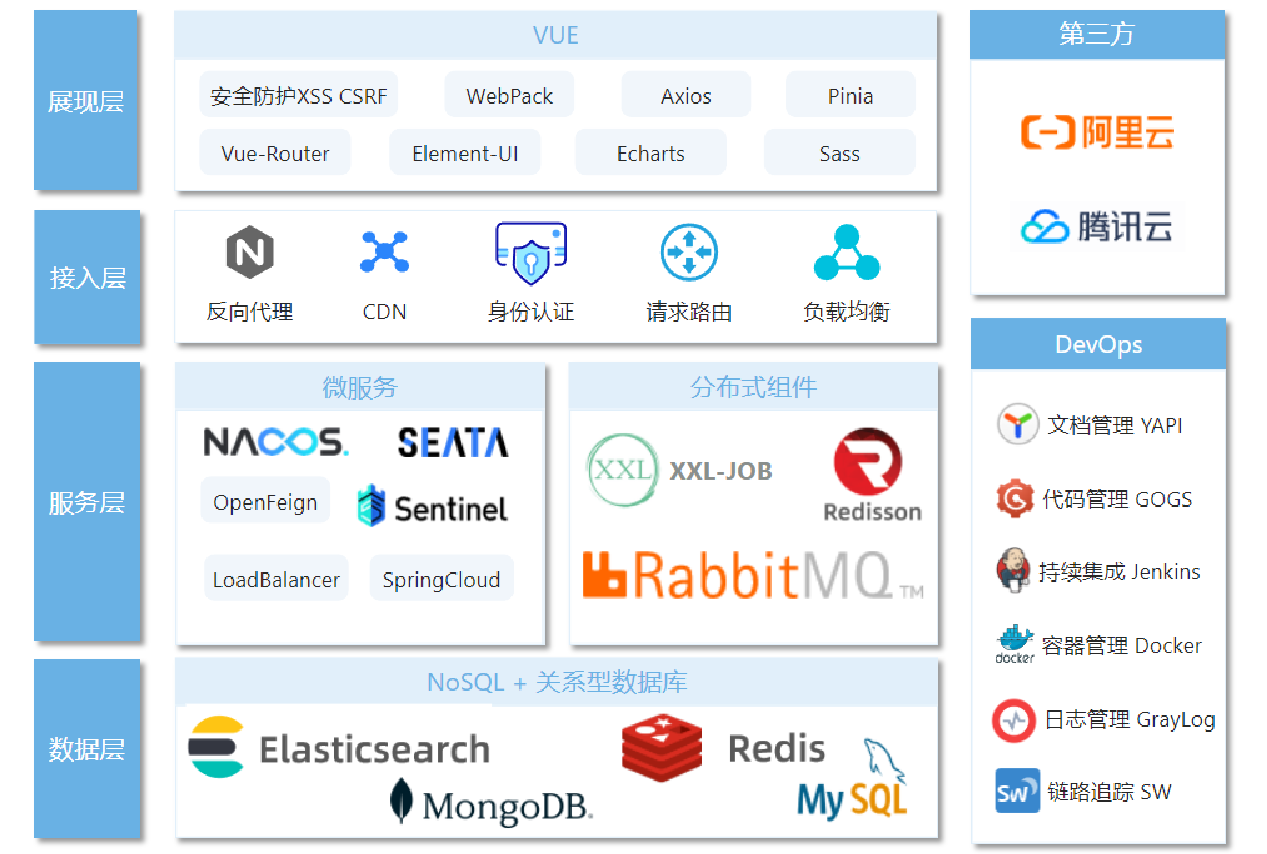
技术架构:
1.2 项目环境搭建
1.2.1 企业开发模式
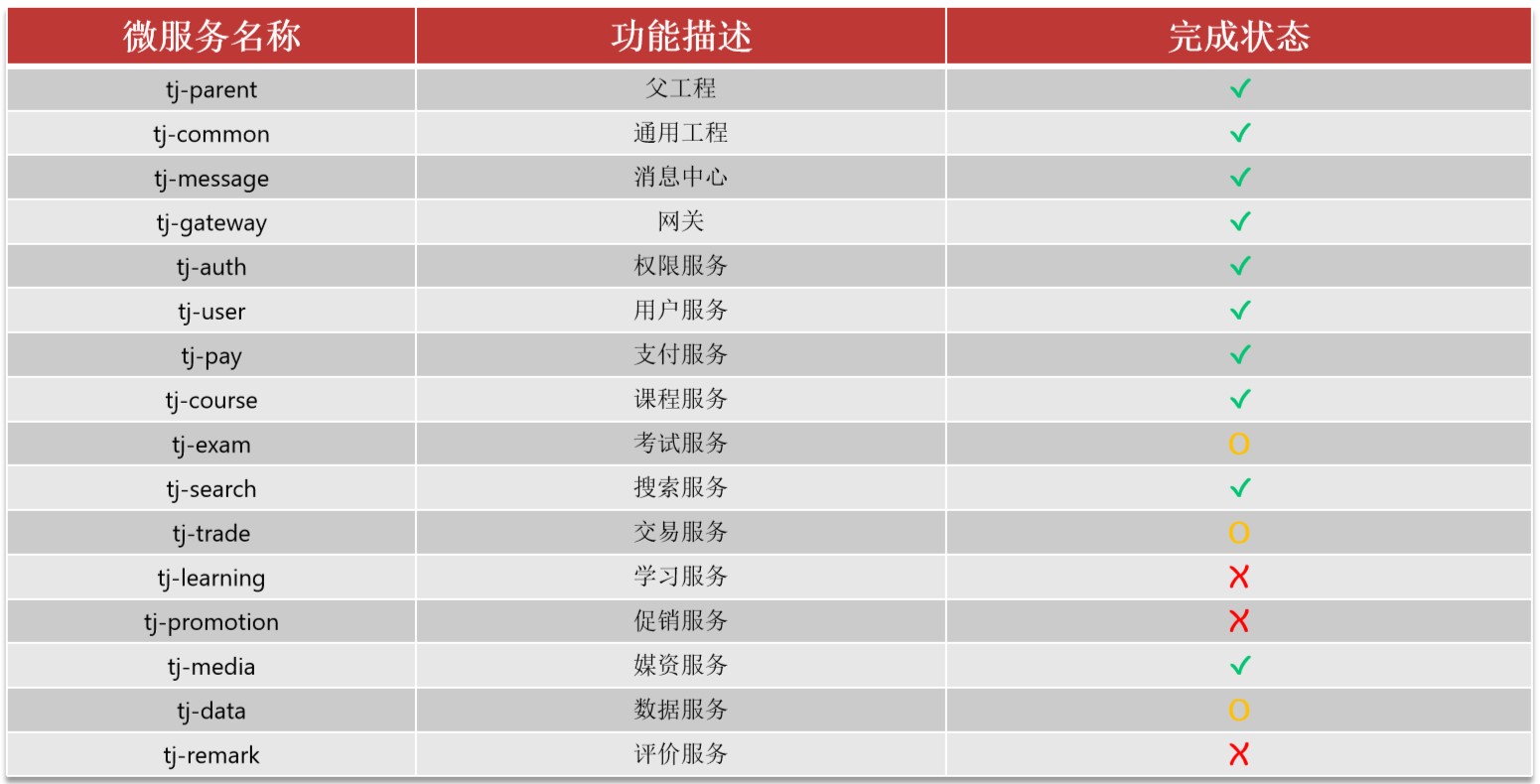
微服务项目与传统项目相比,包含项目模块非常多,每个模块都要独立部署,因此在开发模式上有很大差别:
开发人员成倍增多,分组分别开发不同的微服务模块
微服务模块之间有业务关联,需要相互协作
我们开发时,是否能把所有的项目代码都拉取到本地,然后在本地部署运行、开发测试?
大型微服务项目显然不能,原因如下:
我们可能没有其它模块的代码拉取权限
微服务运行环境过于复杂,本地部署成本较高
微服务模块较多,本地计算机性能难以支撑
在开发的不同阶段,往往有不同的测试手段:
单元测试:测试最小的可测试单元
集成测试:验证某个功能接口
组件测试:验证微服务组件
端对端联调:验证整个系统
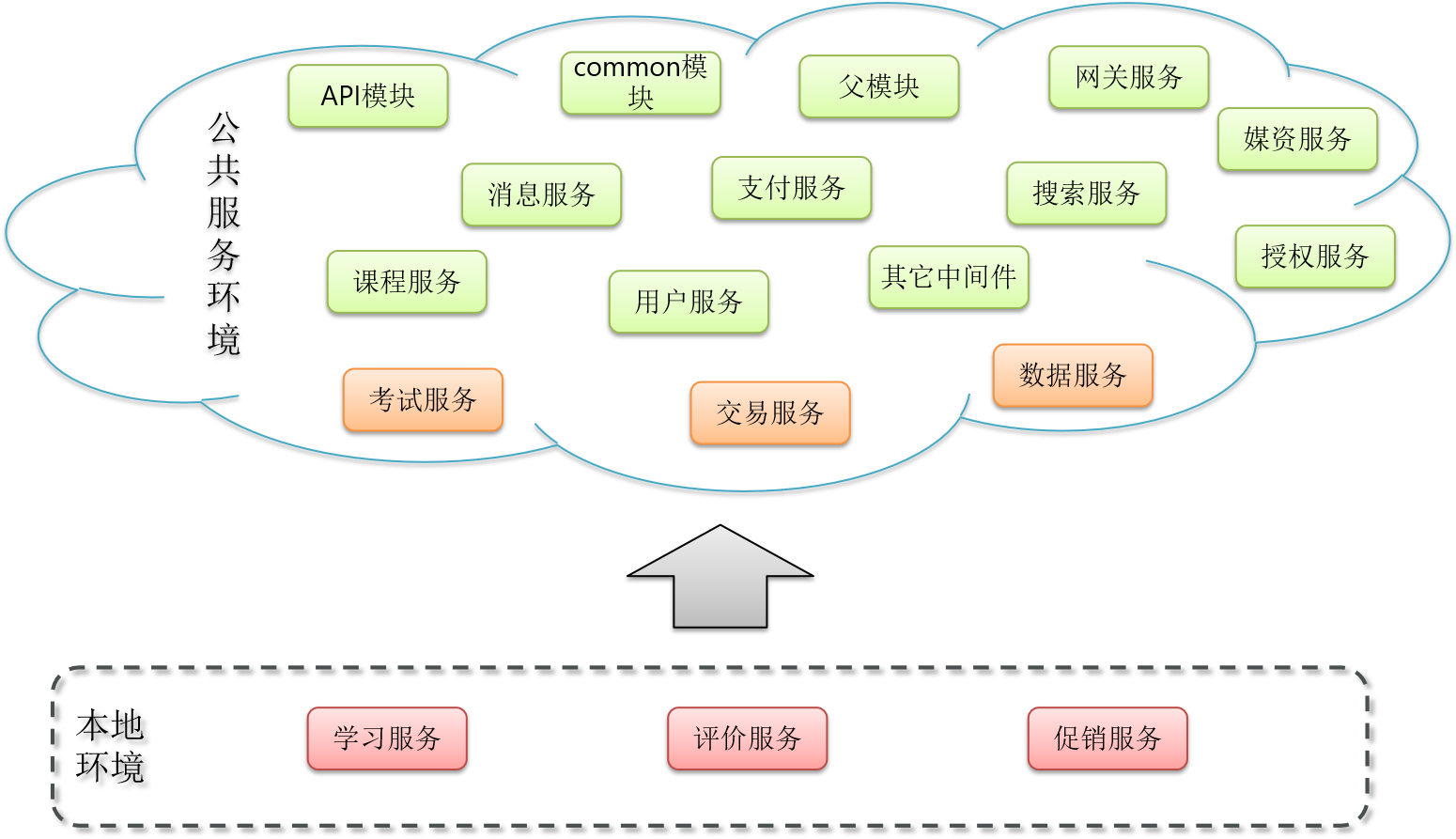
1.2.2 模拟企业环境
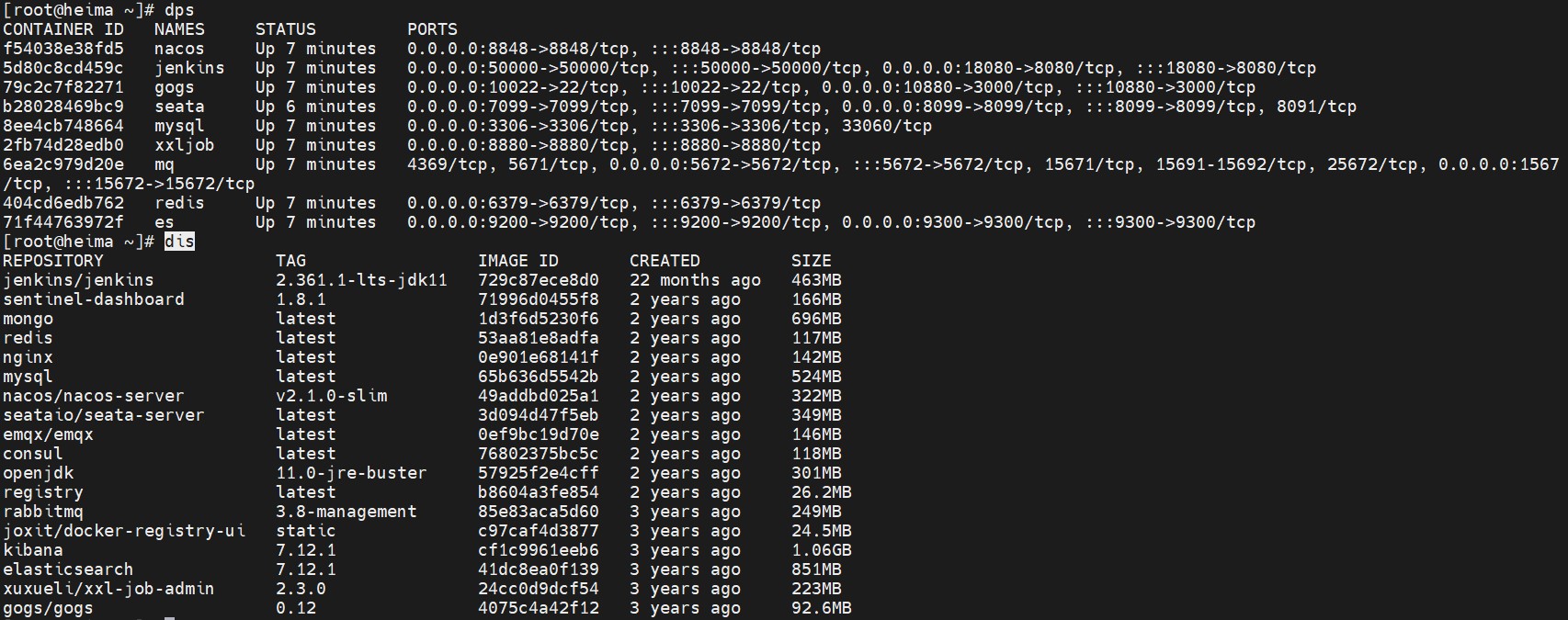
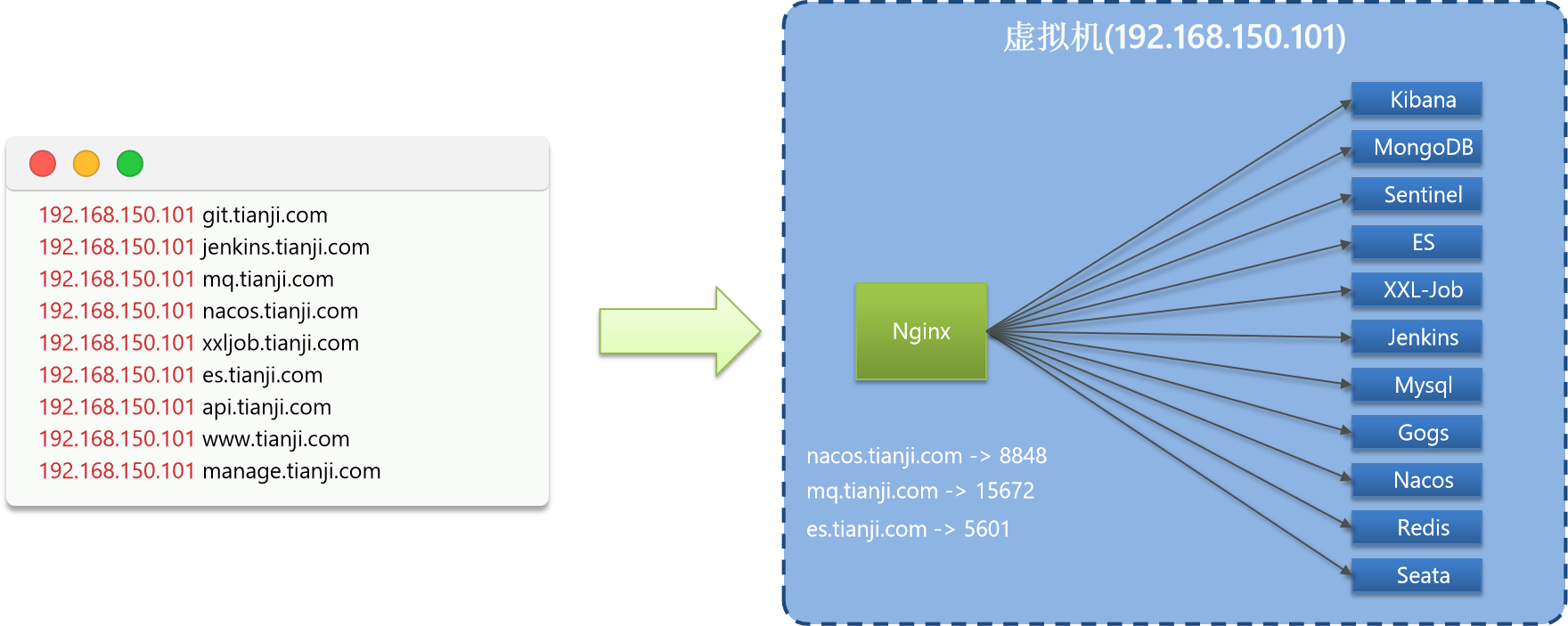
为了模拟真实开发环境,我们准备了一台虚拟机,在其中安装了各种各样的公共服务和组件。
虚拟机导入说明:https://b11et3un53m.feishu.cn/wiki/wikcnp21tivsf57nQrHckQuZ3Vd
自定义部署:https://b11et3un53m.feishu.cn/wiki/R068wmzUtifYg5kEMP7c6EMTn9d
1.2.3 持续集成环境
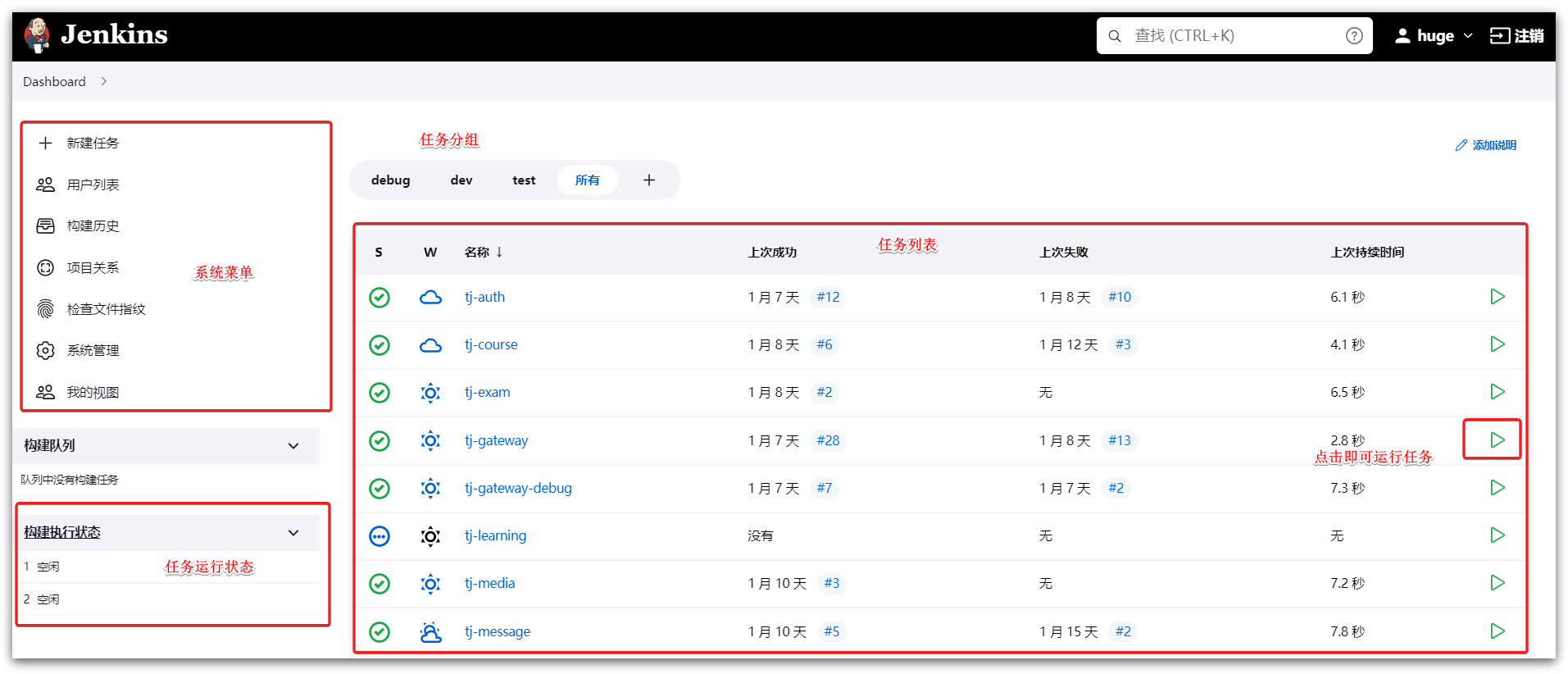
我们在虚拟机中已经基于 Jenkins 实现了持续集成,访问 http://jenkins.tianji.com (账号:root/123) 即可查看控制台:
1.2.4 本地开发部署
我们在虚拟机环境中准备了一个Git私服,访问 http://git.tianji.com (账号:tjxt/123321) 即可查看私服控制台:
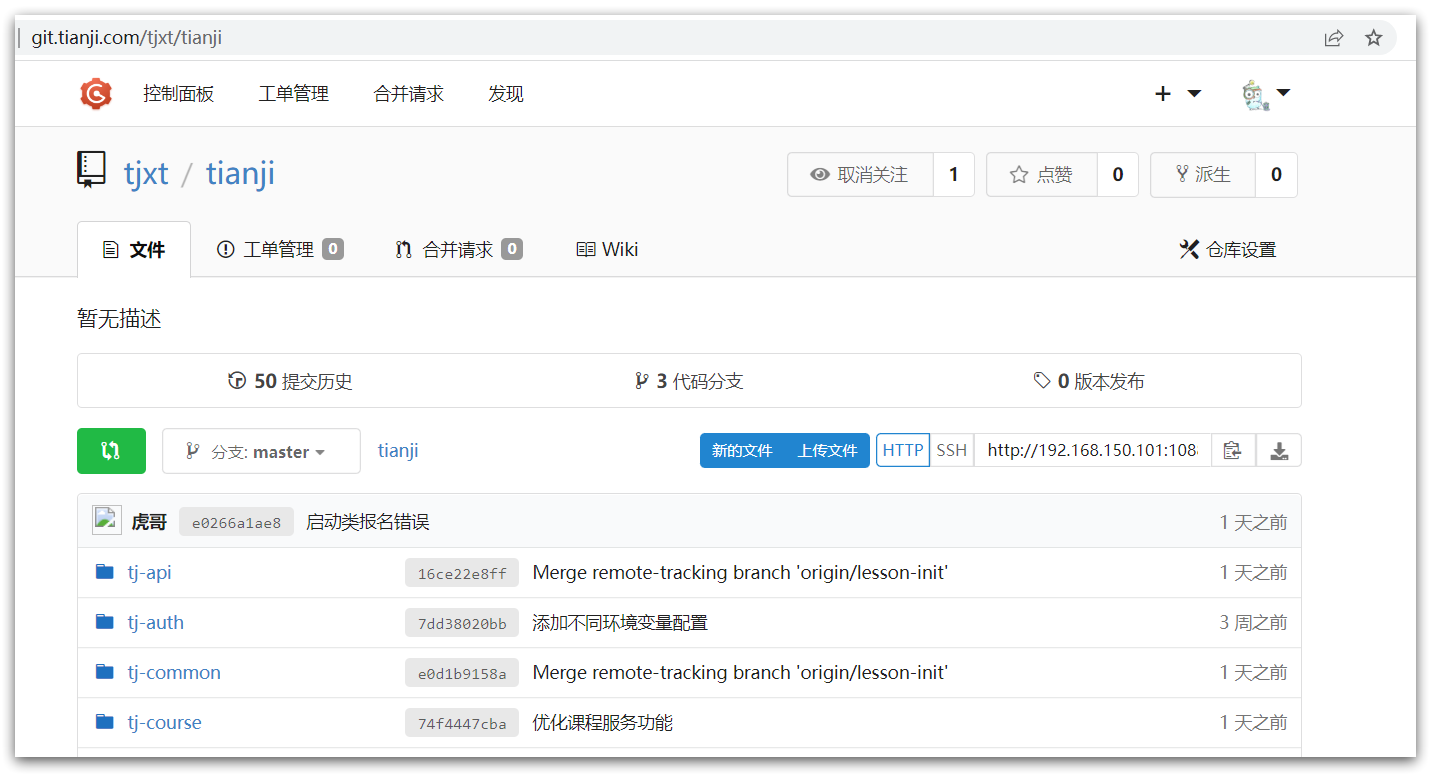
将代码克隆到自己的 IDEA 工作空间中:
# master 分支是完整项目代码,上课要从 lesson-init 分支开发git clone http://192.168.150.101:10880/tjxt/tianji.git -b lesson-init以 lesson-init 分支为起点,创建一个 dev 分支,完成项目开发:
xxxxxxxxxxcd tianjigit checkout -b dev然后用 IDEA 打开项目即可。
1.2.5 熟悉项目
首先是项目结构,目前企业微服务开发项目结构有两种模式:
每个项目下的每一个微服务,需要创建一个 Project,尽可能降低耦合
每个项目创建一个 Project ,项目下的多个微服务是 Project 下的 Module,方便管理(√)
SpringBoot 的配置文件支持多环境配置,在天机学堂中也基于不同环境有不同配置文件:
| 文件 | 说明 |
|---|---|
| bootstrap.yml | 通用配置属性,包含服务名、端口、日志等等各环境通用信息 |
| bootstrap-dev.yml | 线上开发环境配置属性,虚拟机中部署使用 |
| bootstrap-local.yml | 本地开发环境配置属性,本地开发、测试、部署使用 |
除了基本配置以外,其它的配置都放在了 Nacos 中共享,包括两大类:共享的配置、微服务中根据业务变化的配置。
登录 http://nacos.tianji.com (账号:nacos/nacos) 即可看到所有被管理的配置信息。

1.3 学会 DEBUG
1.3.1 阅读源码
BUG:都是普通用户,为什么用户 Jack 可以删除自己的订单,而用户 Rose 则无法成功删除?
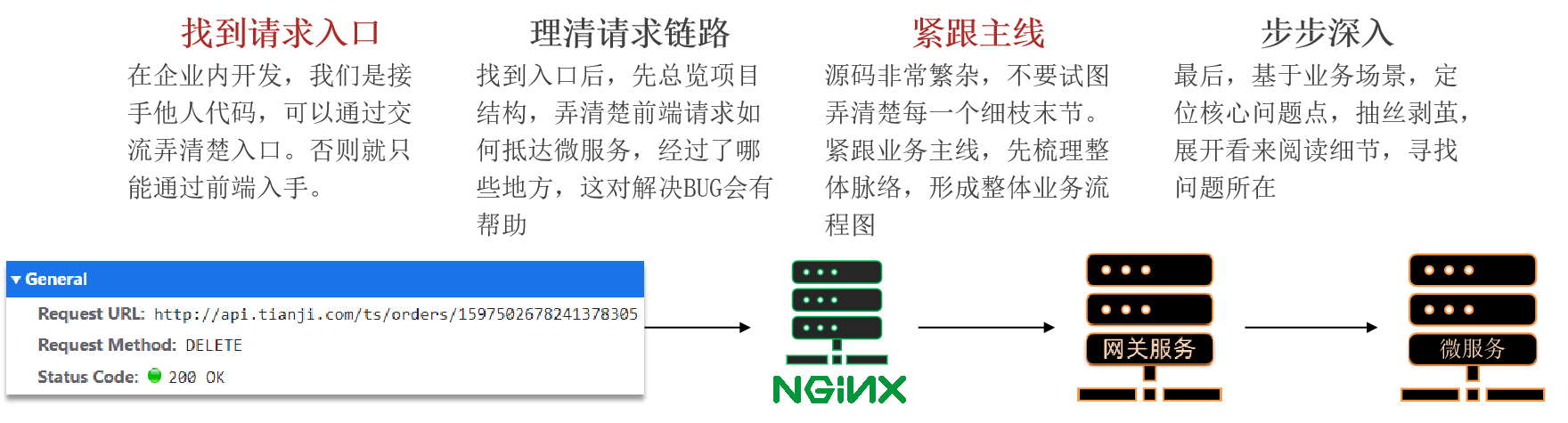
1.3.2 远程调试
如果部署的微服务不在本地,我们可以利用 IDEA 的远程调试功能:
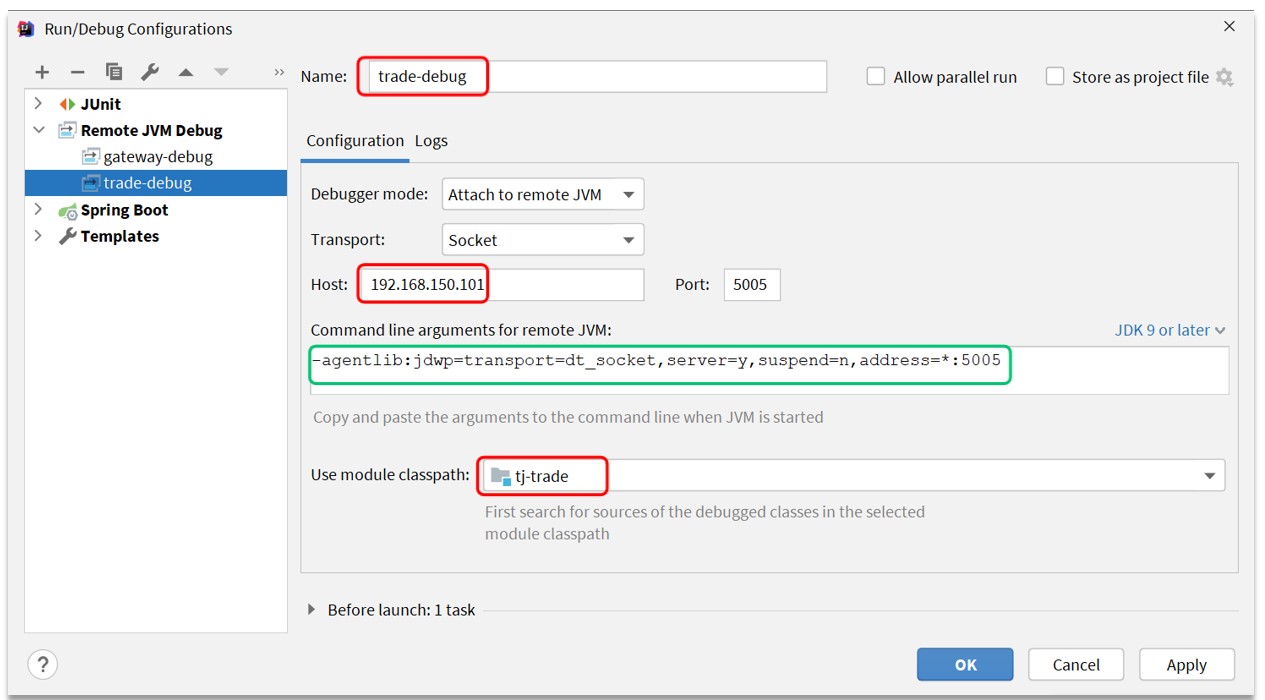
1.3.3 分析解决
xpackage com.tianji.trade.service.impl;
public void deleteOrder(Long id) { if(userId != order.getUserId()) { throw new BadRequestException("不能删除他人订单"); }}BUG 分析:Integer、Long 等包装类 -128 到 127 之间的数值使用共享对象,可以用 == 判断,但其它则需要采用 equals 判断。
xxxxxxxxxxpackage com.tianji.trade.service.impl;
public void deleteOrder(Long id) { if(!userId.equals(order.getUserId())) { throw new BadRequestException("不能删除他人订单"); }}1.3.4 测试部署
当我们完成项目的 BUG 修复后,可以把项目提交并推送到 Git 私服,而 Jenkins 可以帮我们完成项目自动编译、构建。
由于我们现在是基于 dev 分支开发,所以必须修改 Jenkins 中的自动化构建脚本,让其监听 dev 分支的变动:

Day02 - 我的课程
2.1 分析产品原型
2.1.1 分析业务流程
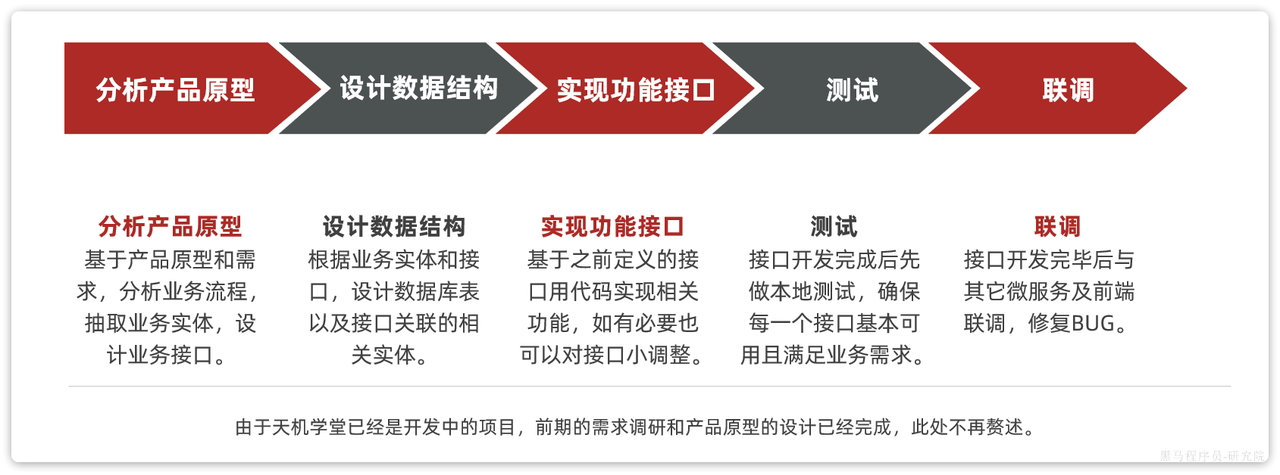
2.1.2 设计业务接口
管理端 - 产品原型与接口:https://lanhuapp.com/link/#/invite?sid=qx03viNU,密码: Ssml
用户端 - 产品原型与接口:https://lanhuapp.com/link/#/invite?sid=qx0Fy3fa,密码: ZsP3
| 编号 | 接口简述 | 请求方式 |
|---|---|---|
| 1 | 支付后,添加课程到课表中 | MQ 通知 |
| 2 | 分页查询我的课表 | GET |
| 3 | 查询学习中的课程 | GET |
| 4 | 查询指定课程状态 | GET |
| 5 | 删除课表中的课程 | DELETE |
| 6 | 退款后,移除课表中的课程 | MQ 通知 |
| 7 | 检查课程是否有效(Feign 接口) | GET |
| 8 | 统计课程学习人数(Feign 接口) | GET |
2.2 数据结构
2.2.1 字段分析
课表要记录的是用户的学习状态,所谓学习状态就是记录谁在学习哪个课程,学习的进度如何。
课表就是用户和课程的中间关系表,因此一定要包含三个字段:
userId:用户 id,也就是谁courseId:课程 id,也就是学的课程id:唯一主键
学习进度则是一些附加的功能字段,页面需要哪些功能就添加哪些字段即可:
status:课程学习状态。0-未学习,1-学习中,2-已学完,3-已过期planStatus:学习计划状态,0-没有计划,1-计划进行中weekFreq:计划的学习频率learnedSections:已学习小节数量,注意,课程总小节数、课程名称、封面等可由课程id查询得出,无需重复记录latestSectionId:最近一次学习的小节id,方便根据id查询最近学习的课程正在学第几节latestLearnTime:最近一次学习时间,用于分页查询的排序:createTime和expireTime:也就是课程加入时间和过期时间
2.2.2 表结构
课表对应的数据库结构应该是这样的:
xxxxxxxxxxCREATE TABLE learning_lesson ( id bigint NOT NULL COMMENT '主键', user_id bigint NOT NULL COMMENT '学员id', course_id bigint NOT NULL COMMENT '课程id', status tinyint DEFAULT '0' COMMENT '课程状态,0-未学习,1-学习中,2-已学完,3-已失效', week_freq tinyint DEFAULT NULL COMMENT '每周学习频率,每周3天,每天2节,则频率为6', plan_status tinyint NOT NULL DEFAULT '0' COMMENT '学习计划状态,0-没有计划,1-计划进行中', learned_sections int NOT NULL DEFAULT '0' COMMENT '已学习小节数量', latest_section_id bigint DEFAULT NULL COMMENT '最近一次学习的小节id', latest_learn_time datetime DEFAULT NULL COMMENT '最近一次学习的时间', create_time datetime NOT NULL DEFAULT CURRENT_TIMESTAMP COMMENT '创建时间', expire_time datetime NOT NULL COMMENT '过期时间', update_time datetime NOT NULL DEFAULT CURRENT_TIMESTAMP ON UPDATE CURRENT_TIMESTAMP COMMENT '更新时间', PRIMARY KEY (id), UNIQUE KEY idx_user_id (user_id,course_id) USING BTREE) ENGINE=InnoDB DEFAULT CHARSET=utf8mb4 COLLATE=utf8mb4_0900_ai_ci COMMENT='学生课表';在一个名为 tj_learning 的 database 中,执行资料提供的 SQL 脚本,创建 learning_lesson 表:
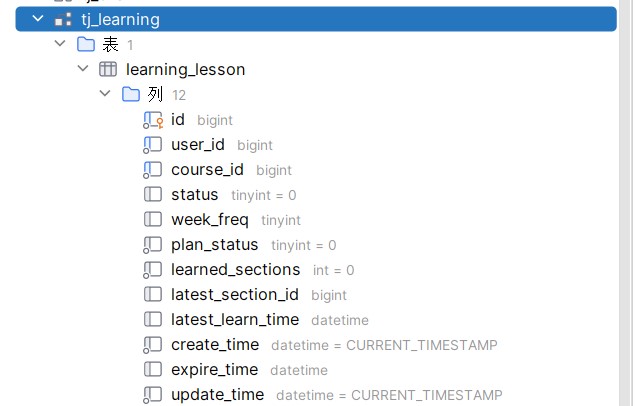
2.2.3 代码生成
一般开发新功能都需要创建一个 feature 类型分支,不能在 DEV 分支直接开发:
xxxxxxxxxxgit checkout -b feature-lessons我们使用的是 Mybatis 作为持久层框架,并且引入了 MybatisPlus 来简化开发。因此,在创建据库以后,就需要创建对应的实体类、mapper、service等。这些代码格式固定,编写起来又比较费时。好在 IDEA 中提供了一个 MP 插件,可以生成这些重复代码:

安装完成以后,我们先配置一下数据库地址:
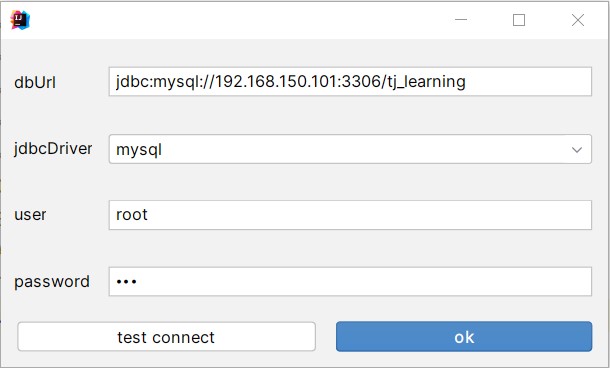
严格按照下图的模式去设置,不要填错项目名称和包名称。最后,点击
code generatro按钮,即可生成代码:
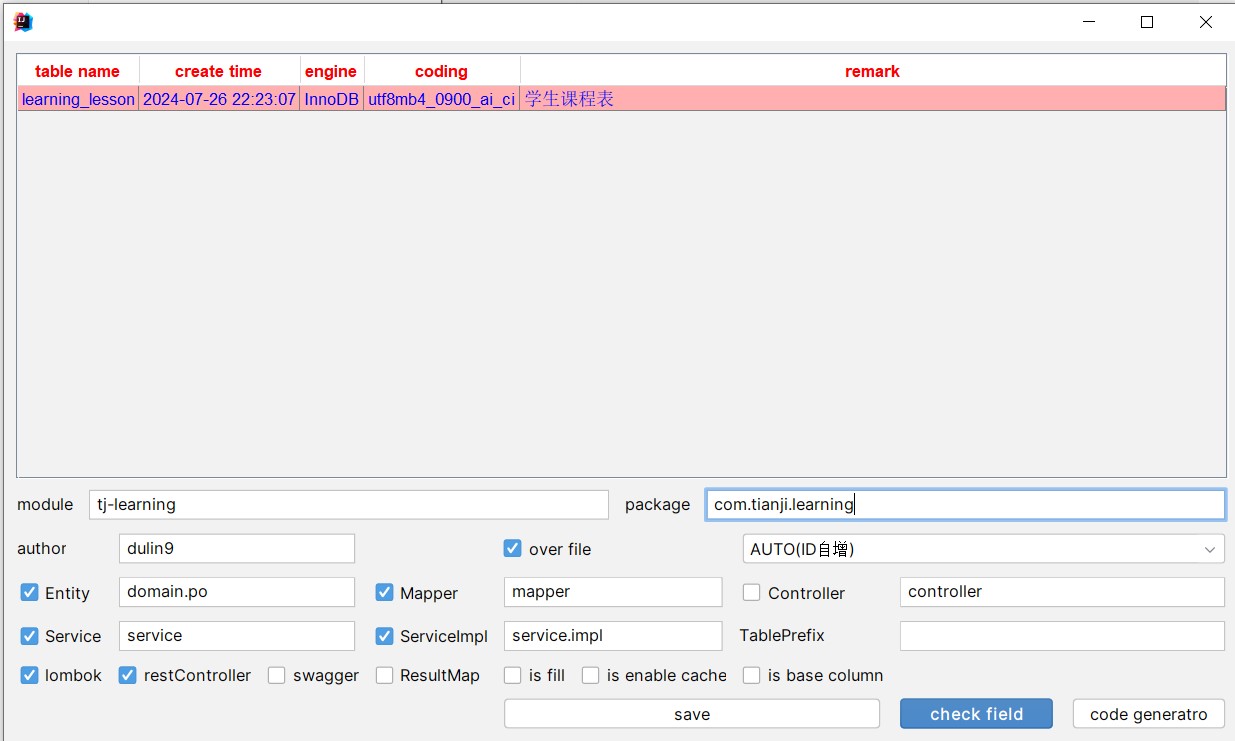
默认情况下 PO 的主键 ID 是自增长,而项目默认希望采用雪花算法作为 ID,因此这里需要对
LearningLesson做修改:
xxxxxxxxxxpackage com.tianji.learning.domain.po;
// @TableId(value = "id", type = IdType.AUTO)(value = "id", type = IdType.ASSIGN_ID)除此之外,我们还要按照Restful风格,对请求路径做修改:
xxxxxxxxxxpackage com.tianji.learning.controller;
// @RequestMapping("/learning-lesson")("/lessons")2.2.4 状态枚举
在数据结构中,课表是有学习状态的,学习计划也有状态。如果每次编码手写很容易写错,因此一般都会定义出枚举:
xxxxxxxxxxpackage com.tianji.learning.enums;
public enum LessonStatus implements BaseEnum {...}xxxxxxxxxxpackage com.tianji.learning.enums;
public enum PlanStatus implements BaseEnum {...}这样一来,我们就需要修改 PO 对象,用枚举类型替代原本的
Integer类型:
xxxxxxxxxxpackage com.tianji.learning.domain.po;
// 课程状态,0-未学习,1-学习中,2-已学完,3-已失效private LessonStatus status;
// 学习计划状态,0-没有计划,1-计划进行中private PlanStatus planStatus;MybatisPlus会在我们与数据库交互时实现自动的数据类型转换,无需我们操心。
2.3 开发接口功能
2.3.1 添加课程到课表中
需求:用户购买课程后,交易服务会通过 MQ 通知学习服务,学习服务将课程加入用户课表中。

在 tj-learning 服务中定义一个 MQ 的监听器:
xxxxxxxxxxpackage com.tianji.learning.mq;
public class LessonChangeListener { private final ILearningLessonService lessonService;
// 监听订单支付或课程报名的消息 (bindings = ( value = (value = "learning.lesson.pay.queue", durable = "true"), exchange = (name = MqConstants.Exchange.ORDER_EXCHANGE, type = ExchangeTypes.TOPIC), key = MqConstants.Key.ORDER_PAY_KEY )) public void listenLessonPay(OrderBasicDTO order){ // 1. 健壮性处理 if(order == null || order.getUserId() == null || CollUtils.isEmpty(order.getCourseIds())){ log.error("接收到MQ消息有误,订单数据为空"); return; } // 2. 添加课程 log.debug("监听到用户{}的订单{},需要添加课程{}到课表中", order.getUserId(), order.getOrderId(), order.getCourseIds()); lessonService.addUserLessons(order.getUserId(), order.getCourseIds()); }}实现 LearningLessonServiceImpl 中的
addUserLessons方法:
xxxxxxxxxxpublic void addUserLessons(Long userId, List<Long> courseIds) { // 1. 查询课程有效期 List<CourseSimpleInfoDTO> cInfoList = courseClient.getSimpleInfoList(courseIds); if (CollUtils.isEmpty(cInfoList)) { log.error("课程信息不存在,无法添加到课表"); return; } // 2. 循环遍历,处理LearningLesson数据 List<LearningLesson> list = new ArrayList<>(cInfoList.size()); for (CourseSimpleInfoDTO cInfo : cInfoList) { LearningLesson lesson = new LearningLesson(); Integer validDuration = cInfo.getValidDuration(); // 获取过期时间 if (validDuration != null && validDuration > 0) { LocalDateTime now = LocalDateTime.now(); lesson.setCreateTime(now); lesson.setExpireTime(now.plusMonths(validDuration)); } lesson.setUserId(userId); // 填充userId和courseId lesson.setCourseId(cInfo.getId()); list.add(lesson); } // 3.批量新增 saveBatch(list);}2.3.2 分页查询我的课表
2.3.2.1 获取登录用户

网关解析 token,获取用户存入header,向下传递:
xxxxxxxxxxpackage com.tianji.gateway.filter;
public class AccountAuthFilter implements GlobalFilter, Ordered { public Mono<Void> filter(ServerWebExchange exchange, GatewayFilterChain chain) { // 尝试获取用户信息 List<String> authHeaders = exchange.getRequest().getHeaders().get(AUTHORIZATION_HEADER); String token = authHeaders == null ? "" : authHeaders.get(0); R<LoginUserDTO> r = authUtil.parseToken(token); // 如果用户是登录状态,尝试更新请求头,传递用户信息 if(r.success()){ exchange.mutate() .request(builder -> builder.header(USER_HEADER, r.getData().getUserId().toString())) .build(); } }}拦截器解析 header 中的用户信息,存入 UserContext:
xxxxxxxxxxpackage com.tianji.authsdk.resource.interceptors;
public class UserInfoInterceptor implements HandlerInterceptor { public boolean preHandle(HttpServletRequest request, HttpServletResponse response, Object handler) { // 1. 尝试获取头信息中的用户信息 String authorization = request.getHeader(JwtConstants.USER_HEADER); // 2. 判断是否为空 if (authorization == null) return true; // 3. 转为用户id并保存 Long userId = Long.valueOf(authorization); UserContext.setUser(userId); return true; }}UserContext 是一个基于 ThreadLocal 的工具,可以确保不同的请求之间互不干扰,避免线程安全问题发生:
xxxxxxxxxxpackage com.tianji.common.utils;
public class UserContext {    private static final ThreadLocal<Long> TL = new ThreadLocal<>();
    public static void setUser(Long userId){        TL.set(userId);    }    public static Long getUser(){        return TL.get();    }    public static void removeUser(){        TL.remove();    }}
2.3.2.2 分页查询我的课表
需求:在个人中心-我的课程页面,可以分页查询用户的课表及学习状态信息。
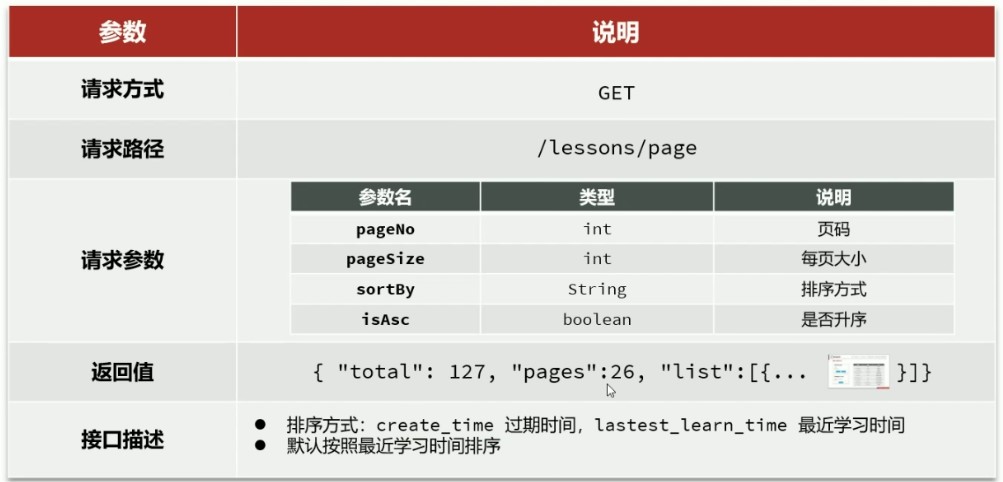
Query 实体类:
xxxxxxxxxxpackage com.tianji.common.domain.query;
(description = "分页请求参数")(chain = true)public class PageQuery { public <T> Page<T> toMpPage(String defaultSortBy, boolean isAsc) { if (StringUtils.isBlank(sortBy)){ sortBy = defaultSortBy; this.isAsc = isAsc; } Page<T> page = new Page<>(pageNo, pageSize); OrderItem orderItem = new OrderItem(); orderItem.setAsc(this.isAsc); orderItem.setColumn(sortBy); page.addOrder(orderItem); return page; }}Controller 层:
xxxxxxxxxxpackage com.tianji.learning.controller;
(tags = "我的课程相关接口")("/lessons")public class LearningLessonController { ("分页查询我的课表") ("page") public PageDTO<LearningLessonVO> queryMyLessons(PageQuery query){ return lessonService.queryMyLessons(query); }}Service 层:
xxxxxxxxxxpublic PageDTO<LearningLessonVO> queryMyLessons(PageQuery query) { // 1. 获取当前登录用户 Long userId = UserContext.getUser(); // 2. 分页查询我的课表 Page<LearningLesson> page = lambdaQuery() // select * from learning_lesson .eq(LearningLesson::getUserId, userId) // where user_id = #{userId} .page(query.toMpPage("latest_learn_time", false)); // order by latest_learn_time List<LearningLesson> records = page.getRecords(); if (CollUtils.isEmpty(records)) { return PageDTO.empty(page); } // 3. 查询我的课程信息 Map<Long, CourseSimpleInfoDTO> cMap = queryCourseSimpleInfoList(records); // 4. 封装 VO 并返回 List<LearningLessonVO> list = new ArrayList<>(records.size()); for (LearningLesson r : records) { LearningLessonVO vo = BeanUtils.copyBean(r, LearningLessonVO.class); CourseSimpleInfoDTO cInfo = cMap.get(r.getCourseId()); vo.setCourseName(cInfo.getName()); vo.setCourseCoverUrl(cInfo.getCoverUrl()); vo.setSections(cInfo.getSectionNum()); list.add(vo); } return PageDTO.of(page, list);}
private Map<Long, CourseSimpleInfoDTO> queryCourseSimpleInfoList(List<LearningLesson> records) { // 3.1 获取课程 id Set<Long> cIds = records.stream().map(LearningLesson::getCourseId).collect(Collectors.toSet()); // 3.2 查询课程信息 List<CourseSimpleInfoDTO> cInfoList = courseClient.getSimpleInfoList(cIds); if (CollUtils.isEmpty(cInfoList)) { throw new BadRequestException("课程信息不存在!"); } // 3.3 把 PO 集合处理成 Map, 否则要双重 for 设置到 VO 集合 Map<Long, CourseSimpleInfoDTO> cMap = cInfoList.stream() .collect(Collectors.toMap(CourseSimpleInfoDTO::getId, c -> c)); return cMap;}2.3.3 查询学习中的课程
需求:在首页、个人中心-课程表页,需要查询并展示当前用户最近一次学习的课程。

Controller 层:
xxxxxxxxxxpackage com.tianji.learning.controller;
("/now")("查询正在学习的课程")public LearningLessonVO queryMyCurrentLesson() { return lessonService.queryMyCurrentLesson();}Service 层:
xxxxxxxxxxprivate final CatalogueClient catalogueClient;
public LearningLessonVO queryMyCurrentLesson() { // 1. 获取当前登录的用户 Long userId = UserContext.getUser(); // 2. 查询正在学习的课程 LearningLesson lesson = lambdaQuery() // select * from learning_lesson .eq(LearningLesson::getUserId, userId) // where user_id = #{userId} .eq(LearningLesson::getStatus, LessonStatus.LEARNING.getValue()) .orderByDesc(LearningLesson::getLatestLearnTime) // order by latest_learn_time .last("limit 1").one(); // limit 1 AND status = 1 if (lesson == null) return null; // 3. 拷贝 PO 基础属性到 VO LearningLessonVO vo = BeanUtils.copyBean(lesson, LearningLessonVO.class); // 4. 查询我的课程信息 CourseFullInfoDTO cInfo = courseClient.getCourseInfoById(lesson.getCourseId(), false, false); if (cInfo == null) throw new BadRequestException("课程不存在"); vo.setCourseName(cInfo.getName()); vo.setCourseCoverUrl(cInfo.getCoverUrl()); vo.setSections(cInfo.getSectionNum()); // 5. 统计课表中的课程数量 Integer courseAmount = lambdaQuery() // select count(1) from learning_lesson .eq(LearningLesson::getUserId, userId).count(); // where user_id = #{userId} vo.setCourseAmount(courseAmount); // 6. 查询小节信息 List<CataSimpleInfoDTO> cataInfos = catalogueClient.batchQueryCatalogue(CollUtils.singletonList(lesson.getLatestSectionId())); if (!CollUtils.isEmpty(cataInfos)) { CataSimpleInfoDTO cataInfo = cataInfos.get(0); vo.setLatestSectionName(cataInfo.getName()); vo.setLatestSectionIndex(cataInfo.getCIndex()); } return vo;}2.3.4 删除课表中的课程
需求:用户可以直接删除《已失效》的课程,学习服务将删除用户课表中的课程。
Controller 层:
xxxxxxxxxxpackage com.tianji.learning.controller;
("用户手动删除当前课程")("/{courseId}")public void deleteCourseFromLesson(("courseId") Long couseId){ Long user = UserContext.getUser(); lessonService.deleteCourseFromLesson(user, couseId);}Service 层:
xxxxxxxxxxpublic void deleteCourseFromLesson(Long userId, Long courseId) { remove(buildUserIdAndCourseIdWrapper(userId, courseId));}2.3.5 移除课表中的课程
需求:用户退款课程后,交易服务会通过 MQ 通知学习服务,学习服务将移除用户课表中的课程。
在 tj-learning 服务中定义一个 MQ 的监听器即可,deleteCourseFromLesson 方法已实现:
xxxxxxxxxxpackage com.tianji.learning.mq;
public class LessonChangeListener { private final ILearningLessonService lessonService;
(bindings = ( value = (value = "trade.refund.result.queue", durable = "true"), exchange = (name = MqConstants.Exchange.ORDER_EXCHANGE, type = ExchangeTypes.TOPIC), key = MqConstants.Key.ORDER_REFUND_KEY )) public void listenLessonRefund(OrderBasicDTO order){ // 1. 健壮性处理 if(order == null || order.getUserId() == null || CollUtils.isEmpty(order.getCourseIds())){ log.error("接收到MQ消息有误,订单数据为空"); return; } // 2. 删除课程表中删除该课程 log.debug("监听到用户{}的订单{},需要添加课程{}到课表中" , order.getUserId(), order.getOrderId(), order.getCourseIds()); lessonService.deleteCourseFromLesson(order.getUserId(), order.getCourseIds().get(0)); }}2.3.6 检查课程是否有效
需求:当用户学习课程时,可能需要播放视频。此时提供播放功能的媒资系统就需要校验用户是否有播放资格。
| 接口说明 | 根据课程 id,检查当前用户的课表中是否有该课程,课程状态是否有效。 |
|---|---|
| 请求方式 | Http 请求,GET |
| 请求路径 | /ls/lessons/{courseId}/valid |
| 请求参数格式 | 课程 id,请求路径占位符,参数名:courseId |
| 返回值格式 | 课表 lessonId,如果是报名了则返回 lessonId,否则返回空 |
Controller 层:
xxxxxxxxxxpackage com.tianji.learning.controller;
("校验当前用户是否可以学习当前课程")("/{courseId}/valid")public Long isLessonValid(("courseId") Long courseId){ return lessonService.isLessonValid(courseId);}Service 层:
xxxxxxxxxxpublic Long isLessonValid(Long courseId) { Long user = UserContext.getUser(); if(user==null || courseId==null) return null; LearningLesson lesson = lambdaQuery() // select * from learning_lesson .eq(LearningLesson::getUserId, user) // where user_id = #{userId} .eq(LearningLesson::getCourseId, courseId) // and course_id = #{courseId} .one(); // 用户课表中没有该课程 if(lesson==null) return null; // 课程的状态是已经过期 if(lesson.getExpireTime() != null && LocalDateTime.now().isAfter(lesson.getExpireTime())){ return null; } return lesson.getId();}2.3.7 查询指定课程状态
需求:进入详情页以后,需要查询用户的课表中是否有该课程,如果有则返回课程的学习进度、课程有效期等信息。
| 接口说明 | 根据课程 id,查询课表中是否有该课程,如果有则返回课程的学习进度、课程有效期等信息。 |
|---|---|
| 请求方式 | Http请求,GET |
| 请求路径 | /ls/lessons/{courseId} |
| 请求参数格式 | 课程 id,请求路径占位符,参数名:courseId |
Controller 层:
xxxxxxxxxxpackage com.tianji.learning.controller;
("用户是否拥有该课程并返回学习进度")("/{courseId}")public LessonStatusVO queryLessonByCourseId( (value = "课程id", example = "1") ("courseId") Long couseId){ LessonStatusVO lessonStatusVO = lessonService.queryLessonByCourseId(couseId); return lessonStatusVO;}Service 层:
xxxxxxxxxxpublic LessonStatusVO queryLessonByCourseId(Long couseId) { // 1. 获取用户信息 Long user = UserContext.getUser(); // 2. 查询用户是否有该课程 LambdaQueryWrapper<LearningLesson> wrapper = buildUserIdAndCourseIdWrapper(user, couseId); LearningLesson lesson = getOne(wrapper); if(lesson==null) return null; // 3. 如果有则设置学习进度 LessonStatusVO vo = BeanUtils.copyBean(lesson, LessonStatusVO.class); return vo;}2.3.8 统计课程学习人数
需求:根据课程 id,统计该课程的报名人数。
| 接口说明 | 根据课程 id,统计该课程的报名人数。 |
|---|---|
| 请求方式 | Http 请求,GET |
| 请求路径 | /ls/lessons/{courseId}/count |
| 请求参数格式 | 课程 id,请求路径占位符,参数名:courseId |
Controller 层:
xxxxxxxxxxpackage com.tianji.learning.controller;
("查询该课程的报名人数")("/lessons/{courseId}/count")Integer countLearningLessonByCourse( (value = "课程id", example = "1") ("courseId") Long courseId){ return lessonService.countLearningLessonByCourse(courseId);}Service 层:
xxxxxxxxxxpublic Integer countLearningLessonByCourse(Long courseId) { Integer count = lambdaQuery() // select count(*) from learning_lesson .eq(LearningLesson::getCourseId, courseId).count(); // where course_id = #{courseId} return count;}
Day03 - 学习系统
3.1 分析产品原型
3.1.1 分析业务流程
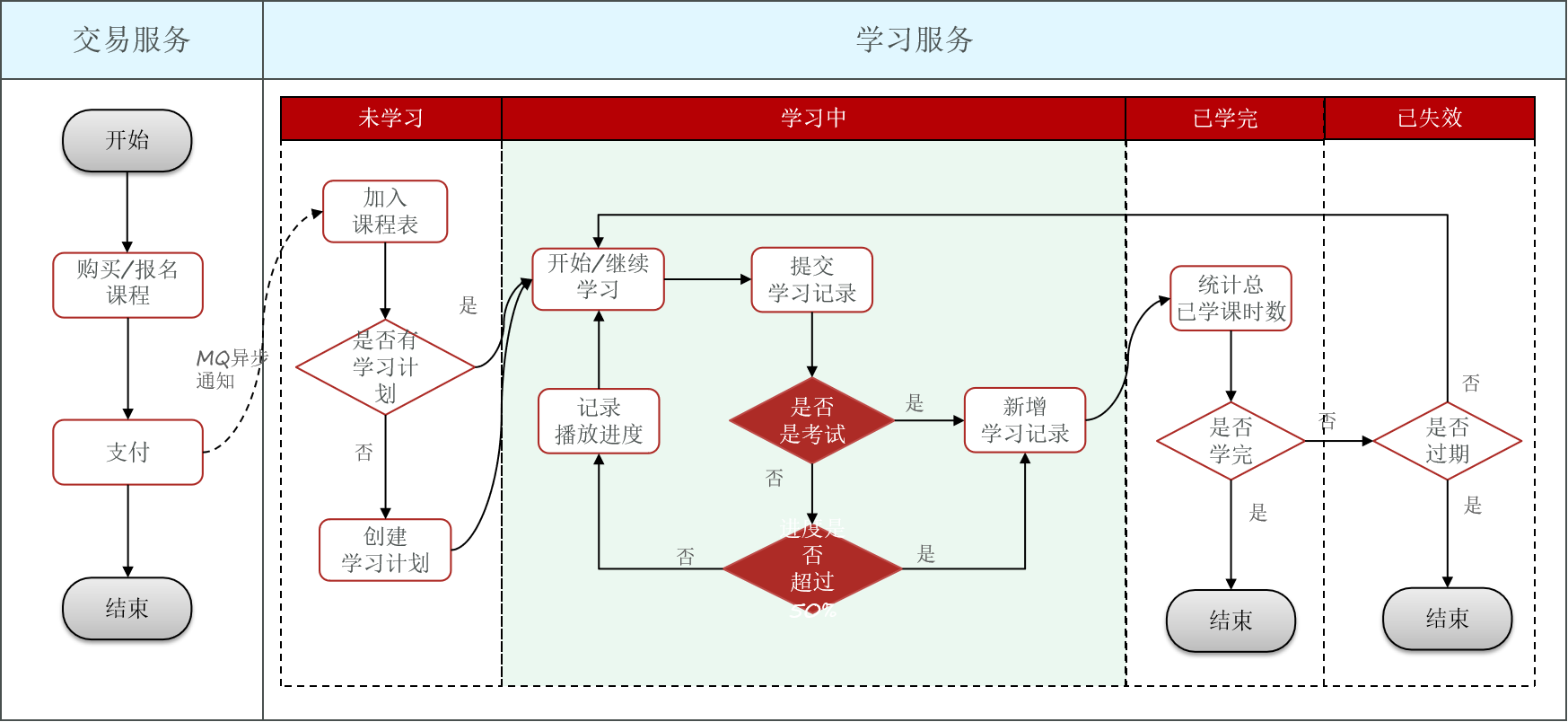
3.1.2 设计业务接口
提交学习记录:
需求:在课程学习页面播放视频时或考试后,需要提交学习记录信息到服务端保存。
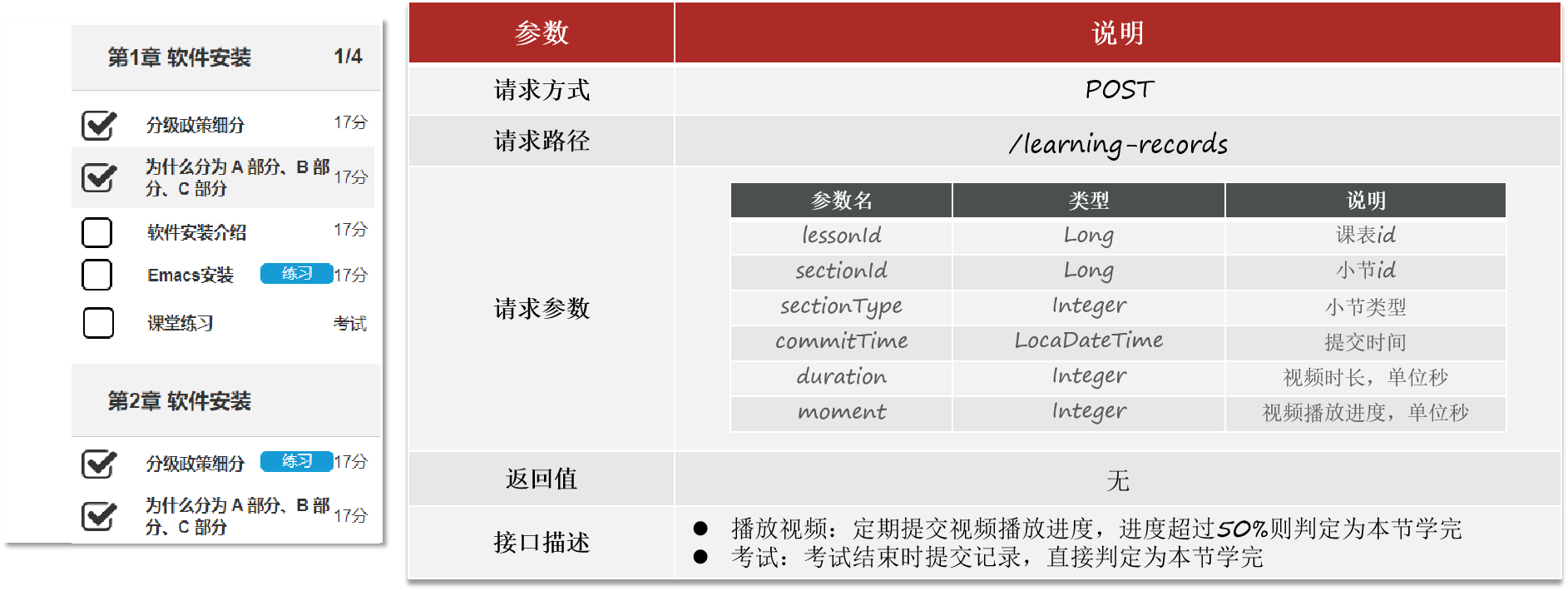
查询学习记录:
需求:在课程学习页面需要查询出每一个小节的基本信息,以及小节对应的学习记录。

创建学习计划:
需求:当点击创建学习计划时,会提交课程信息和计划的学习频率到服务端。服务端需要将数据写入对应的课表中。
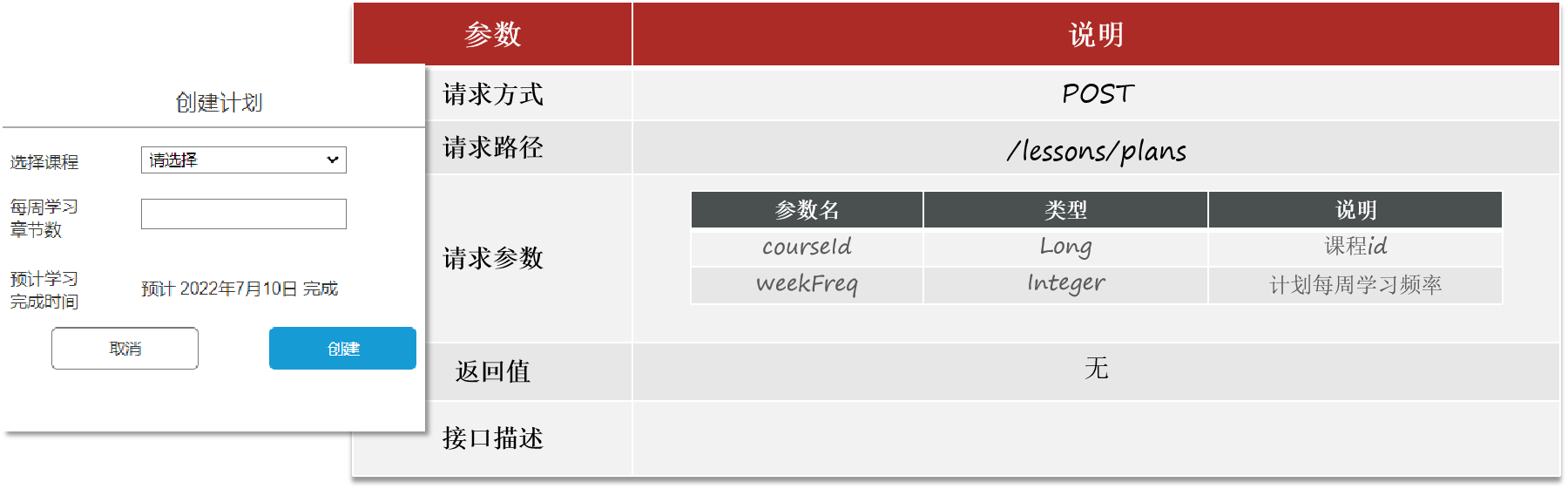
查询学习计划:
需求:在我的课程页面中,需要统计用户本周的学习计划及进度,数据较多,采用分页查询。
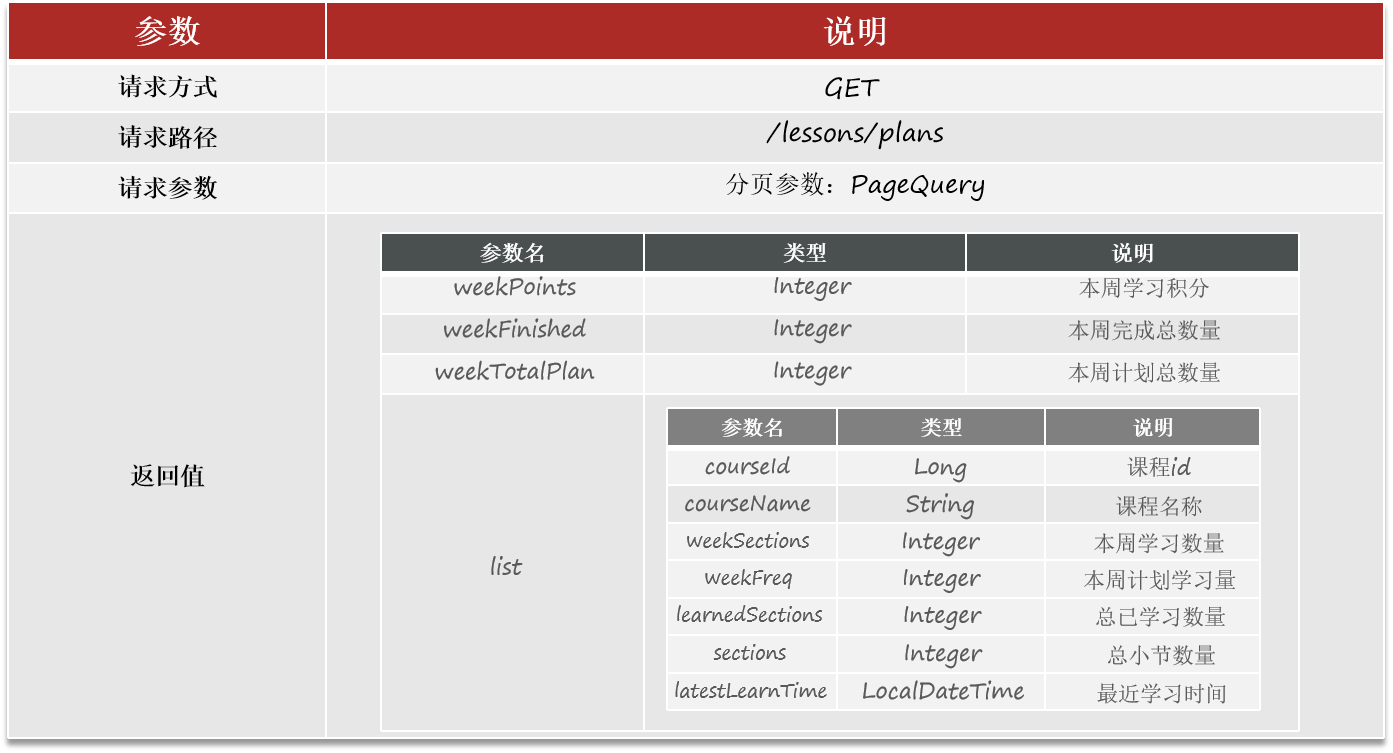
3.1.3 抽取业务实体
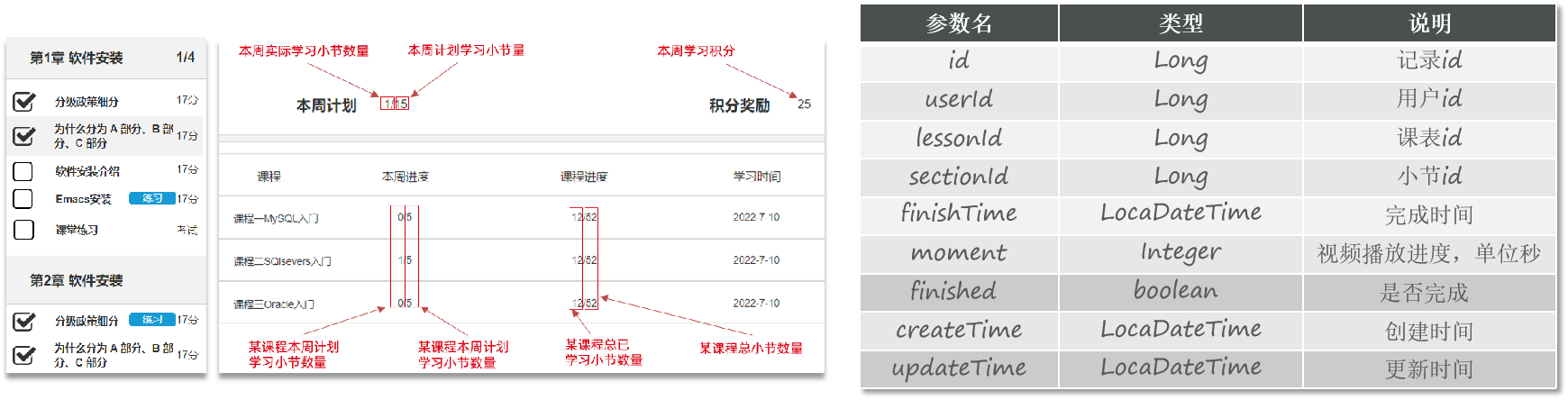
xxxxxxxxxxCREATE TABLE `learning_record` ( `id` bigint NOT NULL COMMENT '学习记录的id', `lesson_id` bigint NOT NULL COMMENT '对应课表的id', `section_id` bigint NOT NULL COMMENT '对应小节的id', `user_id` bigint NOT NULL COMMENT '用户id', `moment` int NULL DEFAULT 0 COMMENT '视频的当前观看时间点,单位秒', `finished` bit(1) NOT NULL DEFAULT b'0' COMMENT '是否完成学习,默认false', `create_time` datetime NOT NULL DEFAULT CURRENT_TIMESTAMP COMMENT '第一次观看时间', `finish_time` datetime NULL DEFAULT NULL COMMENT '完成学习的时间', `update_time` datetime NOT NULL DEFAULT CURRENT_TIMESTAMP ON UPDATE CURRENT_TIMESTAMP COMMENT '更新时间(最近一次观看时间)', PRIMARY KEY (`id`) USING BTREE, UNIQUE INDEX `idx_user_id`(`user_id`, `section_id`) USING BTREE, INDEX `idx_update_time`(`update_time`) USING BTREE, INDEX `idx_lesson_id`(`lesson_id`) USING BTREE) ENGINE = InnoDB CHARACTER SET = utf8mb4 COLLATE = utf8mb4_0900_ai_ci COMMENT = '学习记录表' ROW_FORMAT = DYNAMIC;3.2 开发接口功能
3.2.1 提交学习记录
Controller 层:
xxxxxxxxxxpackage com.tianji.learning.controller;
(tags = "学习记录的相关接口")("/learning-records")public class LearningRecordController { ("提交学习记录") () public void addLearningRecord( LearningRecordFormDTO formDTO){ recordService.addLearningRecord(formDTO); }}Service 层:
xxxxxxxxxxprivate final CourseClient courseClient;
public void addLearningRecord(LearningRecordFormDTO recordDTO) { Long userId = UserContext.getUser(); // 1. 获取登录用户 boolean finished = false; if (recordDTO.getSectionType() == SectionType.VIDEO) { finished = handleVideoRecord(userId, recordDTO); // 2. 处理视频记录 }else{ finished = handleExamRecord(userId, recordDTO); // 3. 处理考试记录 } handleLearningLessonsChanges(recordDTO, finished); // 4. 处理课表数据}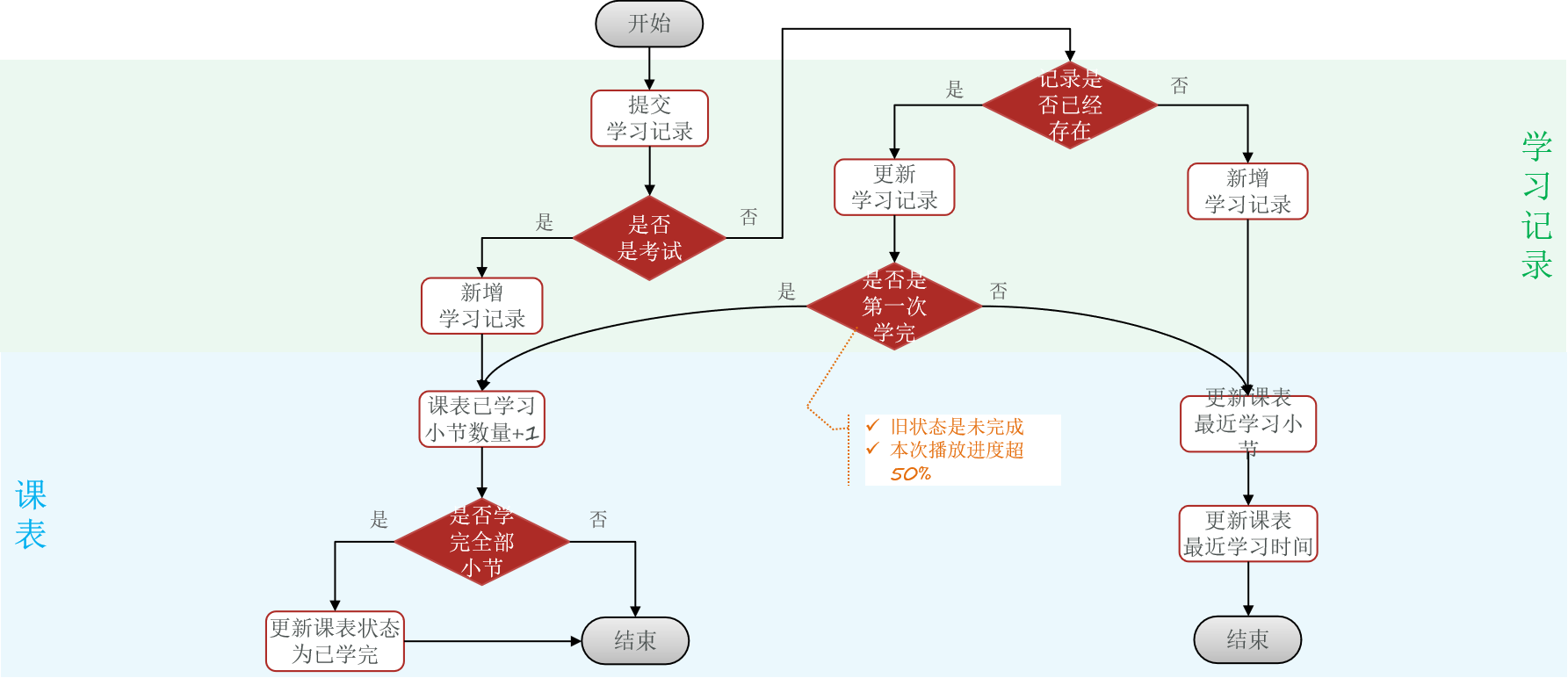
xxxxxxxxxxprivate boolean handleVideoRecord(Long userId, LearningRecordFormDTO recordDTO) {    // 2.1 判断记录是否已经存在    LearningRecord old = queryOldRecord(recordDTO.getLessonId(), recordDTO.getSectionId());    if (old == null) {        // 2.2 新增学习记录        LearningRecord record = BeanUtils.copyBean(recordDTO, LearningRecord.class);        record.setUserId(userId);        boolean success = save(record);        if (!success) throw new DbException("新增学习记录失败!");        return false;    }    // 2.3 更新学习记录    boolean finished = !old.getFinished() && recordDTO.getMoment() * 2 >= recordDTO.getDuration();    boolean success = lambdaUpdate()                            // update learning_record        .set(LearningRecord::getMoment, recordDTO.getMoment())  // set moment = #{moment},        .set(finished, LearningRecord::getFinished, true)       // finished = true,         // finishTime = #{CommitTime}        .set(finished, LearningRecord::getFinishTime, recordDTO.getCommitTime())        .eq(LearningRecord::getId, old.getId()).update();       // where id = #{id}    if(!success) throw new DbException("更新学习记录失败!");    return finished ;}
private LearningRecord queryOldRecord(Long lessonId, Long sectionId) {    return lambdaQuery()                                        // select * from learning_record        .eq(LearningRecord::getLessonId, lessonId)              // where lesson_id = #{lessonId}        .eq(LearningRecord::getSectionId, sectionId).one();     // and section_id = #{sectionId}}
private boolean handleExamRecord(Long userId, LearningRecordFormDTO recordDTO) {    // 3. 新增学习记录    LearningRecord record = BeanUtils.copyBean(recordDTO, LearningRecord.class);    record.setUserId(userId);    record.setFinished(true);    record.setFinishTime(recordDTO.getCommitTime());    boolean success = save(record);    if (!success) throw new DbException("新增考试记录失败!");    return true;}
private void handleLearningLessonsChanges(LearningRecordFormDTO recordDTO, boolean finished) {    // 4.1 判断是否学完小节    LearningLesson lesson = lessonService.getById(recordDTO.getLessonId());    if (lesson == null) throw new BizIllegalException("课程不存在,无法更新数据!");    boolean allLearned = false;    if(finished){        CourseFullInfoDTO cInfo = courseClient.getCourseInfoById(lesson.getCourseId(), false, false);        if (cInfo == null) throw new BizIllegalException("课程不存在,无法更新数据!");        // 4.2 判断是否学完全部小节        allLearned = lesson.getLearnedSections() + 1 >= cInfo.getSectionNum();         }    lessonService.lambdaUpdate()        // 如果是第一次观看视频,则设置 lesson 为正在学习        .set(lesson.getLearnedSections() == 0, LearningLesson::getStatus, LessonStatus.LEARNING.getValue())        // 如果学完全部小节,则更新 lesson 为完成状态        .set(allLearned, LearningLesson::getStatus, LessonStatus.FINISHED.getValue())        // 4.3 如果没学完小节,则更新最后学习时间、学习章节        .set(!finished, LearningLesson::getLatestSectionId, recordDTO.getSectionId())        .set(!finished, LearningLesson::getLatestLearnTime, recordDTO.getCommitTime())        // 4.4 如果已学完小节,则课表已学习小节数量 + 1        .setSql(finished, "learned_sections = learned_sections + 1")        .eq(LearningLesson::getId, lesson.getId()).update();}
3.2.2 查询学习记录
Controller 层:
xxxxxxxxxxpackage com.tianji.learning.controller;
("查询指定课程的学习记录")("/course/{courseId}")public LearningLessonDTO queryLearningRecordByCourse( (value = "课程id", example = "2") ("courseId") Long courseId){ return recordService.queryLearningRecordByCourse(courseId);}Service 层:
xxxxxxxxxxprivate final ILearningLessonService lessonService;
public LearningLessonDTO queryLearningRecordByCourse(Long courseId) { // 1. 查询学习记录 Long userId = UserContext.getUser(); LearningLesson lesson = lessonService.queryByUserAndCourseId(userId, courseId); List<LearningRecord> records = lambdaQuery() // select * from learning_record .eq(LearningRecord::getLessonId, lesson.getId()).list(); // where lesson_id = #{lessonId} // 2. 封装 DTO 并返回 LearningLessonDTO dto = new LearningLessonDTO(); dto.setId(lesson.getId()); dto.setLatestSectionId(lesson.getLatestSectionId()); dto.setRecords(BeanUtils.copyList(records, LearningRecordDTO.class)); return dto;}远程调用接口:
xxxxxxxxxxpackage com.tianji.learning.service.impl;
public LearningLesson queryByUserAndCourseId(Long userId, Long courseId) { return getOne(buildUserIdAndCourseIdWrapper(userId, courseId));}
private LambdaQueryWrapper<LearningLesson> buildUserIdAndCourseIdWrapper(Long userId, Long courseId) { LambdaQueryWrapper<LearningLesson> queryWrapper = new QueryWrapper<LearningLesson>() .lambda() // select * from learning_lesson .eq(LearningLesson::getUserId, userId) // where user_id = #{userId} .eq(LearningLesson::getCourseId, courseId); // and course_id = #{courseId} return queryWrapper;}3.2.3 创建学习计划
Controller 层:
xxxxxxxxxxpackage com.tianji.learning.controller;
("/lessons")(tags = "我的课表相关接口")public class LearningLessonController { ("创建学习计划") ("/plans") public void createLearningPlans( LearningPlanDTO planDTO){ lessonService.createLearningPlan(planDTO.getCourseId(), planDTO.getFreq()); }}Service 层:
xxxxxxxxxxpublic void createLearningPlan(Long courseId, Integer freq) { // 1. 查询课程有关的数据 Long userId = UserContext.getUser(); LearningLesson lesson = queryByUserAndCourseId(userId, courseId); AssertUtils.isNotNull(lesson, "课程信息不存在!"); // 2. 更新课程数据 LearningLesson l = new LearningLesson(); l.setId(lesson.getId()); l.setWeekFreq(freq); if(lesson.getPlanStatus() == PlanStatus.NO_PLAN) { l.setPlanStatus(PlanStatus.PLAN_RUNNING); } updateById(l);}3.2.4 查询学习计划
Controller 层:
xxxxxxxxxxpackage com.tianji.learning.controller;
("查询我的学习计划")("/plans")public LearningPlanPageVO queryMyPlans(PageQuery query){ return lessonService.queryMyPlans(query);}Service 层:
xxxxxxxxxxprivate final LearningRecordMapper recordMapper;
public LearningPlanPageVO queryMyPlans(PageQuery query) { LearningPlanPageVO result = new LearningPlanPageVO(); // 1. 获取当前登录用户 Long userId = UserContext.getUser(); // 2. 获取本周起始时间 LocalDate now = LocalDate.now(); LocalDateTime begin = DateUtils.getWeekBeginTime(now); LocalDateTime end = DateUtils.getWeekEndTime(now); // 3. 查询总的统计数据 // 3.1. 本周总的已学习小节数量 Integer weekFinished = recordMapper.selectCount( new LambdaQueryWrapper<LearningRecord>() // select * from learning_record .eq(LearningRecord::getUserId, userId) // where user_id = #{userId} .eq(LearningRecord::getFinished, true) // and finished = true .gt(LearningRecord::getFinishTime, begin) // and finishTime > begin .lt(LearningRecord::getFinishTime, end) // and finishTime < end; ); result.setWeekFinished(weekFinished); // 3.2 本周总的计划学习小节数量 Integer weekTotalPlan = getBaseMapper().queryTotalPlan(userId); result.setWeekTotalPlan(weekTotalPlan); // TODO 3.3 本周学习积分 // 4. 分页查询课表信息 Page<LearningLesson> p = lambdaQuery() // select * from learning_lesson .eq(LearningLesson::getUserId, userId) // where user_id = #{userId} .eq(LearningLesson::getPlanStatus, PlanStatus.PLAN_RUNNING) // and plan_status = "计划进行中" .in(LearningLesson::getStatus, LessonStatus.NOT_BEGIN, LessonStatus.LEARNING) // and plan_status in ("未学习", "学习中") .page(query.toMpPage("latest_learn_time", false)); // ordered by latest_learn_time DESC; List<LearningLesson> records = p.getRecords(); if (CollUtils.isEmpty(records)) return result.emptyPage(p); // 5. 查询课表对应的课程信息 Map<Long, CourseSimpleInfoDTO> cMap = queryCourseSimpleInfoList(records); // 6. 统计每一个课程本周已学习小节数量 List<IdAndNumDTO> list = recordMapper.countLearnedSections(userId, begin, end); Map<Long, Integer> countMap = IdAndNumDTO.toMap(list); // 7. 封装 VO 并返回 List<LearningPlanVO> voList = new ArrayList<>(records.size()); for (LearningLesson r : records) { // 7.1 拷贝属性到 VO LearningPlanVO vo = BeanUtils.copyBean(r, LearningPlanVO.class); // 7.2 设置详细信息 CourseSimpleInfoDTO cInfo = cMap.get(r.getCourseId()); if (cInfo != null) { vo.setCourseName(cInfo.getName()); vo.setSections(cInfo.getSectionNum()); } // 7.3 每个课程的本周已学习小节数量 vo.setWeekLearnedSections(countMap.getOrDefault(r.getId(), 0)); voList.add(vo); } return result.pageInfo(p.getTotal(), p.getPages(), voList);}远程调用接口:
xxxxxxxxxxpackage com.tianji.learning.mapper;
public interface LearningRecordMapper extends BaseMapper<LearningRecord> { List<IdAndNumDTO> countLearnedSections( ("userId") Long userId, ("begin") LocalDateTime begin, ("end") LocalDateTime end);}xxxxxxxxxx<select id="countLearnedSections" resultType="com.tianji.api.dto.IdAndNumDTO"> SELECT lesson_id AS id, COUNT(1) AS num FROM learning_record WHERE user_id = #{userId} AND finished = 1 AND finish_time > #{begin} AND finish_time < #{end} GROUP BY lesson_id;</select>3.2.5 定时任务 (作业)
需求:编写一个 SpringTask 定时任务,定期检查 learning_lesson 表中的课程是否过期,如果过期则将课程状态修改为已过期。
xxxxxxxxxxpackage com.tianji.learning.job;
public class LessonStatusCheckJob { private final ILearningLessonService lessonService;
(cron = "0 * * * * ?") // 每分钟执行一次 public void lessonStatusCheck() { // 1. 查询状态为未过期的课程 List<LearningLesson> list = lessonService.list( Wrappers.<LearningLesson>lambdaQuery().ne(LearningLesson::getStatus, LessonStatus.EXPIRED) ); LocalDateTime now = LocalDateTime.now(); // 2. 判断是否过期 for (LearningLesson lesson : list) { if (now.isAfter(lesson.getExpireTime())) { lesson.setStatus(LessonStatus.EXPIRED); } } // 3. 批量更新 lessonService.updateBatchById(list); }}
3.3 高并发优化
3.3.1 高并发优化方案

提高单机并发:
读:① 优化代码及 SQL;② 缓存。
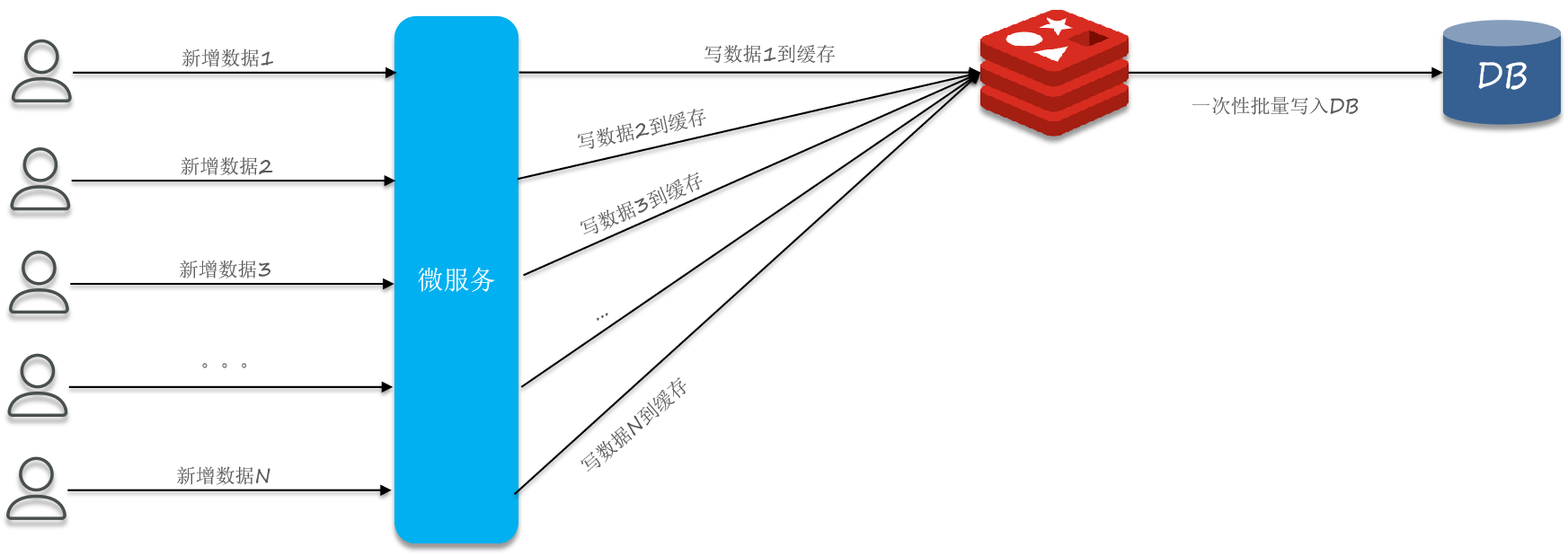
写:① 优化代码及 SQL;② 变同步为异步;③ 合并写请求。
变同步为异步:
优点:① 无需等待,减少响应时间;② 利用 MQ 暂存消息,流量削峰整形作用;③ 降低写频率,减轻数据库并发压力。
缺点:① 依赖MQ可靠性;② 没有降低数据库写次数,仅仅降低写频率。

合并写请求:
优点:① 写缓存速度快,大大减少响应时间;② 降低了数据库写频率和写次数,减轻数据库并发压力。
缺点:① 实现相对复杂;② 依赖缓存系统可靠性;③ 不支持事务和复杂业务。
3.3.2 播放进度优化方案
优化方案选择:
提交播放进度业务虽然看起来复杂,但大多数请求的处理很简单,就是更新播放进度。
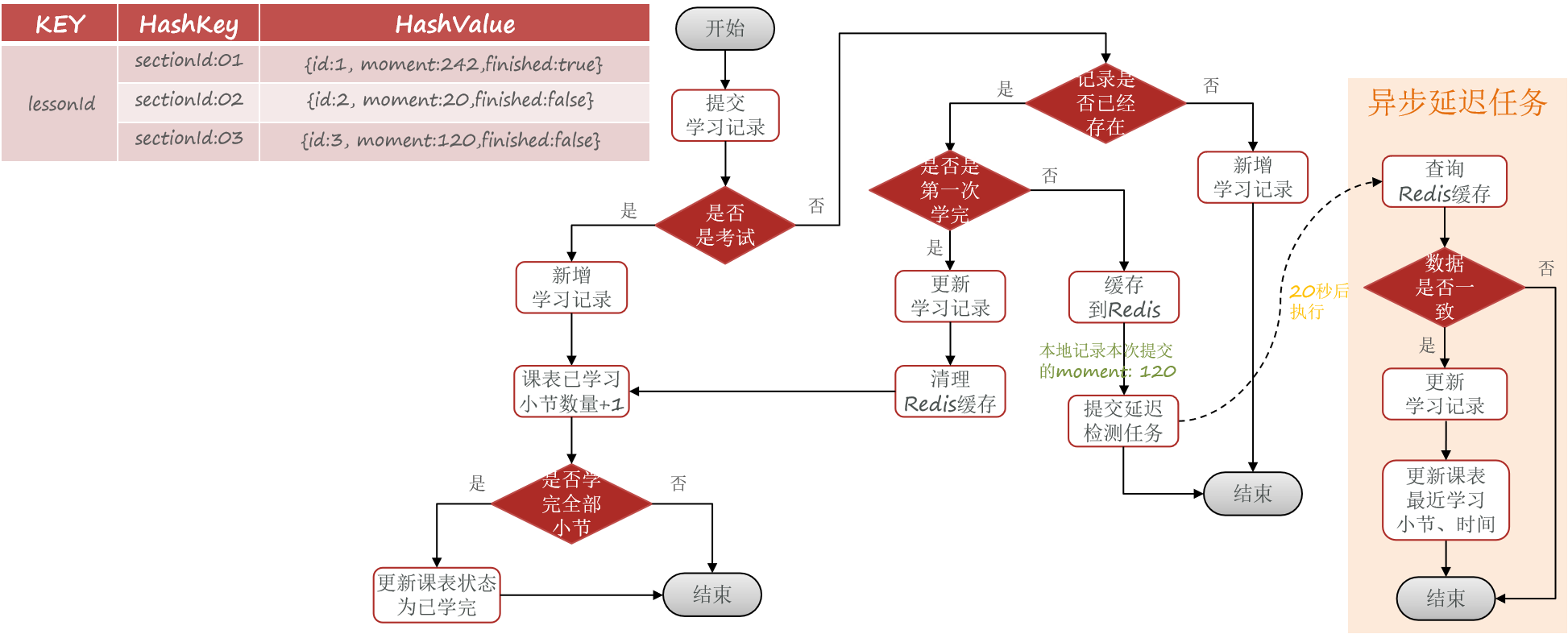
并且播放进度数据是可以合并的(覆盖之前旧数据),所以采用合并写请求方案。
Redis 数据结构设计:
KEY:课表 id(用户 id + 课程 id):
lessonIdHashKey:小节 id:
sectionIdHashValue:记录 id:
id,播放进度:moment,是否学完:finished
持久化思路:
3.3.3 延迟任务
延迟任务方案:
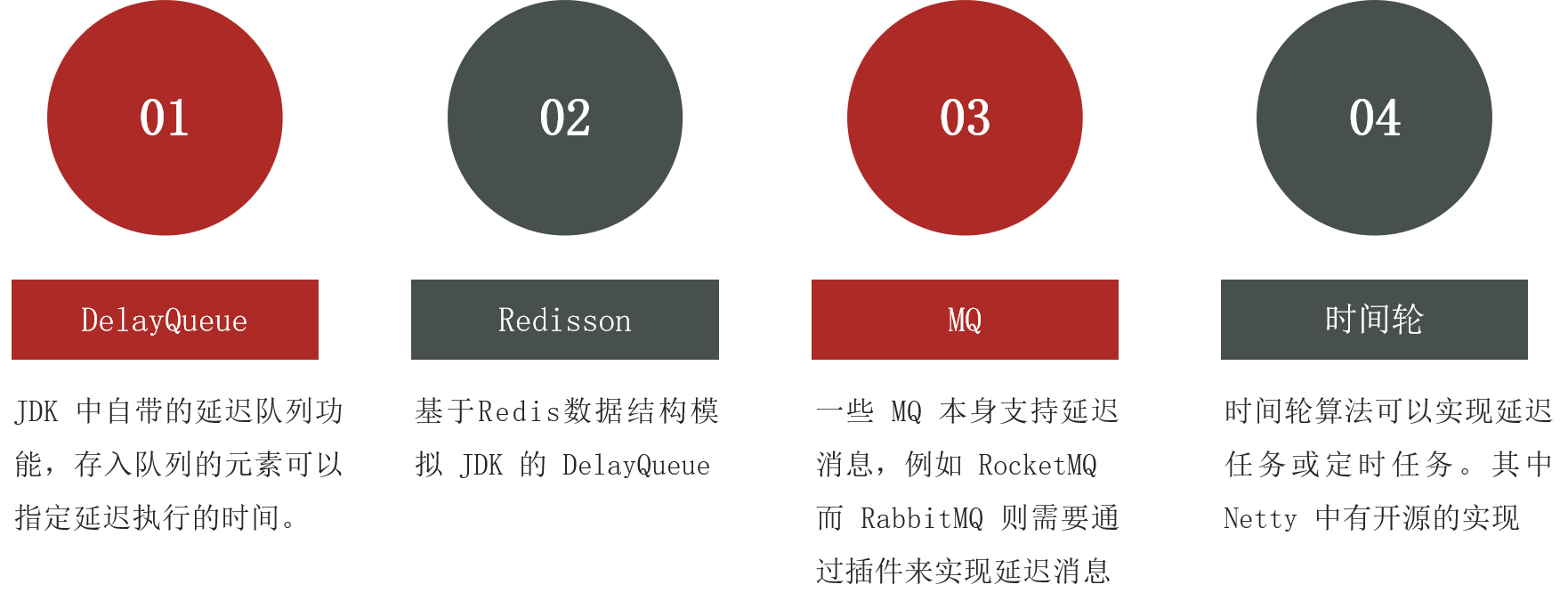
DelayQueue 的原理:
首先来看一下 DelayQueue 的源码:
xxxxxxxxxxpublic class DelayQueue<E extends Delayed> extends AbstractQueue<E> implements BlockingQueue<E> { private final transient ReentrantLock lock = new ReentrantLock(); private final PriorityQueue<E> q = new PriorityQueue<E>();}可以看到 DelayQueue 实现了 BlockingQueue 接口,是一个阻塞队列。DelayQueue 叫延迟队列,其中存储的就是延迟执行的任务。
根据 DelayQueue 的泛型定义,可知存入队列的元素必须是 Delayed 类型,这其实就是一个延迟任务的规范接口:
xxxxxxxxxxpublic interface Delayed extends Comparable<Delayed> { long getDelay(TimeUnit unit);}可以看出Delayed 类型必须具备两个方法:getDelay():获取任务剩余延迟时间;compareTo(T t):根据延迟时间判断执行顺序。
3.3.4 代码改造
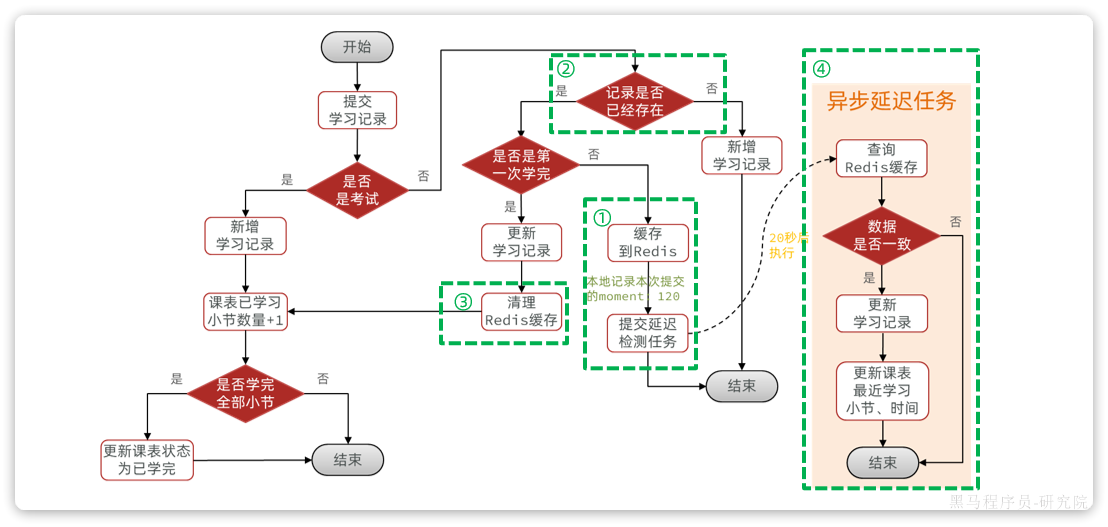
定义延迟任务工具类:(了解)
xxxxxxxxxxpackage com.tianji.learning.utils;
public class LearningRecordDelayTaskHandler {    // 1. 查询 Redis 缓存中的指定小节的播放记录    public LearningRecord readRecordCache(Long lessonId, Long sectionId) {...}    // 2. 删除 Redis 缓存中的指定小节的播放记录    public void cleanRecordCache(Long lessonId, Long sectionId) {...}    // 3.1 添加播放记录到 Redis    public void writeRecordCache(LearningRecord record) {...}    // 3.2 添加一个延迟检测任务到 DelayQueue    public void addLearningRecordTask(LearningRecord record) {...}    // 4. 异步执行 DelayQueue 中的延迟检测任务,检测播放进度是否变化,如果无变化则写入数据库    private void handleDelayTask() {...}}
改造提交学习记录功能:
xxxxxxxxxxpublic void addLearningRecord(LearningRecordFormDTO recordDTO) {    if (!finished) return;                  // 如果未学完, 直接返回, 不操作数据库}
private LearningRecord queryOldRecord(Long lessonId, Long sectionId) {    // ...                                  // 1. 查询 Redis 缓存中的指定小节的播放记录    LearningRecord record = taskHandler.readRecordCache(lessonId, sectionId);    if (record != null) return record;    record = lambdaQuery()        .eq(LearningRecord::getLessonId, lessonId)        .eq(LearningRecord::getSectionId, sectionId).one();    taskHandler.writeRecordCache(record);   // 3.1 添加播放记录到 Redis    return record;}
private boolean handleVideoRecord(Long userId, LearningRecordFormDTO recordDTO) { // ... // 3.2 添加一个延迟检测任务到 DelayQueue if (!finished) { LearningRecord record = new LearningRecord(); record.setLessonId(recordDTO.getLessonId()); record.setSectionId(recordDTO.getSectionId()); record.setMoment(recordDTO.getMoment()); record.setId(old.getId()); record.setFinished(old.getFinished()); taskHandler.addLearningRecordTask(record); return false; } // ... // 2. 删除 Redis 缓存中的指定小节的播放记录 taskHandler.cleanRecordCache(recordDTO.getLessonId(), recordDTO.getSectionId());}xxxxxxxxxxprivate void handleLearningLessonsChanges(LearningRecordFormDTO recordDTO, boolean finished) { LearningLesson lesson = lessonService.getById(recordDTO.getLessonId()); if (lesson == null) throw new BizIllegalException("课程不存在,无法更新数据!"); CourseFullInfoDTO cInfo = courseClient.getCourseInfoById(lesson.getCourseId(), false, false); if (cInfo == null) throw new BizIllegalException("课程不存在,无法更新数据!");
boolean allLearned = false; allLearned = lesson.getLearnedSections() + 1 >= cInfo.getSectionNum(); lessonService.lambdaUpdate() // 如果是第一次观看视频,则设置 lesson 为正在学习 .set(lesson.getLearnedSections() == 0, LearningLesson::getStatus, LessonStatus.LEARNING.getValue()) // 如果学完全部小节,则更新 lesson 为完成状态、完成时间 .set(allLearned, LearningLesson::getStatus, LessonStatus.FINISHED.getValue()) .set(allLearned, LearningLesson::getFinishTime, LocalDateTime.now()) // 如果已学完小节,则课表已学习小节数量 + 1 .setSql("learned_sections = learned_sections + 1") .eq(LearningLesson::getId, lesson.getId()).update();}3.3.5 线程池的使用 (作业)
需求:目前我们的延迟任务执行还是单线程模式,大家将其改造为线程池模式,核心线程数与CPU核数一致即可。
xxxxxxxxxxpackage com.tianji.learning.utils;
public class LearningRecordDelayTaskHandler {    // 建议1. 如果任务为 cpu 运算型,核心线程适合设置为 cpu 核心数    // 建议2. 如果任务为 io 型,推荐设置为 cpu 最大线程数    static ThreadPoolExecutor poolExecutor =         new ThreadPoolExecutor(16, 5, 60, TimeUnit.SECONDS, new LinkedBlockingDeque<>(10));
    private void handleDelayTask(){        try {            poolExecutor.submit(new Runnable() {...});        } catch (Exception e) {            log.error("处理播放记录任务发生异常", e);        }    }}
3.4 面试题
3.4.1 你负责学习系统的设计和开发,那能不能讲讲是如何设计的?
答:我参与了整个学习中心的功能开发,其中有很多的学习辅助功能都很有特色。比如视频播放的进度记录。
我们网站的课程是以录播视频为主,为了提高用户体验,需要实现续播功能。功能本身并不复杂,只不过我们产品提出的要求比较高:
首先续播时间误差要控制在 30 秒以内
而且要做到用户突然断开,甚至切换设备后,都可以继续上一次播放
要达成这个目的,传统的手段显然是不行的。首先,要做到切换设备后还能续播,用户的播放进度必须保存在服务端,而不是客户端。
其次,续播的时间误差不能超过 30 秒,那播放进度的记录频率就需要比较高。我们会在前端每隔 15 秒就发起一次心跳请求,提交最新的播放进度,记录到服务端。这样用户下一次续播时直接读取服务端的播放进度,就可以将时间误差控制在 15 秒左右。
3.4.2 播放进度保存在服务端哪里?如果写在数据库,那压力是不是太大了?
答:提交播放记录最终肯定是要保存到数据库中的。 因为我们不仅要做视频续播,还有用户学习计划、学习进度统计等功能,都需要用到用户的播放记录数据。
但确实如你所说,前端每隔 15 秒一次请求,如果在用户量较大时,直接全部写入数据库,对数据库压力会比较大。
因此我们采用了合并写请求的方案,当用户提交播放进度时会先缓存在 Redis 中,后续再将数据保存到数据库即可。 由于播放进度会不断覆盖,只保留最后一次即可。这样就可以大大减少对于数据库的访问次数和访问频率了。
Day04 - 问答系统
4.1 分析产品原型
4.1.1 分析业务流程
分析业务流程:
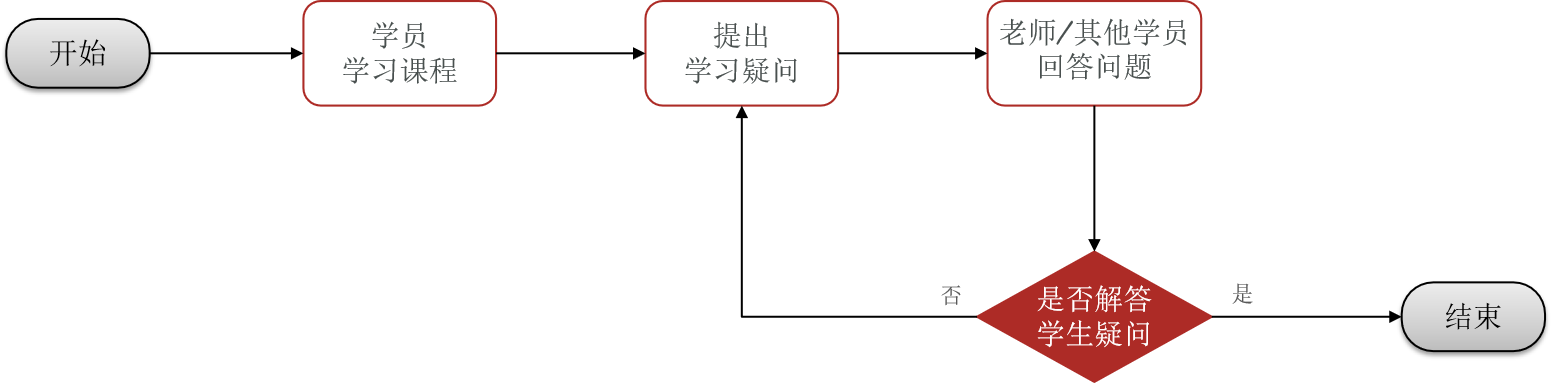
统计接口:
| 编号 | 接口简述 | |
|---|---|---|
| 互动提问 | 1 | 新增互动问题(C 端) |
| 2 | 修改互动问题(C 端) | |
| 3 | 分页查询问题(C 端) | |
| 4 | 查询问题详情(C 端) | |
| 5 | 删除互动问题(C 端) | |
| 6 | 分页查询问题(B 端) | |
| 7 | 查询问题详情(B 端) | |
| 8 | 隐藏显示问题(B 端) | |
| 回答及评论 | 9 | 新增回答或评论(C 端) |
| 10 | 分页查询回答或评论(C 端) | |
| 11 | 分页查询回答或评论(B 端) | |
| 12 | 隐藏显示回答或评论(B 端) |
4.1.2 设计业务接口
新增互动问题(C 端):
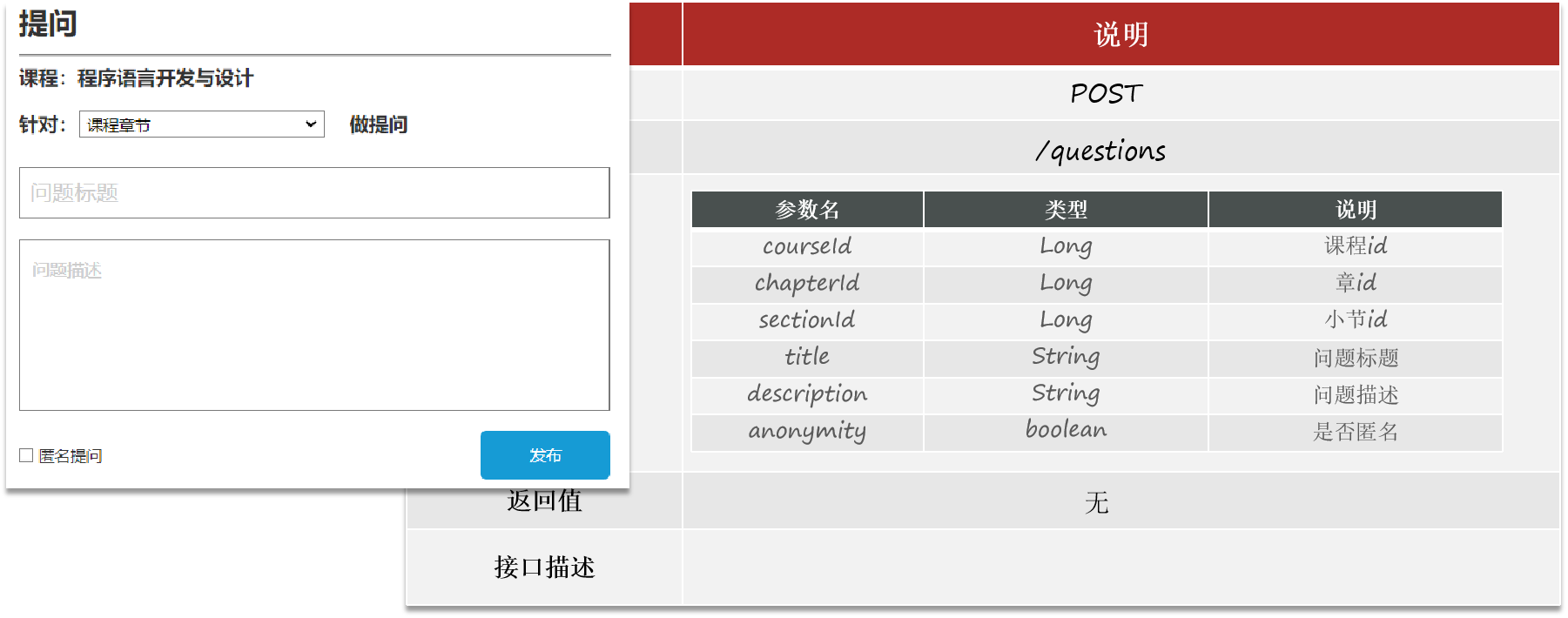
修改互动问题(C 端):

分页查询问题(C 端):
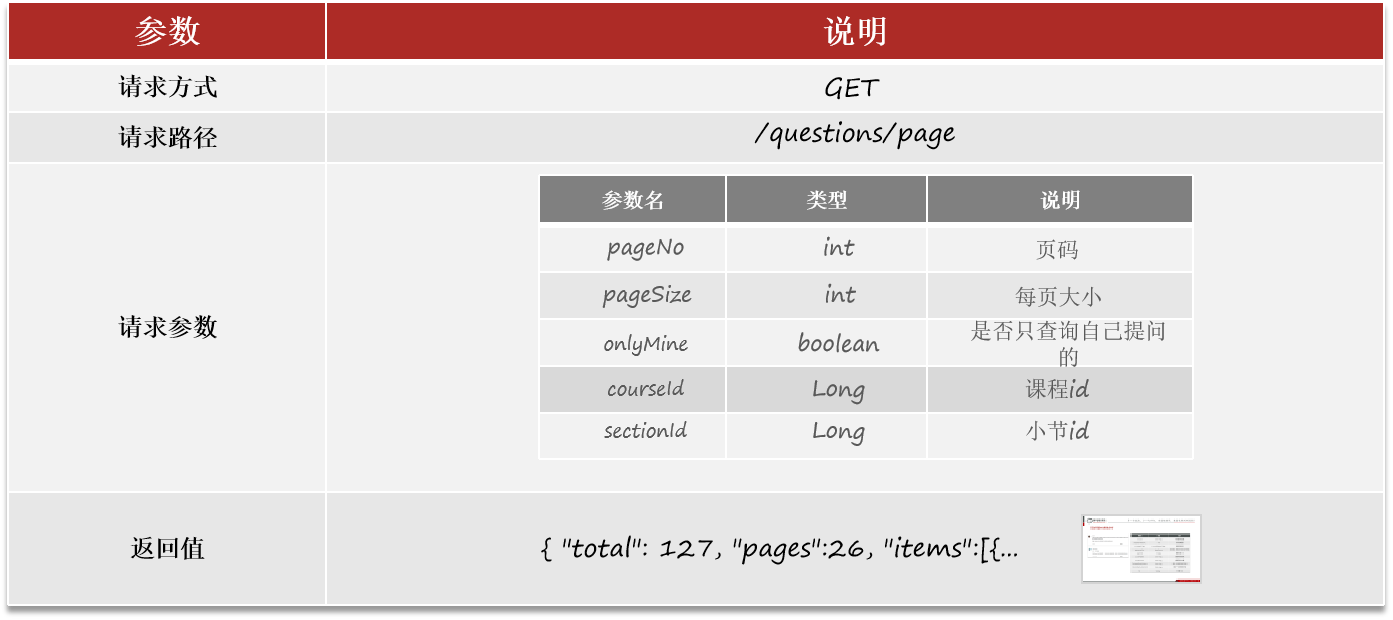
查询问题详情(C 端):

删除互动问题(C 端):
| 请求方式 | GET |
|---|---|
| 请求路径 | /admin/questions/page |
xxxxxxxxxx{   // 请求参数:    "pageNo":  1,                                   // 页码    "pageSize": 5,                                  // 每页大小    "courseName": "课程名称",    "status": 1,                                    // 问题状态,1-已查看、0-未查看    "beginTime": "2023-01-01 12:00:00",             // 提问时间的最小值    "endTime": "2023-01-02 12:00:00",               // 提问时间的最大值}
{   // 返回值:    "list": [        {            "id": "问题id",            "title": "问题标题",            "description": "问题描述",            "chapterName": "章名称",            "sectionName": "小节名称",            "courseName": "课程名称",            "categoryName": "分类名称1/分类名称2/分类名称3",            "userName": "提问者昵称"            "answerTimes": 0,                       // 回答数量                        "createTime": "2022-7-18 19:52:36",            "hidden": true,            "status": 0,                            // 问题状态:0-未查看;1-已查看        }    ],    "pages": 0,                                     // 总页数    "total": 0                                      // 总条数}
分页查询问题(B 端):
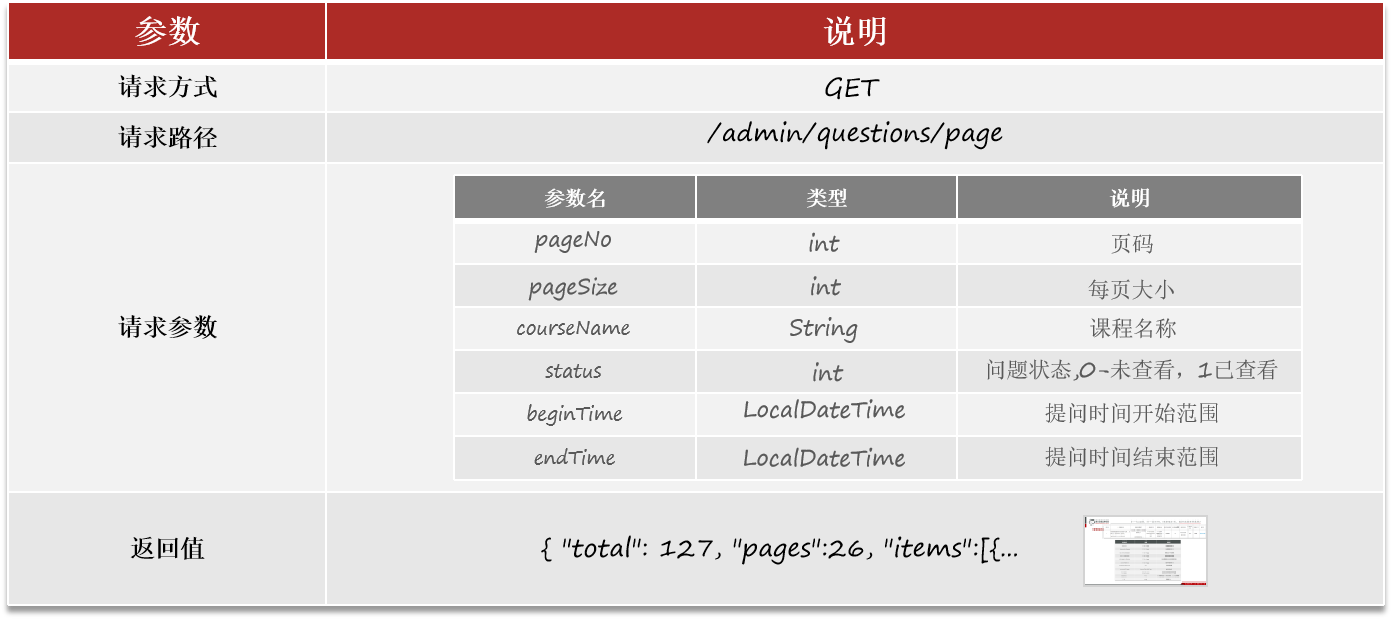
查询问题详情(B 端):
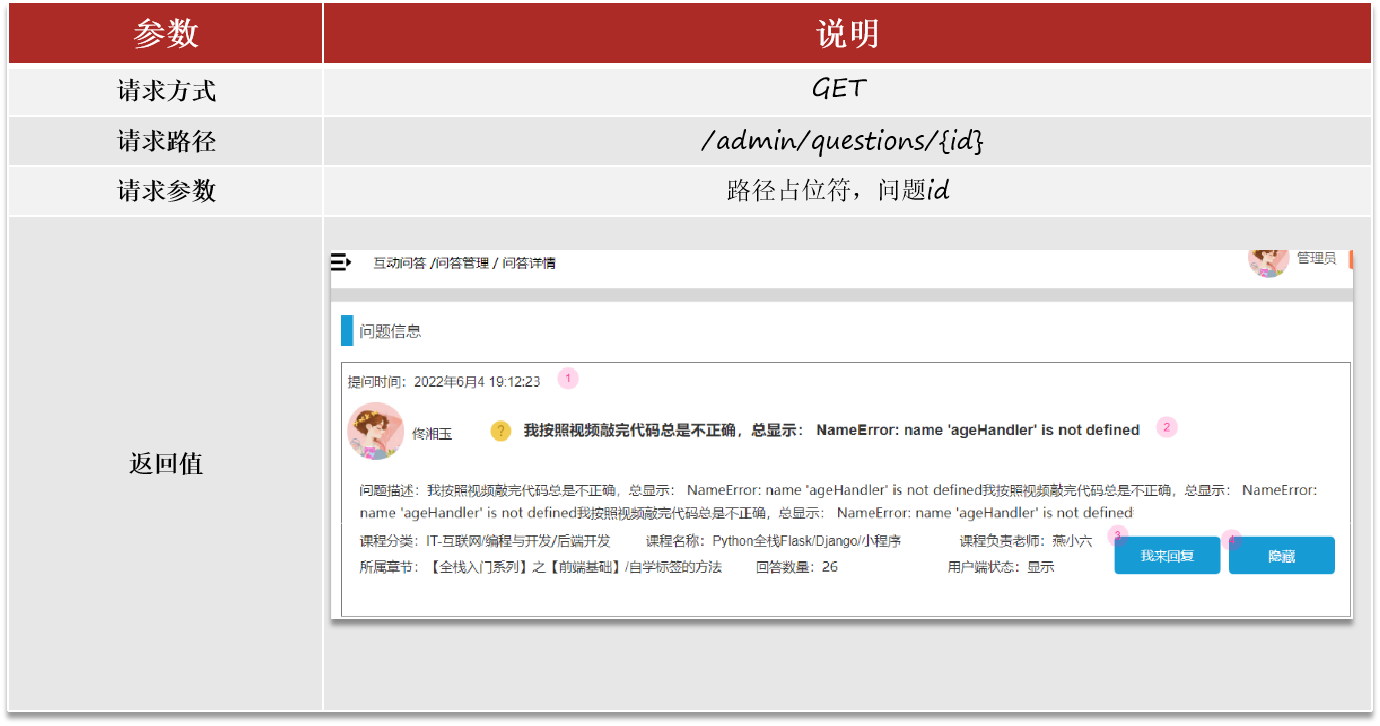
隐藏显示问题(B 端):
| 请求方式 | PUT |
|---|---|
| 请求路径 | /admin/questions/{id}/hidden/{hidden} |
| 请求参数 | 路径占位符参数 |
新增回答或评论(C 端):
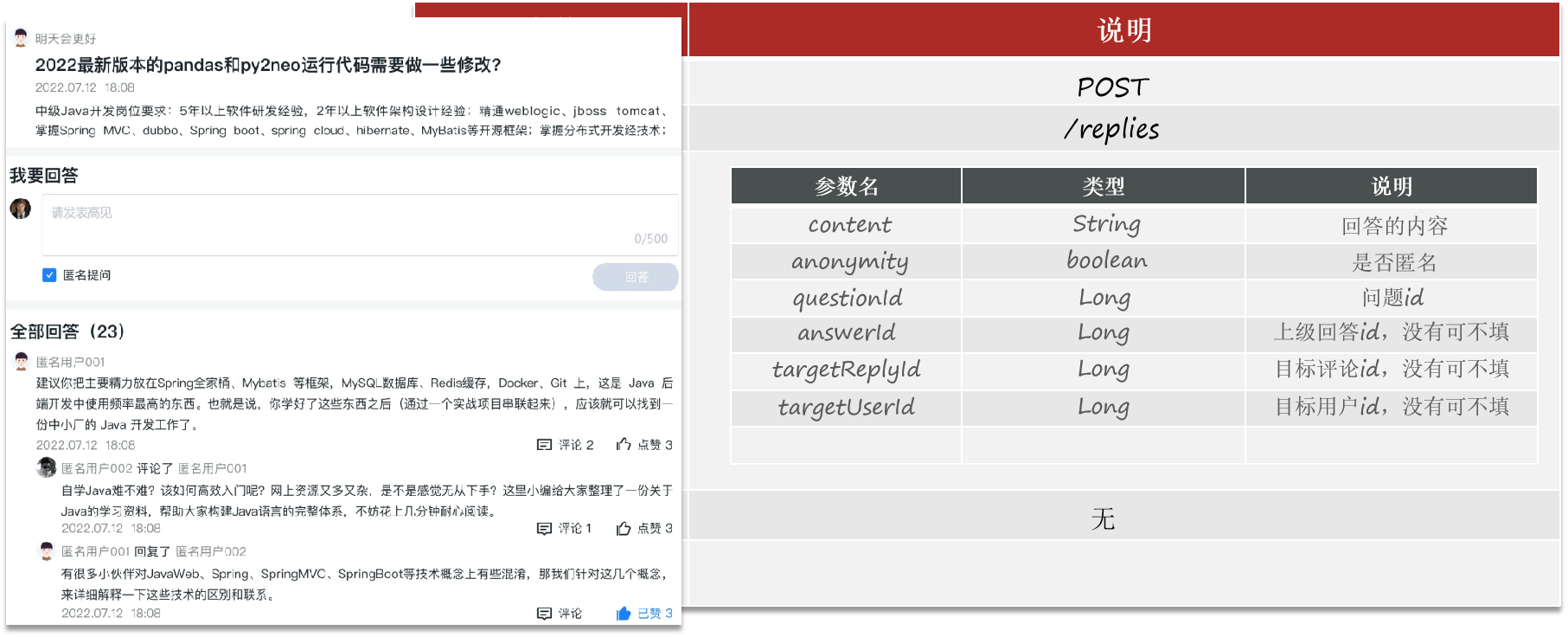
分页查询回答或评论(C 端):
| 请求方式 | GET |
|---|---|
| 请求路径 | /replies/page |
xxxxxxxxxx{   // 请求参数:    "pageNo":  1,                           // 页码    "pageSize": 5,                          // 每页大小    "courseName": "课程名称",     "status": 1,                            // 问题状态,1-已查看、0-未查看    "beginTime": "2023-01-01 12:00:00",     // 提问时间的最小值    "endTime": "2023-01-02 12:00:00",       // 提问时间的最大值}
{   // 返回值:    "list": [        {            "id": "问题id",            "title": "问题标题",            "description": "问题描述",            "chapterName": "章名称",            "sectionName": "小节名称",            "courseName": "课程名称",            "categoryName": "分类名称1/分类名称2/分类名称3",            "userName": "提问者昵称"            "answerTimes": 0,               // 回答数量                        "createTime": "2022-7-18 19:52:36",            "hidden": true,            "status": 0,                    // 问题状态:0-未查看;1-已查看        }    ],    "pages": 0,                             // 总页数    "total": 0                              // 总条数}
分页查询回答或评论(B 端):
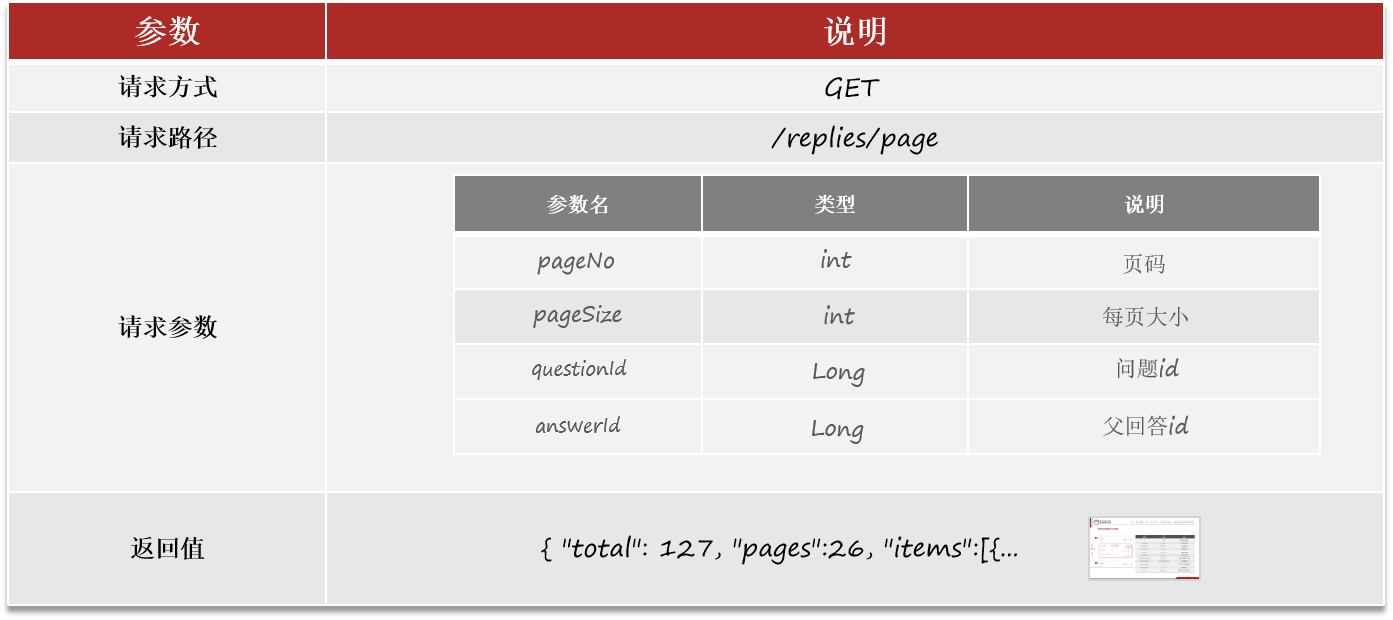
隐藏显示回答或评论(B 端):
| 请求方式 | PUT |
|---|---|
| 请求路径 | /admin/replies/{id}/hidden/{hidden} |
| 请求参数 | 路径占位符参数 |
4.1.3 抽取业务实体
问题表
interaction_question:
xxxxxxxxxxCREATE TABLE IF NOT EXISTS `interaction_question` ( `id` bigint NOT NULL COMMENT '主键,互动问题的id', `title` varchar(255) CHARACTER SET utf8mb4 NOT NULL COMMENT '互动问题的标题', `description` varchar(2048) CHARACTER SET utf8mb4 NOT NULL DEFAULT '' COMMENT '问题描述信息', `course_id` bigint NOT NULL COMMENT '所属课程id', `chapter_id` bigint NOT NULL COMMENT '所属课程章id', `section_id` bigint NOT NULL COMMENT '所属课程节id', `user_id` bigint NOT NULL COMMENT '提问学员id', `latest_answer_id` bigint DEFAULT NULL COMMENT '最新的一个回答的id', `answer_times` int unsigned NOT NULL DEFAULT '0' COMMENT '问题下的回答数量', `anonymity` bit(1) NOT NULL DEFAULT b'0' COMMENT '是否匿名,默认false', `hidden` bit(1) NOT NULL DEFAULT b'0' COMMENT '是否被隐藏,默认false', `status` tinyint DEFAULT '0' COMMENT '管理端问题状态:0-未查看,1-已查看', `create_time` datetime NOT NULL DEFAULT CURRENT_TIMESTAMP COMMENT '提问时间', `update_time` datetime NOT NULL DEFAULT CURRENT_TIMESTAMP ON UPDATE CURRENT_TIMESTAMP COMMENT '更新时间', PRIMARY KEY (`id`) USING BTREE, KEY `idx_course_id` (`course_id`) USING BTREE, KEY `section_id` (`section_id`)) ENGINE=InnoDB DEFAULT CHARSET=utf8mb4 ROW_FORMAT=DYNAMIC COMMENT='互动提问的问题表';回答、评论表
interaction_reply:
xxxxxxxxxxCREATE TABLE IF NOT EXISTS `interaction_reply` ( `id` bigint NOT NULL COMMENT '互动问题的回答id', `question_id` bigint NOT NULL COMMENT '互动问题问题id', `answer_id` bigint DEFAULT '0' COMMENT '回复的上级回答id', `user_id` bigint NOT NULL COMMENT '回答者id', `content` varchar(255) CHARACTER SET utf8mb4 NOT NULL COMMENT '回答内容', `target_user_id` bigint DEFAULT '0' COMMENT '回复的目标用户id', `target_reply_id` bigint DEFAULT '0' COMMENT '回复的目标回复id', `reply_times` int NOT NULL DEFAULT '0' COMMENT '回答下的评论数量', `liked_times` int NOT NULL DEFAULT '0' COMMENT '点赞数量', `hidden` bit(1) NOT NULL DEFAULT b'0' COMMENT '是否被隐藏,默认false', `anonymity` bit(1) NOT NULL DEFAULT b'0' COMMENT '是否匿名,默认false', `create_time` datetime NOT NULL DEFAULT CURRENT_TIMESTAMP COMMENT '创建时间', `update_time` datetime NOT NULL DEFAULT CURRENT_TIMESTAMP ON UPDATE CURRENT_TIMESTAMP COMMENT '更新时间', PRIMARY KEY (`id`) USING BTREE, KEY `idx_question_id` (`question_id`) USING BTREE) ENGINE=InnoDB DEFAULT CHARSET=utf8mb4 ROW_FORMAT=DYNAMIC COMMENT='互动问题的回答或评论';4.2 开发接口功能
4.2.1 新增互动问题(C 端)
需求:在课程详情页,或者用户学习视频页面,都可以对当前课程提出疑问。
Controller 层:
xxxxxxxxxxpackage com.tianji.learning.controller;
("/questions")public class InteractionQuestionController { ("新增互动问题") public void saveQuestion( QuestionFormDTO questionDTO){ questionService.saveQuestion(questionDTO); }}Service 层:
xxxxxxxxxxpublic void saveQuestion(QuestionFormDTO questionDTO) { Long userId = UserContext.getUser(); InteractionQuestion question = BeanUtils.toBean(questionDTO, InteractionQuestion.class); question.setUserId(userId); save(question);}4.2.2 修改互动问题(C 端)
需求:在课程详情页,用户可以对自己提出的问题做编辑,修改问题的相关信息。
Controller 层:
xxxxxxxxxxpackage com.tianji.learning.controller;
("修改互动问题")("{id}")public void updateQuestion(("id") Long id, QuestionFormDTO questionDTO){ questionService.updateQuestion(id, questionDTO);}Service 层:
xxxxxxxxxxpublic void updateQuestion(Long id, QuestionFormDTO questionDTO) { if(StringUtils.isBlank(questionDTO.getTitle()) // 标题为空 || StringUtils.isBlank(questionDTO.getDescription()) // 描述为空 || questionDTO.getAnonymity() == null){ // 匿名为空 throw new BadRequestException("请求参数不能为空"); } InteractionQuestion question = getById(id); if(question == null) { throw new BizIllegalException("该问题已被删除"); } question.setTitle(questionDTO.getTitle()); question.setDescription(questionDTO.getDescription()); question.setAnonymity(questionDTO.getAnonymity()); updateById(question);}4.2.3 分页查询问题(C 端)
需求:在课程详情页或视频学习页面,都可以分页查询课程相关的问题列表,数据较多采用分页查询。
Controller 层:
xxxxxxxxxxpackage com.tianji.learning.controller;
("分页查询问题")("page")public PageDTO<QuestionVO> queryQuestionPage(QuestionPageQuery query){ return questionService.queryQuestionPage(query);}Service 层:
xxxxxxxxxxprivate final InteractionReplyMapper replyMapper;private final UserClient userClient;
public PageDTO<QuestionVO> queryQuestionPage(QuestionPageQuery query) { // 1. 判断课程 id 和小节 id 是否为空 Long courseId = query.getCourseId(); Long sectionId = query.getSectionId(); if (courseId == null && sectionId == null) { throw new BadRequestException("课程id和小节id不能都为空"); } // 2. 分页查询 Page<InteractionQuestion> page = lambdaQuery() .select(InteractionQuestion.class, info -> !info.getProperty().equals("description")) .eq(query.getOnlyMine(), InteractionQuestion::getUserId, UserContext.getUser()) .eq(courseId != null, InteractionQuestion::getCourseId, courseId) .eq(sectionId != null, InteractionQuestion::getSectionId, sectionId) .eq(InteractionQuestion::getHidden, false) .page(query.toMpPageDefaultSortByCreateTimeDesc()); List<InteractionQuestion> records = page.getRecords(); if (CollUtils.isEmpty(records)) { return PageDTO.empty(page); } // 3. 根据 id 查询提问者和最近一次回答的信息 Set<Long> userIds = new HashSet<>(); Set<Long> answerIds = new HashSet<>(); // 3.1 得到提问者 id 和最近一次回答 id for (InteractionQuestion q : records) { if(!q.getAnonymity()) userIds.add(q.getUserId()); // 匿名问题直接忽略 answerIds.add(q.getLatestAnswerId()); } // 3.2 根据 id 查询最近一次回答的信息 answerIds.remove(null); Map<Long, InteractionReply> replyMap = new HashMap<>(answerIds.size()); if(CollUtils.isNotEmpty(answerIds)) { List<InteractionReply> replies = replyMapper.selectBatchIds(answerIds); for (InteractionReply reply : replies) { replyMap.put(reply.getId(), reply); if(!reply.getAnonymity()) userIds.add(reply.getUserId()); // 匿名用户直接忽略 } } // 3.3.根据 id 查询提问者的信息 userIds.remove(null); Map<Long, UserDTO> userMap = new HashMap<>(userIds.size()); if(CollUtils.isNotEmpty(userIds)) { List<UserDTO> users = userClient.queryUserByIds(userIds); userMap = users.stream().collect(Collectors.toMap(UserDTO::getId, u -> u)); } // 4. 封装 VO 并返回 List<QuestionVO> voList = new ArrayList<>(records.size()); for (InteractionQuestion r : records) { // 4.1 将 PO 拷贝到 VO QuestionVO vo = BeanUtils.copyBean(r, QuestionVO.class); vo.setUserId(null); voList.add(vo); // 4.2 封装提问者的信息 if(!r.getAnonymity()){ UserDTO userDTO = userMap.get(r.getUserId()); if (userDTO != null) { vo.setUserId(userDTO.getId()); vo.setUserName(userDTO.getName()); vo.setUserIcon(userDTO.getIcon()); } } // 4.3 封装最近一次回答的信息 InteractionReply reply = replyMap.get(r.getLatestAnswerId()); if (reply != null) { vo.setLatestReplyContent(reply.getContent()); if(!reply.getAnonymity()){ // 匿名用户直接忽略 UserDTO user = userMap.get(reply.getUserId()); vo.setLatestReplyUser(user.getName()); }
} } return PageDTO.of(page, voList);}远程调用接口:
xxxxxxxxxxpackage com.tianji.learning.mapper;
public interface InteractionReplyMapper extends BaseMapper<InteractionReply> {}xxxxxxxxxxpackage com.tianji.api.client.user;
(value = "user-service", fallbackFactory = UserClientFallback.class)public interface UserClient { ("/users/list") List<UserDTO> queryUserByIds(("ids") Iterable<Long> ids);}4.2.4 查询问题详情(C 端)
需求:在课程详情页用户点击某个互动问题后,会进入问答详情页面,查看问题详细信息。
Controller 层:
xxxxxxxxxxpackage com.tianji.learning.controller;
("查询问题详情")("/{id}")public QuestionVO queryQuestionById((value = "问题id", example = "1") ("id") Long id){ return questionService.queryQuestionById(id);}Service 层:
xxxxxxxxxxpublic QuestionVO queryQuestionById(Long id) { // 1. 查询问题详情 InteractionQuestion question = getById(id); // 2. 判断是否为空,或被隐藏了 if(question == null || question.getHidden()) return null; // 3. 查询提问者信息 UserDTO user = null; if(!question.getAnonymity()){ user = userClient.queryUserById(question.getUserId()); } // 4. 封装 VO 并返回 QuestionVO vo = BeanUtils.copyBean(question, QuestionVO.class); if (user != null) { vo.setUserName(user.getName()); vo.setUserIcon(user.getIcon()); } return vo;}4.2.5 删除互动问题(C 端)
需求:用户可以删除自己提问的问题。
Controller 层:
xxxxxxxxxxpackage com.tianji.learning.controller;
("删除互动问题")("{id}")public void deleteQuestion(("id") Long id){ questionService.deleteQuestion(id);}Service 层:
xxxxxxxxxxpublic void deleteQuestion(Long id) { Long user = UserContext.getUser(); InteractionQuestion question = getById(id); if(question == null) return; if(!user.equals(question.getUserId())){ throw new BizIllegalException("该问题提问者非当前用户,无法删除"); } removeById(id);}4.2.6 分页查询问题(B 端)
4.2.6.1 课程名称模糊搜索
在项目中,所有上线的课程数据都会存储到 Elasticsearch 中,方便用户检索课程。并且在 tj-search 模块中提供了相关的查询接口。
其中就有根据课程名称搜索课程信息的功能,并且这个功能还对外开放了一个 Feign 客户端方便我们调用:
xxxxxxxxxxpackage com.tianji.api.client.search;
("search-service")public interface SearchClient { ("/courses/name") List<Long> queryCoursesIdByName((value = "keyword", required = false) String keyword);}4.2.6.2 课程分类数据
查询思路分析:
管理端除了要查询到问题,还需要返回问题所属的一系列信息。这些数据对应到 interaction_question 表中,只包含一些 id 字段。
课程分类信息在以往的查询中没有涉及过,课程分类在首页就能看到,共分为3级。 只要我们查询到了问题所属的课程,就能知道课程关联的三级分类 id,接下来只需要根据分类 id 查询出分类名称即可。
而在 course-service 服务中提供了一个接口,可以查询到所有的分类:
xxxxxxxxxxpackage com.tianji.api.client.course;
(contextId = "catalogue", value = "course-service",path = "catalogues")public interface CatalogueClient { ("/batchQuery") List<CataSimpleInfoDTO> batchQueryCatalogue(("ids") Iterable<Long> ids);}多级缓存:
Redis 虽然能提高性能,但每次查询缓存还是会增加网络带宽消耗,也有网络延迟。
分类数据特点:数据量小、长时间不会发生变化。像这样的数据,还适合做本地缓存(Local Cache),形成多级缓存机制:
数据查询时优先查询本地缓存
本地缓存不存在,再查询 Redis 缓存
Redis 不存在,再去查询数据库
Caffeine 是一个基于 Java8 开发的,提供了最佳命中率的高性能的本地缓存库。目前 Spring 内部缓存使用的就是 Caffeine。
课程分类的本地缓存:(了解)
xxxxxxxxxxpackage com.tianji.api.cache;
public class CategoryCache {...} // 课程分类的缓存工具类xxxxxxxxxxpackage com.tianji.api.config;
public class CategoryCacheConfig {...} // 课程分类的缓存配置4.2.6.3 实现分页查询问题
需求:在后台管理页面,教师可以查看学员提问的问题并予以答复,查询采用分页查询。
Controller 层:
xxxxxxxxxxpackage com.tianji.learning.controller;
("/admin/questions")(tags = "互动问答相关接口")public class InteractionQuestionAdminController { ("分页查询问题") ("page") public PageDTO<QuestionAdminVO> queryQuestionPageAdmin(QuestionAdminPageQuery query){ return questionService.queryQuestionPageAdmin(query); }}Service 层:
xxxxxxxxxxprivate final SearchClient searchClient; // 远程调用: 课程名称模糊搜索private final CatalogueClient catalogueClient; // 远程调用: 查询课程三级分类private final CategoryCache categoryCache; // 远程调用: 课程分类本地缓存
public PageDTO<QuestionAdminVO> queryQuestionPageAdmin(QuestionAdminPageQuery query) { // 1. 处理课程名称,得到课程 id List<Long> courseIds = null; if (StringUtils.isNotBlank(query.getCourseName())) { courseIds = searchClient.queryCoursesIdByName(query.getCourseName()); if (CollUtils.isEmpty(courseIds)) { return PageDTO.empty(0L, 0L); } } // 2. 分页查询 Integer status = query.getStatus(); LocalDateTime begin = query.getBeginTime(); LocalDateTime end = query.getEndTime(); Page<InteractionQuestion> page = lambdaQuery() // select * from interaction_question .in(courseIds != null, InteractionQuestion::getCourseId, courseIds)// where course_id in (courseIds) .eq(status != null, InteractionQuestion::getStatus, status) // and status = #{status} .gt(begin != null, InteractionQuestion::getCreateTime, begin) // and create_time > #{begin} .lt(end != null, InteractionQuestion::getCreateTime, end) // and create_time < #{end} .page(query.toMpPageDefaultSortByCreateTimeDesc()); // ordered by create_time ASC; List<InteractionQuestion> records = page.getRecords(); if (CollUtils.isEmpty(records)) { return PageDTO.empty(page); }
// 3. 获取用户数据、课程数据、章节数据 Set<Long> userIds = new HashSet<>(); Set<Long> cIds = new HashSet<>(); Set<Long> cataIds = new HashSet<>(); // 3.1 获取各种数据的 id 集合 for (InteractionQuestion q : records) { userIds.add(q.getUserId()); cIds.add(q.getCourseId()); cataIds.add(q.getChapterId()); cataIds.add(q.getSectionId()); } // 3.2 根据 id 查询用户数据 List<UserDTO> users = userClient.queryUserByIds(userIds); Map<Long, UserDTO> userMap = new HashMap<>(users.size()); if (CollUtils.isNotEmpty(users)) { userMap = users.stream().collect(Collectors.toMap(UserDTO::getId, u -> u)); } // 3.3 根据 id 查询课程数据 List<CourseSimpleInfoDTO> cInfos = courseClient.getSimpleInfoList(cIds); Map<Long, CourseSimpleInfoDTO> cInfoMap = new HashMap<>(cInfos.size()); if (CollUtils.isNotEmpty(cInfos)) { cInfoMap = cInfos.stream().collect(Collectors.toMap(CourseSimpleInfoDTO::getId, c -> c)); } // 3.4 根据 id 查询章节数据 List<CataSimpleInfoDTO> catas = catalogueClient.batchQueryCatalogue(cataIds); Map<Long, String> cataMap = new HashMap<>(catas.size()); if (CollUtils.isNotEmpty(catas)) { cataMap = catas.stream() .collect(Collectors.toMap(CataSimpleInfoDTO::getId, CataSimpleInfoDTO::getName)); }
// 4. 封装 VO 并返回 List<QuestionAdminVO> voList = new ArrayList<>(records.size()); for (InteractionQuestion q : records) { // 4.1 将 PO 拷贝到 VO QuestionAdminVO vo = BeanUtils.copyBean(q, QuestionAdminVO.class); voList.add(vo); // 4.2 封装用户信息 UserDTO user = userMap.get(q.getUserId()); if (user != null) { vo.setUserName(user.getName()); } // 4.3 封装课程信息以及分类信息 CourseSimpleInfoDTO cInfo = cInfoMap.get(q.getCourseId()); if (cInfo != null) { vo.setCourseName(cInfo.getName()); vo.setCategoryName(categoryCache.getCategoryNames(cInfo.getCategoryIds())); } // 4.4 封装章节信息 vo.setChapterName(cataMap.getOrDefault(q.getChapterId(), "")); vo.setSectionName(cataMap.getOrDefault(q.getSectionId(), "")); } return PageDTO.of(page, voList);}4.2.7 查询问题详情(B 端)
需求:在后台管理的问答列表中,管理员可以点击并查看某个问题的详细信息。
Controller 层:
xxxxxxxxxxpackage com.tianji.learning.controller;
("查询问题详情")("{id}")public QuestionVO queryQuestionById((value = "问题id", example = "1") ("id") Long id){ return questionService.queryQuestionById(id);}Service 层:
xxxxxxxxxxprivate final UserClient userClient;
public QuestionVO queryQuestionById(Long id) { // 1. 判断问题 id、问题是否为空,或被隐藏了 InteractionQuestion question = getById(id); if(id == null || question == null || question.getHidden()) return null; QuestionVO vo = BeanUtils.copyBean(question, QuestionVO.class); // 2. 查询用户信息,封装 VO 并返回 if(!question.getAnonymity()){ UserDTO userDTO = userClient.queryUserById(question.getUserId()); if(userDTO != null){ vo.setUserName(userDTO.getName()); vo.setUserIcon(userDTO.getIcon()); } } return vo;}远程调用接口:
xxxxxxxxxxpackage com.tianji.api.client.user;
("/users/{id}")UserDTO queryUserById(("id") Long id);4.2.8 隐藏显示问题(B 端)
需求:在管理端的互动问题列表中,管理员可以隐藏某个问题,这样就不会在用户端页面展示了。
Controller 层:
xxxxxxxxxxpackage com.tianji.learning.controller;
("隐藏显示问题")("/questions/{id}/hidden/{hidden}")public void hiddenQuestionAdmin(("id") Long id, ("hidden") Boolean hidden){ questionService.hiddenQuestionAdmin(id, hidden);}Service 层:
xxxxxxxxxxpublic void hiddenQuestionAdmin(Long id, Boolean hidden) { InteractionQuestion question = getById(id); if(question == null){ throw new BadRequestException("该问题不存在"); } question.setHidden(hidden); updateById(question);}4.2.9 新增回答或评论(C 端)
需求:在问题详情页面,学员可以回答问题,或者对他人的回答做评论。
Controller 层:
xxxxxxxxxxpackage com.tianji.learning.controller;
(tags = "用户端回答或评论相关接口")("/replies")public class InteractionReplyController { ("新增回答或评论") public void addReplyOrAnswer( ReplyDTO dto){ replyService.addReplyOrAnswer(dto); }}Service 层:
xxxxxxxxxxprivate final InteractionQuestionMapper questionMapper;
public void addReplyOrAnswer(ReplyDTO dto) { // 1. 获取当前用户 Long user = UserContext.getUser(); // 2. 保存回答或评论 InteractionReply reply = BeanUtils.copyBean(dto, InteractionReply.class); reply.setUserId(user); InteractionQuestion question = questionMapper.selectById(dto.getQuestionId()); boolean save = save(reply); if(!save) throw new DbException("数据库保存该回答/评论失败"); // 3. 判断是评论还是回答 if(dto.getAnswerId() == null && dto.getTargetReplyId() == null){ // 3.1 是回答,则更新 AnswerId 为 0 并累计回答次数 question.setAnswerTimes(question.getAnswerTimes()+1); question.setLatestAnswerId(reply.getId()); } else { // 3.2 是评论,则更新被评论对象的被评论次数 InteractionReply byId = getById(dto.getAnswerId()); byId.setReplyTimes(byId.getReplyTimes() + 1); updateById(byId); } // 4. 是学生,则更新该问题状态为未查看 if(dto.getIsStudent()){ question.setStatus(QuestionStatus.UN_CHECK); questionMapper.updateById(question); }}远程调用接口:
xxxxxxxxxxpackage com.tianji.learning.mapper;
public interface InteractionQuestionMapper extends BaseMapper<InteractionQuestion> {}
4.2.10 分页查询回答或评论(C 端)
需求:在问题详情页面,用户可以查看学员问题详情下的回答列表或者回答下的评论列表。
Controller 层:
xxxxxxxxxxpackage com.tianji.learning.controller;
("分页查询回答或评论")("page")public PageDTO<ReplyVO> queryReplyOrAnswerPage(ReplyPageQuery query){ return replyService.queryReplyOrAnswerPage(query, Boolean.FALSE);}Service 层:
xxxxxxxxxxprivate final UserClient userClient;
public PageDTO<ReplyVO> queryReplyOrAnswerPage(ReplyPageQuery query, Boolean isAdmin) { // 判断 QuestionId 和 AnswerId 是否都为空 Long answerId = query.getAnswerId(); Long questionId = query.getQuestionId(); if(answerId == null && questionId == null){ throw new BadRequestException("错误参数,被回答id和问题id不能都为NULL"); } // 1. 查询问题下的回答列表 或者 回答下的评论列表 Page<InteractionReply> page = lambdaQuery() .eq(query.getQuestionId() != null, InteractionReply::getQuestionId, query.getQuestionId()) // 查询回答列表(在问题详情页面触发),或查询评论列表(在点击评论后触发) .eq(InteractionReply::getAnswerId, query.getAnswerId() == null ? 0L : query.getAnswerId()) .eq(!isAdmin, InteractionReply::getHidden, Boolean.FALSE) // 先按照点赞数量倒叙,相同点赞数量再按照创建时间倒叙 .page(query.toMpPage(new OrderItem(DATA_FIELD_NAME_LIKED_TIME, false), new OrderItem(DATA_FIELD_NAME_CREATE_TIME, false))); List<InteractionReply> replyList = page.getRecords(); if(CollUtils.isEmpty(replyList)){ return PageDTO.empty(page); } // 2. 远程批量查询用户信息 Set<Long> userIds = new HashSet<>(); Set<Long> replyIds = new HashSet<>(); for (InteractionReply rep : replyList) { // 2.1 添加回复者 id userIds.add(rep.getUserId()); // 2.2 添加被回复者 id if(query.getAnswerId()!=null){ userIds.add(rep.getTargetUserId()); } // 2.3 添加评论 id replyIds.add(rep.getId()); } Map<Long, UserDTO> userDTOMap = userClient .queryUserByIds(userIds).stream().collect(Collectors.toMap(UserDTO::getId, c -> c)); // 3. TODO 查询用户点赞状态(入参是当前分页的评论id集合,出参是当前分页被点过赞的评论id集合)
// 4. 封装 VO 并返回 List<ReplyVO> vos = BeanUtils.copyList(replyList, ReplyVO.class); List<ReplyVO> collect = vos.stream().map(i -> { // 4.1设置用户信息 // 如果该回答或评论非匿名则设置用户信息 if (!i.getAnonymity() || isAdmin) { UserDTO userDTO = userDTOMap.get(i.getUserId()); if (userDTO != null) { i.setUserIcon(userDTO.getIcon()); i.setUserName(userDTO.getName()); i.setUserType(userDTO.getType()); } } // 4.2 设置被评论对象用户信息 if (i.getTargetReplyId() != 0) { Long upId = i.getTargetReplyId(); // 得到上一级的评论 InteractionReply upReply = getById(upId); // 上一级评论不是匿名才设置 TargetUserName if(!upReply.getAnonymity() || isAdmin){ UserDTO userDTO = userDTOMap.get(upReply.getUserId()); if (userDTO != null) { i.setTargetUserName(userDTO.getName()); } } } // TODO 4.3 设置用户点赞信息(当前用户是否对该评论点过赞) return i; }).collect(Collectors.toList()); return PageDTO.of(page, collect);}远程调用接口:
xxxxxxxxxxpackage com.tianji.api.client.user;
("/users/list")List<UserDTO> queryUserByIds(("ids") Iterable<Long> ids);4.2.11 分页查询回答或评论(B 端)
需求:在后台管理页面,教师可以查看学员问题详情下的回答列表或者回答下的评论列表。
Controller 层:
xxxxxxxxxxpackage com.tianji.learning.controller;
("分页查询回答或评论")("/replies/page")public PageDTO<ReplyVO> queryReplyOrAnswerPageAdmin(ReplyPageQuery query){ return replyService.queryReplyOrAnswerPageAdmin(query);}Service 层:
xxxxxxxxxxpublic PageDTO<ReplyVO> queryReplyOrAnswerPageAdmin(ReplyPageQuery query) { return queryReplyOrAnswerPage(query, Boolean.TRUE);}// queryReplyOrAnswerPage 方法已实现,与 C 端分页查询共用4.2.12 隐藏显示回答或评论(B 端)
需求:在管理端的回答或评论列表中,管理员可以隐藏回答或评论,这样就不会在用户端页面展示了。
Controller 层:
xxxxxxxxxxpackage com.tianji.learning.controller;
("隐藏显示回答或评论")("/replies/{id}/hidden/{hidden}")public void hiddenReplyAdmin(("id") Long id, ("hidden") Boolean hidden){ replyService.hiddenReplyAdmin(id, hidden);}Service 层:
xxxxxxxxxxprivate final InteractionQuestionMapper questionMapper;
public void hiddenReplyAdmin(Long id, Boolean hidden) { // 1. 查询回答或评论 InteractionReply reply = lambdaQuery() // select * from interaction_reply .eq(InteractionReply::getId, id).one(); // where id = #{id} if(hidden && reply.getHidden()){ throw new BadRequestException("参数错误,禁止重复提交"); } // 2. 设置隐藏 reply.setHidden(hidden); updateById(reply); // 3. 设置该评论上级答案的评论数变化 int num = hidden ? -1 : 1; if(reply.getAnswerId() != 0){ // 如果是评论,则设置答案的评论数变化 InteractionReply answer = lambdaQuery() // select * from interaction_reply where id = #{answer_id} .eq(InteractionReply::getId, reply.getAnswerId()).one(); answer.setReplyTimes(answer.getReplyTimes() + num); updateById(answer); } else { // 如果是回答,则设置问题的回答数变化 InteractionQuestion question = questionMapper.selectById(reply.getQuestionId()); question.setAnswerTimes(question.getAnswerTimes() + num); questionMapper.updateById(question); }}远程调用接口:
xxxxxxxxxxpackage com.tianji.learning.mapper;
public interface InteractionQuestionMapper extends BaseMapper<InteractionQuestion> {}
Day05 - 点赞系统
5.1 分析产品原型
5.1.1 需求分析
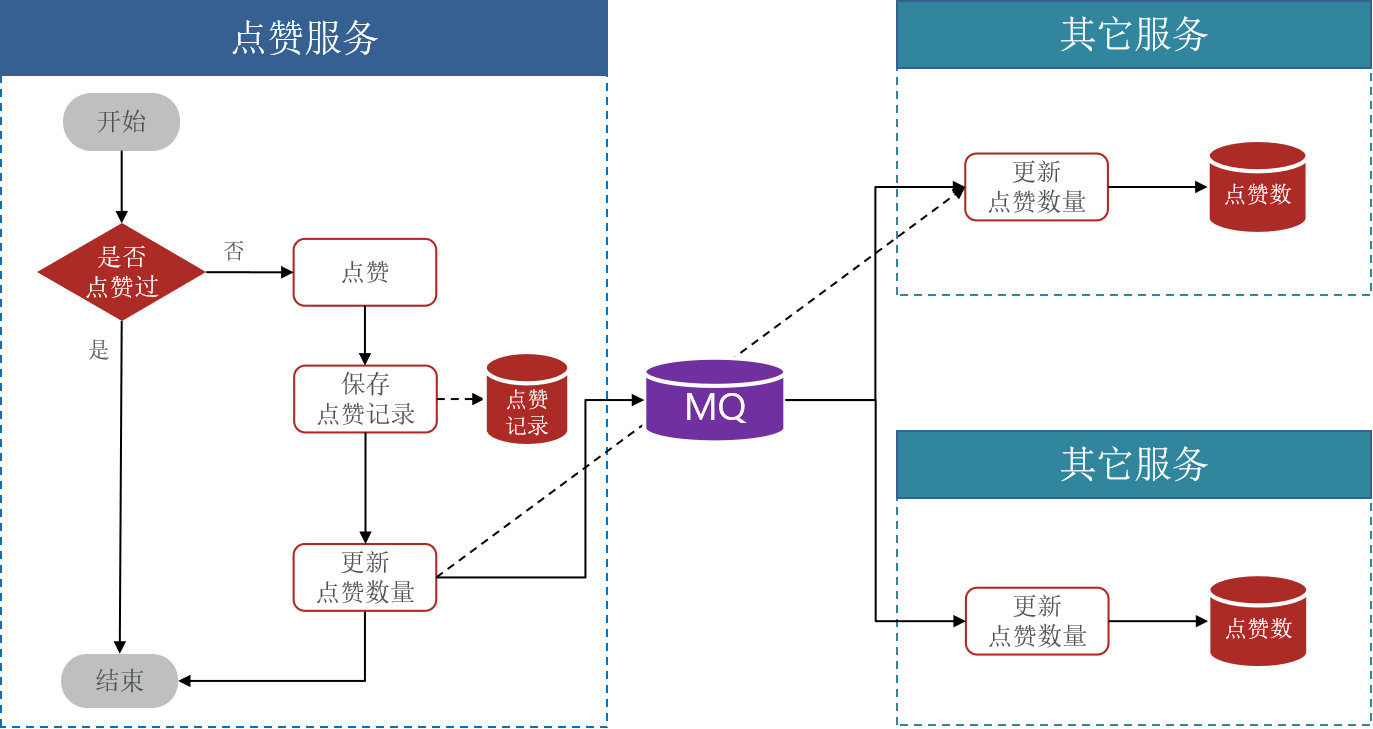
5.1.2 数据结构
xxxxxxxxxxCREATE TABLE IF NOT EXISTS `liked_record` ( `id` bigint NOT NULL AUTO_INCREMENT COMMENT '主键id', `user_id` bigint NOT NULL COMMENT '用户id', `biz_id` bigint NOT NULL COMMENT '点赞的目标id', `biz_type` VARCHAR(16) NOT NULL COMMENT '点赞的目标类型', `create_time` datetime NOT NULL DEFAULT CURRENT_TIMESTAMP COMMENT '创建时间', `update_time` datetime NOT NULL DEFAULT CURRENT_TIMESTAMP ON UPDATE CURRENT_TIMESTAMP COMMENT '更新时间', PRIMARY KEY (`id`), UNIQUE KEY `idx_biz_user` (`biz_id`,`user_id`)) ENGINE=InnoDB AUTO_INCREMENT=8 DEFAULT CHARSET=utf8mb4 COLLATE=utf8mb4_0900_ai_ci COMMENT='点赞记录表';
5.2 点赞功能
5.2.1 点赞或取消
需求:用户可以给喜欢的回答、笔记等点赞,也可以取消点赞。
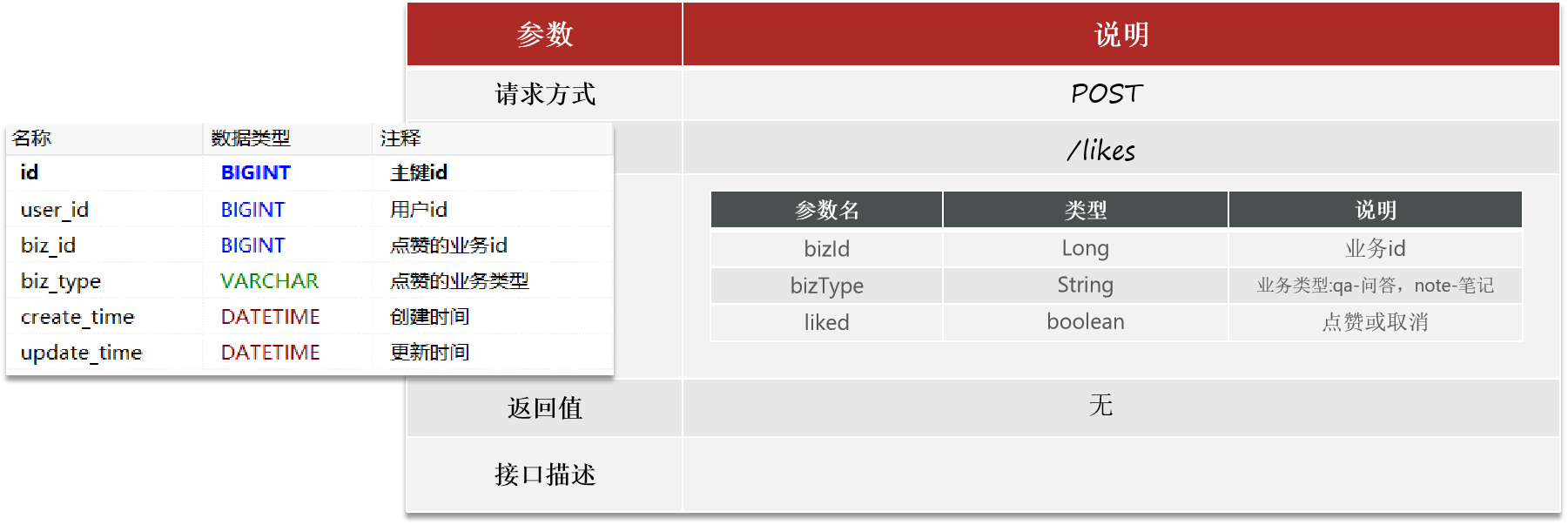
Controller 层:
xxxxxxxxxxpackage com.tianji.remark.controller;
(tags = "点赞相关接口")("/likes")public class LikedRecordController { ("点赞或取消") () public void addLikeRecord( LikeRecordFormDTO dto){ likedRecordService.addLikeRecord(dto); }}Service 层:
xxxxxxxxxxprivate final StringRedisTemplate redisTemplate;private final RabbitMqHelper mqHelper;
public void addLikeRecord(LikeRecordFormDTO recordDTO) { // 1. 根据 liked 执行点赞或取消 boolean success = recordDTO.getLiked() ? like(recordDTO) : unlike(recordDTO); // 2. 如果执行失败,则返回 if (!success) return; // 3. 如果执行成功,则统计点赞数 Integer likedTimes = lambdaQuery() // select count(*) from liked_record where biz_id = #{BizId} .eq(LikedRecord::getBizId, recordDTO.getBizId()).count(); // 4. 发送 MQ 通知 mqHelper.send( // send("{bizType}.times.changed", LikedTimesDTO) LIKE_RECORD_EXCHANGE,StringUtils.format(LIKED_TIMES_KEY_TEMPLATE, recordDTO.getBizType()), LikedTimesDTO.of(recordDTO.getBizId(), likedTimes));}
private boolean like(LikeRecordFormDTO recordDTO) { // 1. 查询点赞记录 Long userId = UserContext.getUser(); Integer count = lambdaQuery() // select count(*) from liked_record .eq(LikedRecord::getUserId, userId) // where user_id = #{UserId} .eq(LikedRecord::getBizId, recordDTO.getBizId()).count(); // and biz_id = #{BizId} // 2. 如果已存在,则执行失败 if (count > 0) return false; // 3. 如果不存在,则执行成功 LikedRecord r = new LikedRecord(); r.setUserId(userId); r.setBizId(recordDTO.getBizId()); r.setBizType(recordDTO.getBizType()); save(r); return true;}
private boolean unlike(LikeRecordFormDTO recordDTO) { return remove( new QueryWrapper<LikedRecord>().lambda() // select * from liked_record .eq(LikedRecord::getUserId, UserContext.getUser()) // where user_id = #{UserId} .eq(LikedRecord::getBizId, recordDTO.getBizId())); // and biz_id = #{BizId}}远程调用接口:
xxxxxxxxxxpackage com.tianji.common.autoconfigure.mq;
public <T> void send(String exchange, String routingKey, T t) {    log.debug("准备发送消息,exchange:{}, RoutingKey:{}, message:{}", exchange, routingKey, t);    // 1. 设置消息标示,用于消息确认,消息发送失败直接抛出异常,交给调用者处理    String id = UUID.randomUUID().toString(true);    CorrelationData correlationData = new CorrelationData(id);    // 2. 设置发送超时时间为 500 毫秒    rabbitTemplate.setReplyTimeout(500);    // 3. 发送消息,同时设置消息 id    rabbitTemplate.convertAndSend(exchange, routingKey, t, processor, correlationData);}
5.2.2 查询点赞状态
需求:业务微服务有查询点赞状态的需求,要求:
编写查询点赞状态的接口
提供对应的 FeignClient
改造
分页查询回答或评论接口,判断用户是否点赞并返回
Controller 层:
xxxxxxxxxxpackage com.tianji.remark.controller;
("list")("查询指定业务id的点赞状态")public Set<Long> isBizLiked(("bizIds") List<Long> bizIds){ return likedRecordService.isBizLiked(bizIds);}Service 层:
xxxxxxxxxxpublic Set<Long> isBizLiked(List<Long> bizIds) { Long userId = UserContext.getUser(); List<LikedRecord> list = lambdaQuery() // select * from liked_record .in(LikedRecord::getBizId, bizIds) // where biz_id in (#{bizIds}) .eq(LikedRecord::getUserId, userId).list(); // and user_id = #{userId}; return list.stream().map(LikedRecord::getBizId).collect(Collectors.toSet()); // set(#{bizIds})}暴露 Feign 接口:
由于该接口是给其它微服务调用的,所以必须暴露出 Feign 客户端,并且定义好 fallback 降级处理:
xxxxxxxxxxpackage com.tianji.api.client.remark;
(value = "remark-service", fallbackFactory = RemarkClientFallBack.class)public interface RemarkClient { ("/likes/list") Set<Long> getLikedStatusByBizList(("bizIds") Iterable<Long> bizIds);}xxxxxxxxxxpackage com.tianji.api.client.remark.fallback;
public class RemarkClientFallBack implements FallbackFactory<RemarkClient> { public RemarkClient create(Throwable cause) { log.info("调用点赞服务失败,原因是:{}", cause.getMessage()); return new RemarkClient(){ public Set<Long> getLikedStatusByBizList(Iterable<Long> bizIds) {return null;} }; }}由于每个微服务扫描包不一致,因此我们需要通过 SpringBoot 的自动加载机制来加载这些 fallback 类:
xxxxxxxxxxpackage com.tianji.api.config;
public class FallbackConfig { public LearningClientFallback learningClientFallback(){return new LearningClientFallback();} public TradeClientFallback tradeClientFallback(){return new TradeClientFallback();} public RemarkClientFallback remarkClientFallback(){return new RemarkClientFallback();}}xxxxxxxxxx# META-INF/spring.factories
org.springframework.boot.autoconfigure.EnableAutoConfiguration= \ com.tianji.api.config.FallbackConfig改造
分页查询回答或评论接口:
xxxxxxxxxxprivate final RemarkClient remarkClient;
public PageDTO<ReplyVO> queryReplyOrAnswerPage(ReplyPageQuery query, Boolean isAdmin) { // 3.查询用户点赞状态(入参是当前分页的评论 id 集合,出参是当前分页被点过赞的评论 id 集合) Set<Long> bizLiked = remarkClient.getLikedStatusByBizList(replyIds);}5.2.3 监听点赞数变更的消息
需求:在学习服务添加 MQ 监听器,监听点赞数变更的消息,更新回答的点赞数量。

xxxxxxxxxxpackage com.tianji.learning.mq;
public class LikeTimesChangeListener { private final IInteractionReplyService replyService;
(bindings = ( value = (name = "qa.liked.times.queue", durable = "true"), exchange = (name = LIKE_RECORD_EXCHANGE, type = ExchangeTypes.TOPIC), key = QA_LIKED_TIMES_KEY )) public void listenReplyLikedTimesChange(LikedTimesDTO dto){ log.debug("监听到回答或评论{}的点赞数变更:{}", dto.getBizId(), dto.getLikedTimes()); InteractionReply r = new InteractionReply(); r.setId(dto.getBizId()); r.setLikedTimes(dto.getLikedTimes()); replyService.updateById(r); }}远程调用接口:
xxxxxxxxxxpackage com.tianji.learning.service;
public interface IInteractionReplyService extends IService<InteractionReply> {}
5.3 点赞功能改进
5.3.1 改进思路分析
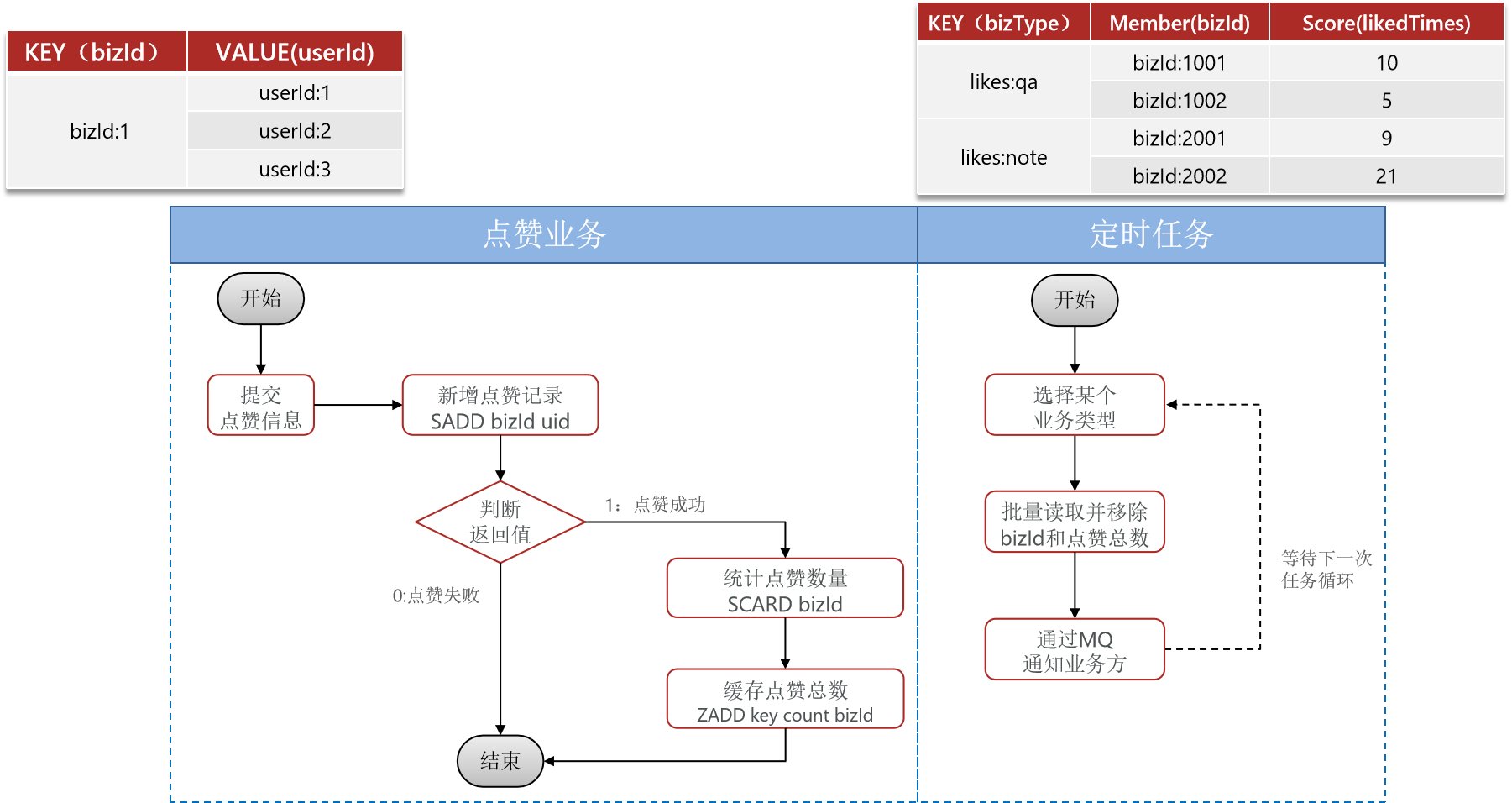
5.3.2 改造点赞功能
5.3.2.1 点赞或取消
xxxxxxxxxxpublic void addLikeRecord(LikeRecordFormDTO recordDTO) { // 3. 如果执行成功,则统计点赞总数 Long likedTimes = redisTemplate.opsForSet() // SIZE bizId bizId .size(RedisConstants.LIKES_BIZ_KEY_PREFIX + recordDTO.getBizId()); // 4. 缓存点赞总数到 Redis redisTemplate.opsForZSet().add( // ADD bizType bizId likedTimes RedisConstants.LIKES_TIMES_KEY_PREFIX + recordDTO.getBizType(), recordDTO.getBizId().toString(), likedTimes);}5.3.2.2 查询点赞状态
当我们判断某用户是否点赞时,需要使用下面命令:SISMEMBER bizId userId。
但这个命令只能判断一个用户对某一个业务的点赞状态。而我们的接口是要查询当前用户对多个业务的点赞状态。
Redis 中提供了一个功能 Pipeline,可以在一次请求中执行多个命令,实现批处理效果:
xxxxxxxxxxpublic Set<Long> isBizLiked(List<Long> bizIds) { // 2. 查询点赞状态 List<Object> objects = redisTemplate.executePipelined((RedisCallback<Object>) connection -> { StringRedisConnection src = (StringRedisConnection) connection; for (Long bizId : bizIds) { // SISMEMBER bizId userId src.sIsMember(RedisConstants.LIKES_BIZ_KEY_PREFIX + bizId, userId.toString()); } return null; }); // 3. 返回结果 return IntStream.range(0, objects.size()) // 创建从 0 到集合 size 的流 .filter(i -> (boolean) objects.get(i)) // 遍历每个元素,保留结果为 true 的角标 i .mapToObj(bizIds::get) // 根据 i 取 bizIds 的数据,即点赞过的 id .collect(Collectors.toSet()); // 封装为 set 集合}5.3.2.3 定时任务
定时任务的实现方案有很多,简单的例如:SpringTask、Quartz。
还有一些依赖第三方服务的分布式任务框架:Elastic-Job、XXL-Job。此处使用简单的 SpringTask 来实现并测试效果。
在 tj-remark 模块的启动类上添加注解:
xxxxxxxxxx // 其作用就是启用 Spring 的定时任务功能定义一个定时任务处理器类:
xxxxxxxxxxpackage com.tianji.remark.task;
public class LikedTimesCheckTask { // 由于可能存在多个业务类型,不能厚此薄彼只处理部分业务。所以我们会遍历多种业务类型,分别处理。 private static final List<String> BIZ_TYPES = List.of("QA", "NOTE"); // 为了避免一次处理的业务过多,这里设定了每次处理的业务数量为30,当然这些都是可以调整的。 private static final int MAX_BIZ_SIZE = 30; private final ILikedRecordService recordService;
(fixedDelay = 20000) public void checkLikedTimes(){ for (String bizType : BIZ_TYPES) { recordService.readLikedTimesAndSendMessage(bizType, MAX_BIZ_SIZE); } }}调用接口:
xxxxxxxxxxpackage com.tianji.remark.service.impl;
public void readLikedTimesAndSendMessage(String bizType, int maxBizSize) { // 1. 读取并移除 Redis 中缓存的点赞总数 String key = RedisConstants.LIKES_TIMES_KEY_PREFIX + bizType; Set<ZSetOperations.TypedTuple<String>> tuples = redisTemplate.opsForZSet().popMin(key, maxBizSize); if (CollUtils.isEmpty(tuples)) return; // 2. 数据转换 List<LikedTimesDTO> list = new ArrayList<>(tuples.size()); for (ZSetOperations.TypedTuple<String> tuple : tuples) { String bizId = tuple.getValue(); Double likedTimes = tuple.getScore(); if (bizId == null || likedTimes == null) continue; list.add(LikedTimesDTO.of(Long.valueOf(bizId), likedTimes.intValue())); } // 3. 发送 MQ 消息 mqHelper.send( LIKE_RECORD_EXCHANGE, StringUtils.format(LIKED_TIMES_KEY_TEMPLATE, bizType), list);}5.3.2.4 监听点赞数变更的信息
xxxxxxxxxxpackage com.tianji.learning.mq;
public class LikeTimesChangeListener {    public void listenReplyLikedTimesChange(List<LikedTimesDTO> likedTimesDTOs){        log.debug("监听到回答或评论的点赞数变更");        List<InteractionReply> list = new ArrayList<>(likedTimesDTOs.size());        for (LikedTimesDTO dto : likedTimesDTOs) {            InteractionReply r = new InteractionReply();            r.setId(dto.getBizId());            r.setLikedTimes(dto.getLikedTimes());            list.add(r);        }        replyService.updateBatchById(list);    }}
5.4 面试题
5.4.1 你负责点赞系统的设计和开发,那能不能讲讲是如何设计的?
答:首先在设计之初我们分析了一下点赞业务可能需要的一些要求。
在我们项目中需要用到点赞的业务不止一个,因此点赞系统必须具备通用性,独立性,不能跟具体业务耦合。
点赞业务可能会有较高的并发,我们要考虑到高并发写库的压力问题。(此处停顿,等待追问)
具体实现细节:
我们将点赞功能抽离出来作为独立服务,当然服务中除了点赞功能以外,还有与之关联的评价功能,不过这部分我没有参与了。
在数据层面也会用业务类型对不同点赞数据做隔离。从具体实现上来说,为了减少数据库压力:
首先利用 Redis 来保存点赞记录、点赞数量。然后,利用定时任务将点赞数量同步给业务方,持久化到数据库中。
5.4.2 那你们 Redis 中具体使用了哪种数据结构呢?
答:我们使用了两种数据结构,SET 和 ZSET。
首先保存点赞记录,使用了 set 结构,key 是
业务type + 业务id,value 是点赞的用户id。当用户点赞就用
SADD,当用户取消点赞就用SREM,当判断是否点赞就用SISMEMBER,当统计点赞数量时就用SCARD。而 SET 结构在头信息中保存元素数量,因此 SCARD 直接读取该值,时间复杂度
O(1),性能非常好。(此处停顿,等待追问)
为什么不让用户 id 为 key,业务 id 为 value 呢?如果用户量很大,可能出现 BigKey 吧?
答:考虑到我们的项目数据量并不会很大,因此点赞数量通常不会超过 1000,因此不会出现 BigKey。
但如果考虑到有大用户量的场景,有两种选择:一种是选择您说的这种方案;
另一种则是对用户 id 做 hash 分片,将大 V 的 key 进行拆分,结构为
业务type + 业务id + 用户id高8位。不过页面需要判断用户有没有对某些业务点赞,会传来多个业务 id 的集合,而
SISMEMBER只能一次判断一个业务的点赞状态。要判断多个业务的点赞状态,就必须多次调用命令,与 Redis 多次交互,这显然是不合适的。(此处停顿,等待追问)
所以,我们就采用了
Pipeline管道方式,这样就可以一次请求实现多个业务点赞状态的判断了。
那你 ZSET 干什么用的?
答:如果只有 SET,我们没办法知道哪些业务的点赞数发生了变化。因此,我们用 ZSET 来记录点赞数变化的业务及对应的点赞总数。
可以理解为一个待持久化的点赞任务队列。每当业务被点赞,不仅要缓存点赞记录,还要把 业务id 及 点赞总数 写入 ZSET。
这样定时任务开启时,只需要从 ZSET 中获取并移除数据,然后发送 MQ 给业务方,并持久化到数据库即可。
5.4.3 为什么一定要用 ZSET 结构,把更新过的业务扔到一个 List 不行吗?
答:扔到 List 结构中虽然也能实现,但是存在一些问题:
一个业务如果在定时间隔内多次被点赞,那就会多次向 List 中添加点赞总数,数据库也要持久化多次,但只有最后一次才有效。
而使用 ZSET 是因为
member的唯一性,多次添加会覆盖旧的点赞数量,最终只会持久化一次。(此处停顿,等待追问)
那就改为 SET 结构,SET 中只放业务 id,业务方收到 MQ 通知后再次查询不就行了。
答:这样会导致多次网络通信,增加系统网络负担。而 ZSET 则可以同时保存业务 id 及最新点赞数量,避免多次网络查询。
Day06 - 积分系统
6.1 分析产品原型
6.1.1 接口统计
| 业务 | 编号 | 接口简述 |
|---|---|---|
| 签到 | 1 | 签到 |
| 2 | 查询签到记录 | |
| 积分 | 3 | 新增积分记录 |
| 4 | 查询今日积分情况 | |
| 5 | 查询赛季列表 | |
| 排行榜 | 6 | 查询实时赛季积分榜 |
| 7 | 查询历史赛季积分榜 |
6.1.2 数据结构
签到记录:
xxxxxxxxxxCREATE TABLE `sign_record` ( `id` bigint NOT NULL AUTO_INCREMENT COMMENT '主键', `user_id` bigint NOT NULL COMMENT '用户id', `year` year NOT NULL COMMENT '签到年份', `month` tinyint NOT NULL COMMENT '签到月份', `date` date NOT NULL COMMENT '签到日期', `is_backup` bit(1) NOT NULL COMMENT '是否补签', PRIMARY KEY (`id`),) ENGINE=InnoDB DEFAULT CHARSET=utf8mb4 COMMENT='签到记录表';积分记录:
xxxxxxxxxxCREATE TABLE `points_record` ( `id` BIGINT(19) NOT NULL AUTO_INCREMENT COMMENT '积分记录表id', `user_id` BIGINT(19) NOT NULL COMMENT '用户id', `type` TINYINT(3) NOT NULL COMMENT '积分方式:1-课程学习,2-每日签到,3-课程问答, 4-课程笔记,5-课程评价', `points` TINYINT(3) NOT NULL COMMENT '积分值', `create_time` DATETIME NOT NULL DEFAULT CURRENT_TIMESTAMP COMMENT '创建时间', PRIMARY KEY (`id`) USING BTREE)COMMENT='学习积分记录,每个月底清零';排行榜记录:
xxxxxxxxxxCREATE TABLE `points_board` (    `id` BIGINT(19) NOT NULL COMMENT '榜单id',    `user_id` BIGINT(19) NOT NULL COMMENT '学生id',    `points` INT(10) NOT NULL COMMENT '积分值',    `rank` TINYINT(3) NOT NULL COMMENT '名次',    `season` SMALLINT(5) NOT NULL COMMENT '赛季id',    PRIMARY KEY (`id`) USING BTREE)COMMENT='学霸天梯榜';
CREATE TABLE `points_board_season` (    `id` INT(10) NOT NULL AUTO_INCREMENT COMMENT '自增长id,season标示',    `name` VARCHAR(32) NULL DEFAULT NULL COMMENT '赛季名称,例如:第1赛季',    `begin_time` DATE NOT NULL COMMENT '赛季开始时间',    `end_time` DATE NOT NULL COMMENT '赛季结束时间',    PRIMARY KEY (`id`) USING BTREE)ENGINE=InnoDB;
6.2 签到功能
6.2.1 思路分析
我们按月来统计用户签到信息,签到记录为 1,未签到则记录为 0。 把每一个 bit 位对应当月的每一天,形成了映射关系。用 0 和 1 标示业务状态,这种思路就称为位图(BitMap)。
Redis 中提供了 BitMap 数据结构,并且提供了很多操作 bit 的命令。 BitMap 基于 String 结构,而 String 类型的最大空间是 512MB(2^31 个 bit),因此保存数据的量级是十分恐怖的。
修改 BitMap 中的数据:
xxxxxxxxxxSETBIT bm 0 1 # 第 1 天签到SETBIT bm 7 1 # 第 8 天签到读取 BitMap 中的数据:
xxxxxxxxxx# 例:bm = 10110000, 查询从第 1~4 天的签到记录:BITFIELD bm GET u4 0 # 无符号数,返回 (1011)2 = 11BITFIELD bm GET i4 0 # 有符号数,返回 (1101)2 = -56.2.2 签到
需求:在个人中心的积分页面,每天都可以签到一次,连续签到有积分奖励。请实现签到接口,记录用户每天签到信息。
Controller 层:
xxxxxxxxxxpackage com.tianji.learning.controller;
(tags = "签到相关接口")("sign-records")public class SignRecordController { ("签到接口") public SignResultVO addSignRecords(){ return recordService.addSignRecords(); }}Service 层:
xxxxxxxxxxpublic SignResultVO addSignRecords() { // 1. 签到 Long userId = UserContext.getUser(); LocalDate now = LocalDate.now(); // key = sign:uid:userId:yyyyMM String key = RedisConstants.SIGN_RECORD_KEY_PREFIX + userId + now.format(DateUtils.SIGN_DATE_SUFFIX_FORMATTER); int offset = now.getDayOfMonth() - 1; // offset Boolean exists = redisTemplate.opsForValue().setBit(key, offset, true); if (BooleanUtils.isTrue(exists)) { // SETBIT key offset true throw new BizIllegalException("不允许重复签到!"); } // 2. 计算连续签到天数 int signDays = countSignDays(key, now.getDayOfMonth()); // 3. 计算签到得分 int rewardPoints = 0; switch (signDays) { case 7: // 连续签到一周, 奖励积分 10 rewardPoints = 10; break; case 14: // 连续签到两周, 奖励积分 20 rewardPoints = 20; break; case 28: // 连续签到四周, 奖励积分 40 rewardPoints = 40; break; } // TODO 4. 保存积分明细记录
// 5. 封装 VO 并返回 SignResultVO vo = new SignResultVO(); vo.setSignDays(signDays); vo.setRewardPoints(rewardPoints); return vo;}xxxxxxxxxxprivate int countSignDays(String key, int len) { // 1. 获取本月从第一天开始,到今天为止的所有签到记录 List<Long> result = redisTemplate.opsForValue().bitField(key, BitFieldSubCommands.create().get(BitFieldSubCommands.BitFieldType.unsigned(len)).valueAt(0)); if (CollUtils.isEmpty(result)) { // BITFIELD key GET ulen 0 return 0; } // 例: len = 8, result = {00010111, ...} int num = result.get(0).intValue(); int count = 0; // num = 00010111 // 2. 循环与 1 做与运算,判断最后一个 bit,为 0 则终止 while ((num & 1) == 1) { count++; num >>>= 1; } return count; // count = 3, 即连续签到3天}6.2.3 查询签到记录
需求:在个人中心,我的积分页面需要展示用户的签到记录。设计一个接口,返回当前用户本月到今天为止的所有签到记录。
Controller 层:
xxxxxxxxxxpackage com.tianji.learning.controller;
("查询签到记录接口")public Deque<Integer> querySignRecords(){ return recordService.querySignRecords();}Service 层:
xxxxxxxxxxpublic Deque<Integer> querySignRecords() { // 1. 获取登录用户 Long user = UserContext.getUser(); // 2. 获取 key = sign:uid:userId:yyyyMM LocalDate now = LocalDate.now(); String format = now.format(DateTimeFormatter.ofPattern(":yyyyMM")); String key = RedisConstants.SIGN_RECORD_KEY_PREFIX + user + format; // 3. 获取本月签到记录 Deque<Integer> list = getDaysOfMonth(now.getDayOfMonth(), key); return list;}xxxxxxxxxxprivate Deque<Integer> getDaysOfMonth(String key, int len) { // 1. 获取 bitMap 记录值 List<Long> list = redisTemplate.opsForValue().bitField(key, // BITFIELD key GET ulen 0 BitFieldSubCommands.create().get(BitFieldSubCommands.BitFieldType.unsigned(len)).valueAt(0)); Long num = list.get(0); // 例:len = 8, num = 00010111 // 2. Long 值转 List<Integer> String s = Long.toBinaryString(num); Deque<Integer> arr = new LinkedList<>(); // s = "10111", s.length() = 5 for (char c : s.toCharArray()) { arr.addLast(c == '1'? 1 : 0); } for(int i=0; i<len - s.length(); i++){ // i: 0 -> 2 arr.addFirst(0); } return arr; // arr = [0,0,0,1,0,1,1,1]}6.3 积分功能
6.3.1 新增积分记录
6.3.1.1 思路分析
需求:用户签到、学习、回答问题、写笔记、笔记被采集等行为都可以产生积分,并基于积分形成排行榜。
虽然我们积分功能目前是在学习中心实现的,不过考虑的以后的扩展性,此处我们还是考虑使用 MQ 来实现异步解耦:
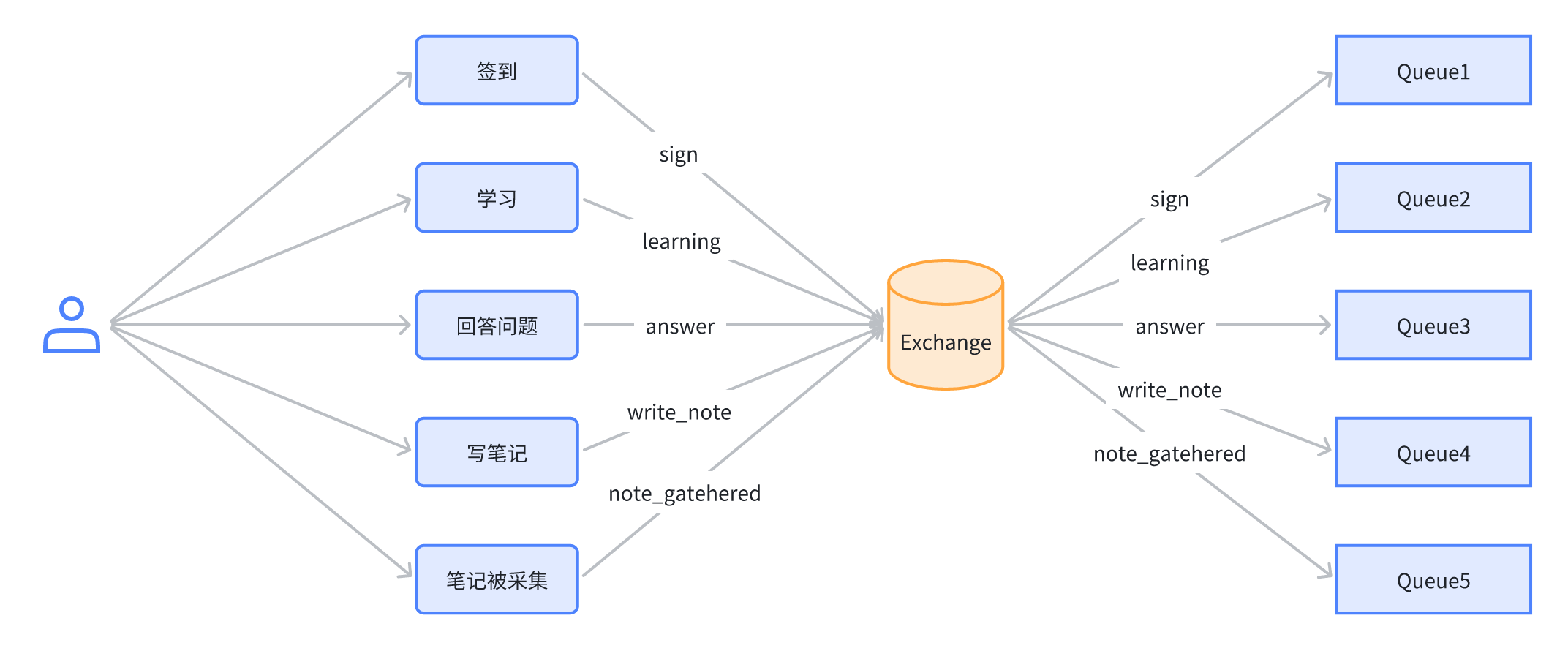
6.3.1.2 发送MQ消息
先定义一个 MQ 消息体:
xxxxxxxxxxpackage com.tianji.learning.mq.message;
(staticName = "of")public class SignInMessage { private Long userId; private Integer points;}然后改造签到功能:
xxxxxxxxxxprivate final RabbitMqHelper mqHelper;
public SignResultVO addSignRecords() { // 4. 保存积分明细记录 mqHelper.send( MqConstants.Exchange.LEARNING_EXCHANGE, // learning.topic MqConstants.Key.SIGN_IN, // key = sign.in SignInMessage.of(userId, rewardPoints + 1)); // message = (userId, points)}6.3.1.3 编写消息监听器
xxxxxxxxxxpackage com.tianji.learning.mq;
public class LearningPointsListener { // 监听回答问题事件, 积分 +5 (bindings = ( value = (name = "qa.points.queue", durable = "true"), exchange = (name = MqConstants.Exchange.LEARNING_EXCHANGE, type = ExchangeTypes.TOPIC), key = MqConstants.Key.WRITE_REPLY // key = reply.new, learning.topic, message = (userId) )) public void listenWriteReplyMessage(Long userId){ recordService.addPointsRecord(userId, 5, PointsRecordType.QA); }
// 监听签到事件, 积分 +points (bindings = ( value = (name = "sign.points.queue", durable = "true"), exchange = (name = MqConstants.Exchange.LEARNING_EXCHANGE, type = ExchangeTypes.TOPIC), key = MqConstants.Key.SIGN_IN // key = sign.in, learning.topic, message = (userId, points) )) public void listenSignInMessage(SignInMessage message){ recordService.addPointsRecord(message.getUserId(), message.getPoints(), PointsRecordType.SIGN); }}6.3.1.4 保存积分明细
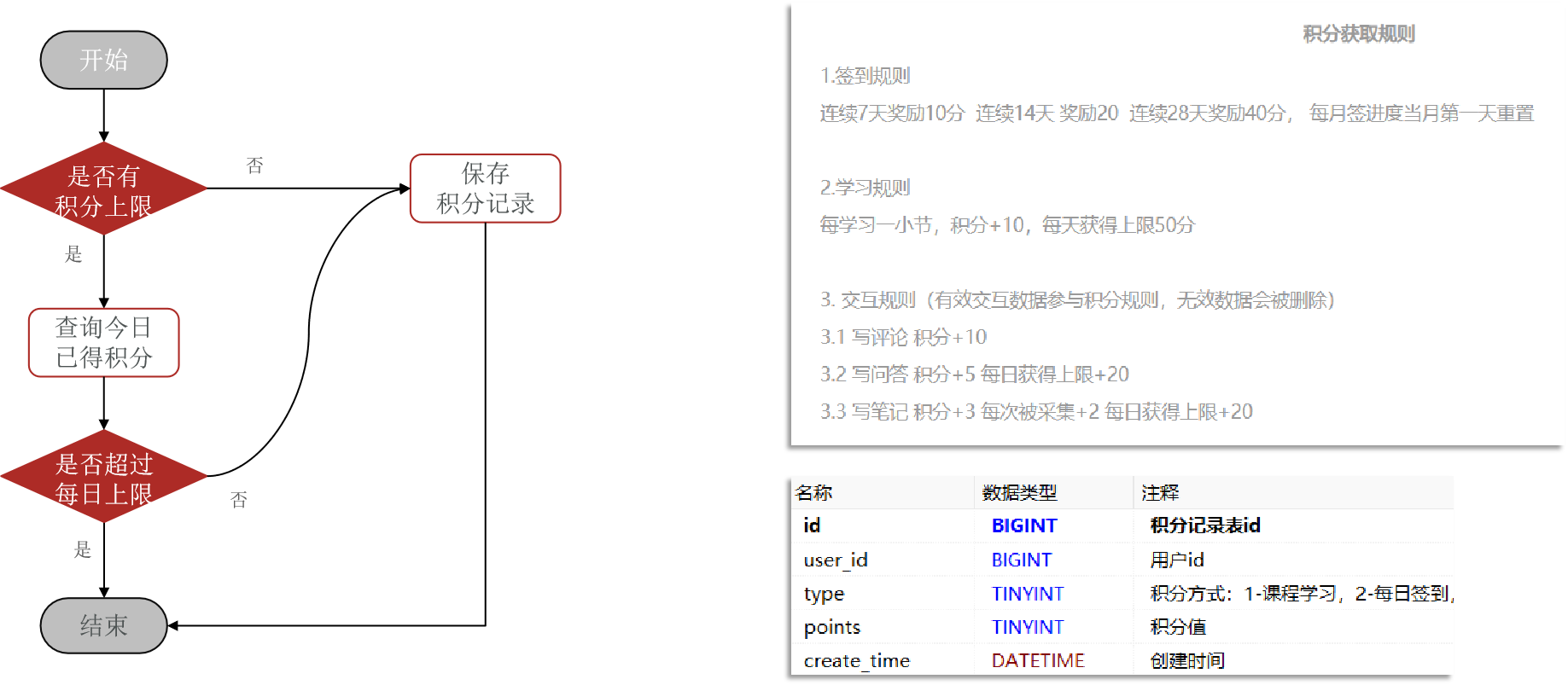
Service 层:
xxxxxxxxxxpublic void addPointsRecord(Long userId, int points, PointsRecordType type) { // 1. 判断是否有积分上限 LocalDateTime now = LocalDateTime.now(); int maxPoints = type.getMaxPoints(); int realPoints = points; if(maxPoints > 0) { // 2. 有积分上限,则查询今日已得积分 LocalDateTime begin = DateUtils.getDayStartTime(now); LocalDateTime end = DateUtils.getDayEndTime(now); int currentPoints = queryUserPointsByTypeAndDate(userId, type, begin, end); // 3. 判断是否超过每日上限 if(currentPoints >= maxPoints) { return; } if(points + currentPoints > maxPoints){ realPoints = maxPoints - currentPoints; } } // 4. 没有积分上限,则直接保存积分记录 PointsRecord p = new PointsRecord(); p.setPoints(realPoints); p.setUserId(userId); p.setType(type); save(p);}xxxxxxxxxxprivate int queryUserPointsByTypeAndDate( Long userId, PointsRecordType type, LocalDateTime begin, LocalDateTime end) { QueryWrapper<PointsRecord> wrapper = new QueryWrapper<>(); wrapper.lambda() // select * from points_record .eq(PointsRecord::getUserId, userId) // where user_id = #{userId} .eq(type != null, PointsRecord::getType, type) // and type is not null and type = #{type} // and begin is not null and end is not null and createTime between begin and end; .between(begin != null && end != null, PointsRecord::getCreateTime, begin, end); Integer points = getBaseMapper().queryUserPointsByTypeAndDate(wrapper); return points == null ? 0 : points; // SELECT SUM(points) FROM points_record ${wrapper}}Mapper 层:
xxxxxxxxxxpublic interface PointsRecordMapper extends BaseMapper<PointsRecord> { ("SELECT SUM(points) FROM points_record ${ew.customSqlSegment}") Integer queryUserPointsByTypeAndDate((Constants.WRAPPER) QueryWrapper<PointsRecord> wrapper);}6.3.2 查询今日积分情况
需求:在个人中心,用户可以查看当天各种不同类型的已获得的积分和积分上限。
Controller 层:
xxxxxxxxxxpackage com.tianji.learning.controller;
("查询今日积分情况")("today")public List<PointsStatisticsVO> queryMyPointsToday(){ return pointsRecordService.queryMyPointsToday();}Service 层:
xxxxxxxxxxpublic List<PointsStatisticsVO> queryMyPointsToday() { // 1. 查询今日积分情况 Long userId = UserContext.getUser(); LocalDateTime now = LocalDateTime.now(); LocalDateTime begin = DateUtils.getDayStartTime(now); LocalDateTime end = DateUtils.getDayEndTime(now); QueryWrapper<PointsRecord> wrapper = new QueryWrapper<>(); wrapper.lambda() // select * from points_record .eq(PointsRecord::getUserId, userId) // where user_id = #{userId} .between(PointsRecord::getCreateTime, begin, end); // and createTime between begin and end; List<PointsRecord> list = getBaseMapper().queryUserPointsByDate(wrapper); // SELECT type, SUM(points) AS points FROM points_record ${wrapper} GROUP BY type if (CollUtils.isEmpty(list)) { return CollUtils.emptyList(); } // 2. 封装 VO 集合并返回 List<PointsStatisticsVO> vos = new ArrayList<>(list.size()); for (PointsRecord p : list) { PointsStatisticsVO vo = new PointsStatisticsVO(); vo.setType(p.getType().getDesc()); vo.setMaxPoints(p.getType().getMaxPoints()); vo.setPoints(p.getPoints()); vos.add(vo); } return vos;}Mapper 层:
xxxxxxxxxxpublic interface PointsRecordMapper extends BaseMapper<PointsRecord> { ("SELECT type, SUM(points) AS points FROM points_record ${ew.customSqlSegment} GROUP BY type") List<PointsRecord> queryUserPointsByDate((Constants.WRAPPER) QueryWrapper<PointsRecord> wrapper);}6.3.3 查询赛季列表
需求:在历史赛季榜单中,有一个下拉选框,可以选择历史赛季信息。
Controller 层:
xxxxxxxxxxpackage com.tianji.learning.controller;
("/boards")(tags = "积分相关接口")public class PointsBoardController { ("查询赛季信息列表") ("/seasons/list") public List<PointsBoardSeasonVO> queryPointsBoardSeasons(){ List<PointsBoardSeason> list = seasonService .lambdaQuery().lt(PointsBoardSeason::getBeginTime, LocalDateTime.now()).list(); if(CollUtils.isEmpty(list)){ return CollUtils.emptyList(); } return BeanUtils.copyList(list, PointsBoardSeasonVO.class); }}Service 层:
xxxxxxxxxxpublic class PointsBoardSeasonServiceImpl extends ServiceImpl<PointsBoardSeasonMapper, PointsBoardSeason> implements IPointsBoardSeasonService {}Mapper 层:
xxxxxxxxxxpublic interface PointsBoardSeasonMapper extends BaseMapper<PointsBoardSeason> {}6.4 排行榜功能
6.4.1 查询实时赛季积分榜
6.4.1.1 思路分析
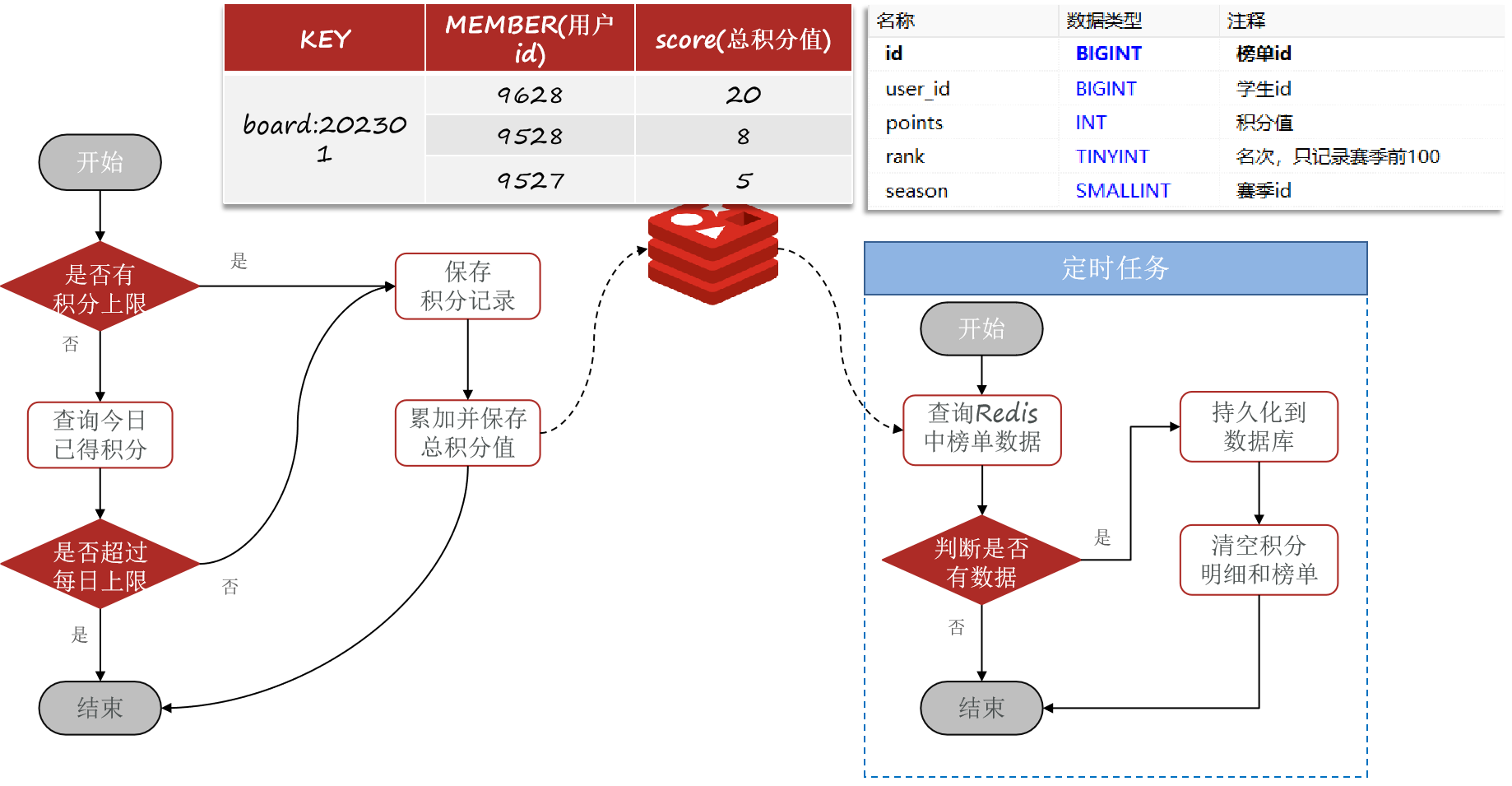
6.4.1.2 生成实时榜单
定义 Redis 的 KEY 前缀:
xxxxxxxxxxpackage com.tianji.learning.constants;
public interface RedisConstants { String POINTS_BORAD_KEY_PREFIX = "boards:";}xxxxxxxxxxpackage com.tianji.common.utils;
public class DateUtils extends LocalDateTimeUtil { public static final DateTimeFormatter POINTS_BOARD_SUFFIX_FORMATTER = DateTimeFormatter.ofPattern("yyyyMM");}修改
保存积分明细接口:
xxxxxxxxxxprivate final StringRedisTemplate redisTemplate;
public void addPointsRecord(Long userId, int points, PointsRecordType type) { // 4. 更新总积分到 Redis String key = RedisConstants.POINTS_BOARD_KEY_PREFIX + // key = boards:yyyyMM now.format(DateUtils.POINTS_BOARD_SUFFIX_FORMATTER); // ZINCRBY key realPoints userId redisTemplate.opsForZSet().incrementScore(key, userId.toString(), realPoints);}6.4.1.3 查询实时赛季积分榜
需求:在个人中心,学生可以查看指定赛季积分排行榜(只显示前100 ),还可以查看自己总积分和排名。
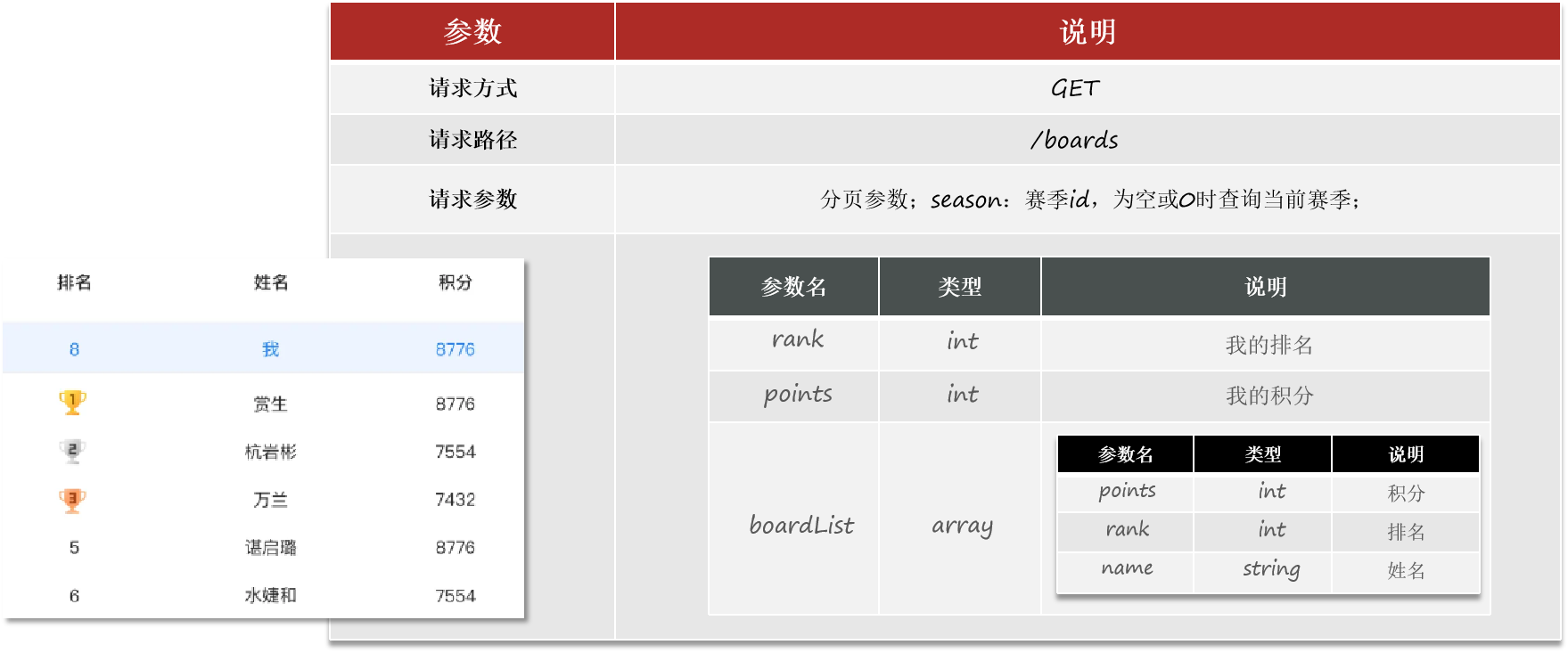
Controller 层:
xxxxxxxxxxpackage com.tianji.learning.controller;
("查询积分榜")public PointsBoardVO queryPointsBoardBySeason(PointsBoardQuery query){ return pointsBoardService.queryPointsBoardBySeason(query);}Service 层:
xxxxxxxxxxprivate final StringRedisTemplate redisTemplate;private final UserClient userClient;
public PointsBoardVO queryPointsBoardBySeason(PointsBoardQuery query) { // 1. 判断是否是查询当前赛季 Long season = query.getSeason(); boolean isCurrent = season == null || season == 0; // 2. 查询我的积分和排名 LocalDateTime now = LocalDateTime.now(); // key = boards:yyyyMM String key = RedisConstants.POINTS_BOARD_KEY_PREFIX + now.format(DateUtils.POINTS_BOARD_SUFFIX_FORMATTER); PointsBoard myBoard = isCurrent ? // 查询当前榜单(Redis): 查询历史榜单(MySQL)TODO queryMyCurrentBoard(key) : queryMyHistoryBoard(season); // 3. 查询榜单列表 List<PointsBoard> list = isCurrent ? // 查询当前榜单列表 : 查询历史榜单列表 TODO queryCurrentBoardList(key, query.getPageNo(), query.getPageSize()) : queryHistoryBoardList(query); // 4. 封装 VO 并返回 PointsBoardVO vo = new PointsBoardVO(); // 4.1. 处理我的信息 if (myBoard != null) { vo.setPoints(myBoard.getPoints()); vo.setRank(myBoard.getRank()); } if (CollUtils.isEmpty(list)) return vo; // 4.2. 查询用户信息 // select * from points_board where user_Id = #{userId} Set<Long> uIds = list.stream().map(PointsBoard::getUserId).collect(Collectors.toSet()); List<UserDTO> users = userClient.queryUserByIds(uIds); Map<Long, String> userMap = new HashMap<>(uIds.size()); if(CollUtils.isNotEmpty(users)) { // userMap = toMap(id, name) userMap = users.stream().collect(Collectors.toMap(UserDTO::getId, UserDTO::getName)); } // 4.3. 封装 VO List<PointsBoardItemVO> items = new ArrayList<>(list.size()); for (PointsBoard p : list) { PointsBoardItemVO v = new PointsBoardItemVO(); v.setPoints(p.getPoints()); v.setRank(p.getRank()); v.setName(userMap.get(p.getUserId())); items.add(v); } vo.setBoardList(items); return vo;}xxxxxxxxxxprivate PointsBoard queryMyCurrentBoard(String key) { BoundZSetOperations<String, String> ops = redisTemplate.boundZSetOps(key); String userId = UserContext.getUser().toString(); Double points = ops.score(userId); // ZSCORE key userId 获取有序集合 Long rank = ops.reverseRank(userId); // ZREVRANK key userId 逆序排名积分 PointsBoard p = new PointsBoard(); p.setPoints(points == null ? 0 : points.intValue()); p.setRank(rank == null ? 0 : rank.intValue() + 1); return p;}xxxxxxxxxxpublic List<PointsBoard> queryCurrentBoardList(String key, Integer pageNo, Integer pageSize) { // 1. 计算分页 int from = (pageNo - 1) * pageSize; // 2. 查询当前榜单列表: ZREVRANGE key from to WITHSCORES Set<ZSetOperations.TypedTuple<String>> tuples = redisTemplate.opsForZSet() .reverseRangeWithScores(key, from, from + pageSize - 1); if (CollUtils.isEmpty(tuples)) { return CollUtils.emptyList(); } // 3. 封装到 list int rank = from + 1; List<PointsBoard> list = new ArrayList<>(tuples.size()); for (ZSetOperations.TypedTuple<String> tuple : tuples) { String userId = tuple.getValue(); Double points = tuple.getScore(); if (userId == null || points == null) continue; PointsBoard p = new PointsBoard(); p.setUserId(Long.valueOf(userId)); p.setPoints(points.intValue()); p.setRank(rank++); list.add(p); } return list;}远程调用接口:
xxxxxxxxxx("/users/list")List<UserDTO> queryUserByIds(("ids") Iterable<Long> ids);6.4.2 查询历史赛季积分榜
6.4.2.1 存储方案

分区:
分区是一种数据存储方案,可以解决单表数据较多的问题。MySQL5.1 开始支持表分区功能。
优点:提高数据检索、统计的性能;打破磁盘容量限制;根据分区清理数据效率高。
缺点:分区字段必须是索引的一部分或全部;分区方式不够灵活;只支持水平分区。
分表:
分表是一种表设计方案,由开发者在创建表时按照自己的业务需求拆分表。
优点:解决了字段多和数据多引起的各种问题;分区方式更灵活。
缺点:需要判断操作哪张表;垂直分表需要处理事务问题、数据关联问题;水平分表要处理聚合操作的数据合并问题。
分库和集群:
按照业务垂直分库
优点:避免了不同服务间数据耦合;请求分流,提高了整体的并发能力。
缺点:热点服务容易出现单点故障;部分库依然存在瓶颈;有分布式事务问题。
主从备份读写分离
优点:解决了海量数据存储的问题;提高了读写并发能力,避免了单点故障。
缺点:分片后数据聚合统计比较复杂;会有主从数据同步问题;存在分布式事务问题。
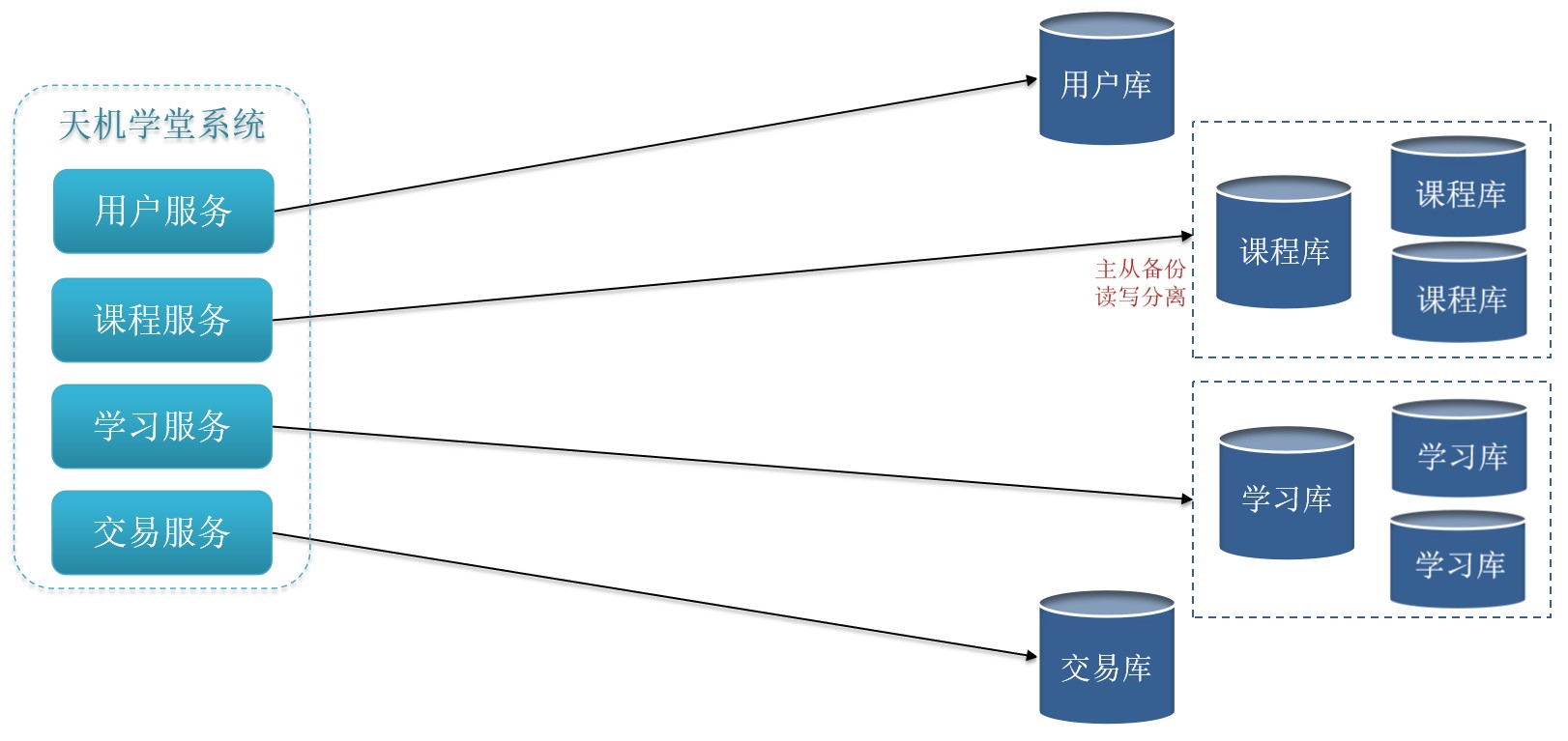
解决单表数据量大的问题有哪些方案?
首先是库内表分区或分表,可以解决大多数问题。如果单个库压力太大,再考虑分库。
水平分库结合分表,实现数据分片。进一步提高数据存储规模。
数据库的读写压力较大,并发较高该怎么办?
首先考虑垂直分表,看看能不能将写频繁的数据与其它数据分离,避免互相影响。
如果不行则考虑搭建主从集群,实现读写分离。
6.4.2.2 存储策略
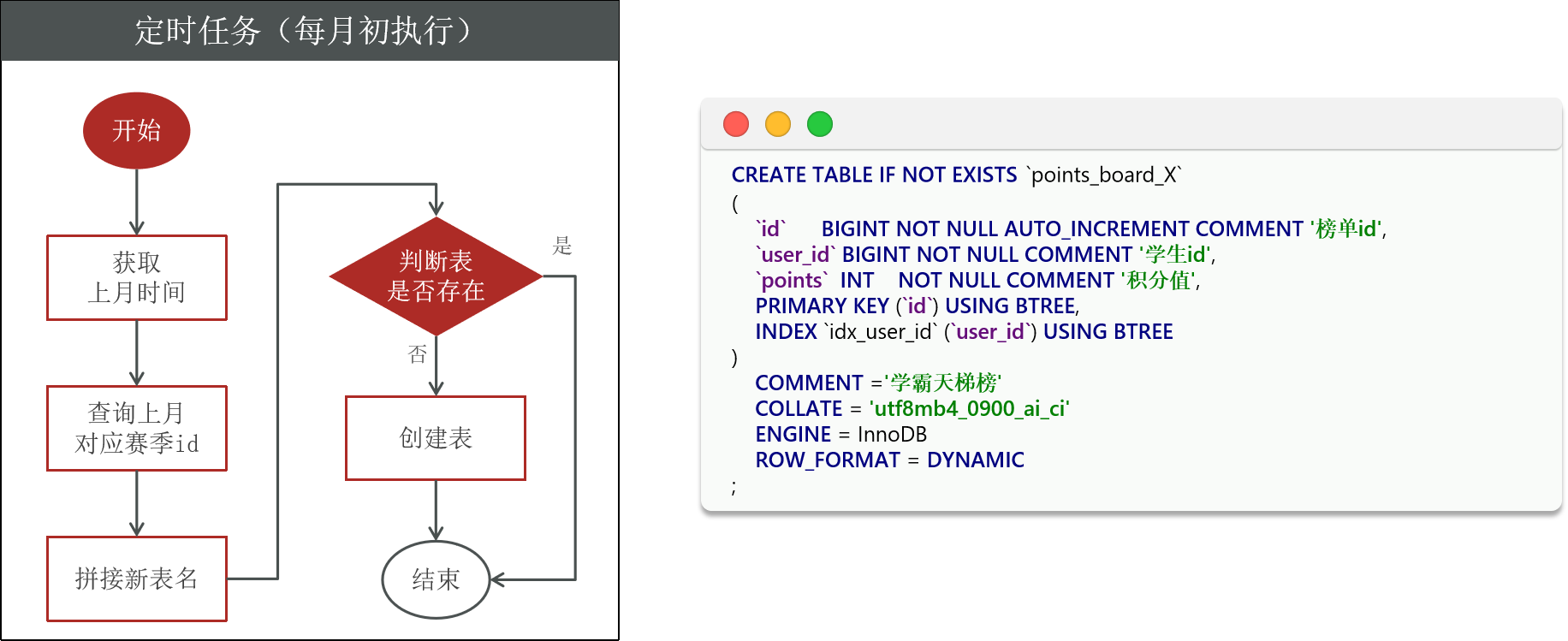
历史榜单数据量单表可能达到数千万,如何解决?
我们按照赛季对历史榜单分表,减少了单表存储量。而且根据赛季查询时只需要读一张表,提高了查询效率。 另外,我们可以按照榜单顺序持久化,采用递增 id,那么榜单 id 就是用户排名。避免了查询时的排序处理,查询效率大大提高。
历史赛季表是如何创建的?
在每个月初通过定时任务调用,完成上一赛季的表创建。
6.4.2.3 定时任务创建表
定时任务:
xxxxxxxxxxpackage com.tianji.learning.handler;
public class PointsBoardPersistentHandler { private final IPointsBoardSeasonService seasonService; private final IPointsBoardService pointsBoardService;
(cron = "0 0 3 1 * ?") // 每月 1 号,凌晨 3 点执行 public void createPointsBoardTableOfLastSeason(){ // 1. 获取上月时间 LocalDateTime time = LocalDateTime.now().minusMonths(1); // 2. 查询赛季 id Integer season = seasonService.querySeasonByTime(time); if (season == null) return; // 3. 创建榜单表 pointsBoardService.createPointsBoardTableBySeason(season); }}查询赛季 id:
xxxxxxxxxxpublic Integer querySeasonByTime(LocalDateTime time) { Optional<PointsBoardSeason> optional = lambdaQuery() // select * from points_board_season .le(PointsBoardSeason::getBeginTime, time) // where begin_time <= #{time} .ge(PointsBoardSeason::getEndTime, time).oneOpt(); // and end_time >= #{time} limit 1 return optional.map(PointsBoardSeason::getId).orElse(null);}创建榜单表:
xxxxxxxxxxpublic void createPointsBoardTableBySeason(Integer season) { getBaseMapper().createPointsBoardTable(POINTS_BOARD_TABLE_PREFIX + season);}Mapper 层:
xxxxxxxxxxvoid createPointsBoardTable(("tableName") String tableName);xxxxxxxxxx<insert id="createPointsBoardTable" parameterType="java.lang.String"> CREATE TABLE `${tableName}` <!-- tableName = points_board_season --> ( `id` BIGINT NOT NULL AUTO_INCREMENT COMMENT '榜单id', `user_id` BIGINT NOT NULL COMMENT '学生id', `points` INT NOT NULL COMMENT '积分值', PRIMARY KEY (`id`) USING BTREE, INDEX `idx_user_id` (`user_id`) USING BTREE ) COMMENT ='学霸天梯榜' COLLATE = 'utf8mb4_0900_ai_ci' ENGINE = InnoDB ROW_FORMAT = DYNAMIC</insert>6.4.2.4 分布式任务调度
XXL-JOB 是一个分布式任务调度平台,其设计目标是开发迅速、学习简单、轻量级、易扩展。已接入多家公司线上产品线,开箱即用。
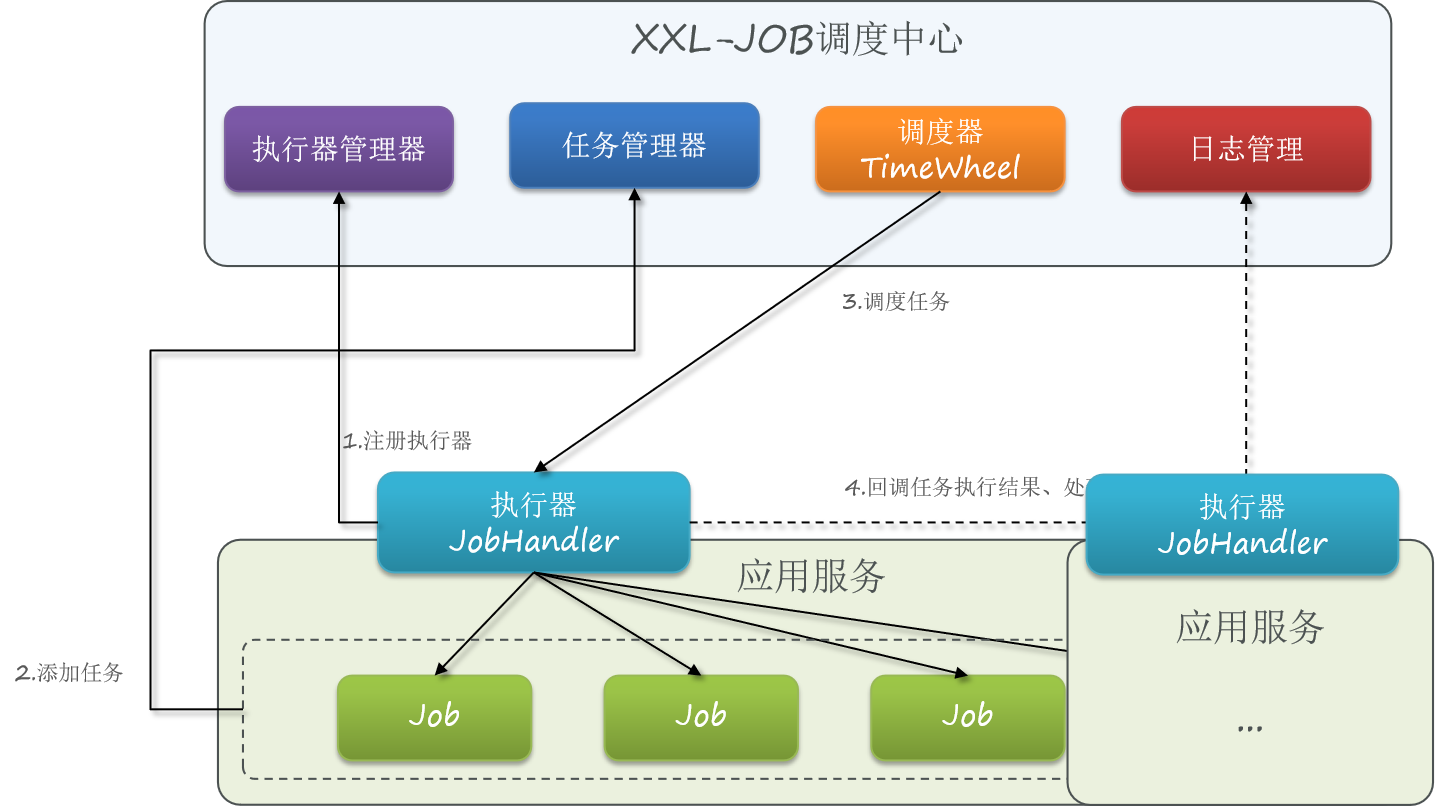
部署调度中心:
运行资料中提供的,初始化 SQL 文件,创建 XXL-JOB 所需表。参考以下 Docker 命令创建容器:
xxxxxxxxxxdocker run -d \-e PARAMS="--spring.datasource.url=jdbc:mysql://192.168.150.101:3306/xxl_job?Unicode=true&characterEncoding=UTF-8 \--spring.datasource.username=root \--spring.datasource.password=123" \--restart=always \-p 8880:8080 \-v xxl-job-admin-applogs:/data/applogs \--name xxl-job-admin \xuxueli/xxl-job-admin:2.3.0集成执行器:
首先引入 XXL-JOB 依赖,配置执行器:(了解)
xxxxxxxxxx<dependency> <groupId>com.xuxueli</groupId> <artifactId>xxl-job-core</artifactId></dependency>xxxxxxxxxxpackage com.tianji.common.autoconfigure.xxljob;
public class XxlJobConfig {...}xxxxxxxxxxpackage com.tianji.common.autoconfigure.xxljob;
public class XxlJobProperties {...}然后,在 PointsBoardPersistentHandler 中将任务的 @Scheduled 注解替换为 @XXLJob 注解:
xxxxxxxxxxpackage com.tianji.learning.task;
("createTableJob")public void createPointsBoardTableOfLastSeason(){...}注册执行器:登录 XXL-JOB 控制台,注册执行器:

配置任务调度:进入任务管理菜单,选中
学习中心执行器,然后新增任务:
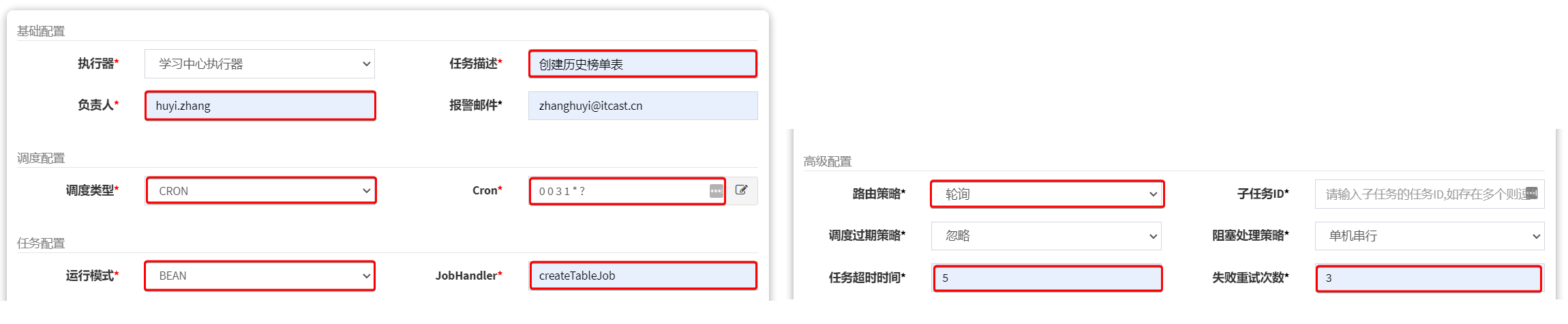
6.4.2.5 榜单持久化
需求:每个月第一天凌晨,将 Redis 中的上月榜单数据持久化到数据库中,并清理 Redis 数据。
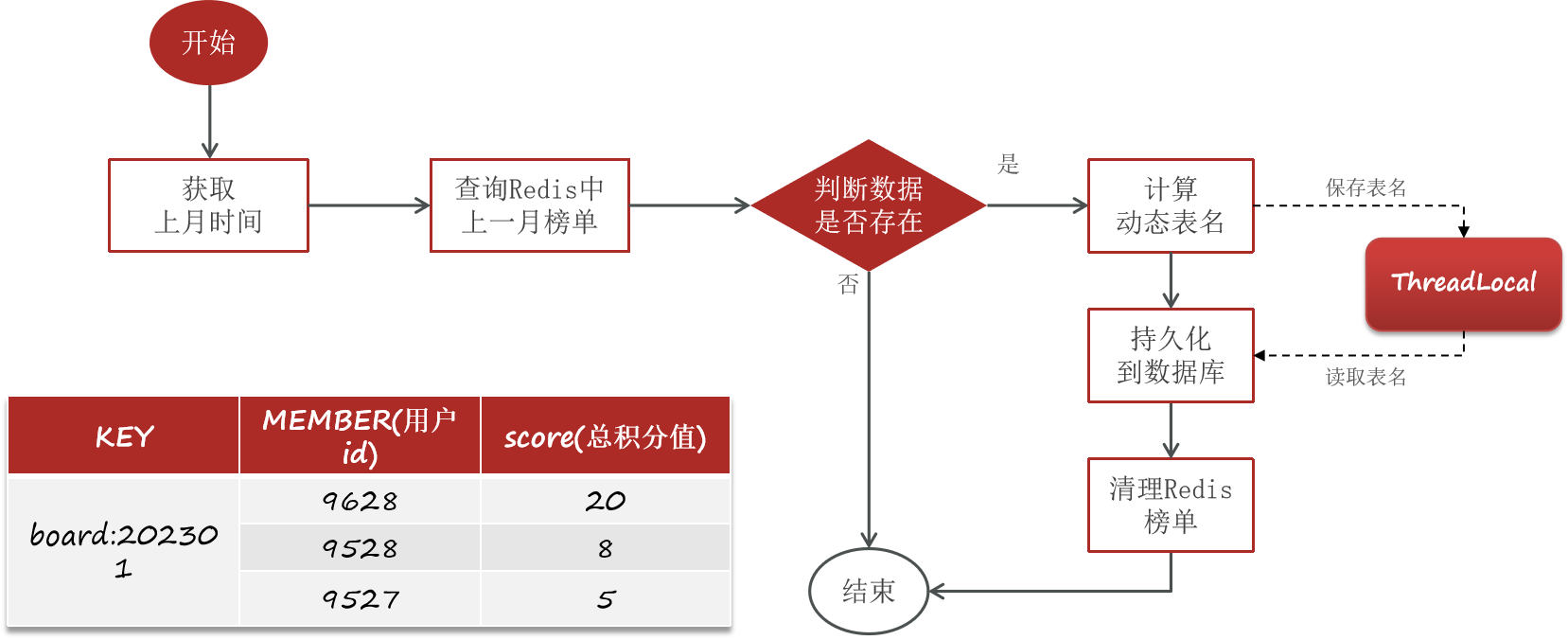
动态表名:
定义一个传递表名称的工具:
xxxxxxxxxxpackage com.tianji.learning.utils;
public class TableInfoContext {    private static final ThreadLocal<String> TL = new ThreadLocal<>();
    public static void setInfo(String info) {TL.set(info);}    public static String getInfo() {return TL.get();}    public static void remove() {TL.remove();}}
定义一个配置类:
xxxxxxxxxxpackage com.tianji.learning.config;
public class MybatisConfiguration { public DynamicTableNameInnerInterceptor dynamicTableNameInnerInterceptor() { // 准备一个Map,用于存储 TableNameHandler Map<String, TableNameHandler> map = new HashMap<>(1); // 存入一个 TableNameHandler,用来替换 points_board 表名称 map.put("points_board", (sql, tableName) -> TableInfoContext.getInfo() == null ? tableName : TableInfoContext.getInfo()); return new DynamicTableNameInnerInterceptor(map); }}修改 MybatisConfig 的拦截器配置:
xxxxxxxxxxpackage com.tianji.common.autoconfigure.mybatis;
public MybatisPlusInterceptor mybatisPlusInterceptor( (required = false) DynamicTableNameInnerInterceptor dynamicTableNameInnerInterceptor) { // 定义插件主体,注意顺序:表名 > 多租户 > 分页 > 乐观锁 > 字段填充 MybatisPlusInterceptor interceptor = new MybatisPlusInterceptor(); if (dynamicTableNameInnerInterceptor != null) { interceptor.addInnerInterceptor(dynamicTableNameInnerInterceptor); } PaginationInnerInterceptor paginationInnerInterceptor = new PaginationInnerInterceptor(DbType.MYSQL); paginationInnerInterceptor.setMaxLimit(200L); interceptor.addInnerInterceptor(paginationInnerInterceptor); //分页插件 interceptor.addInnerInterceptor(new MyBatisAutoFillInterceptor()); //自动填充插件 return interceptor;}定时持久化任务:
xxxxxxxxxxpackage com.tianji.learning.handler;
("savePointsBoard2DB")public void savePointsBoard2DB(){ // 1. 获取上月时间 LocalDateTime time = LocalDateTime.now().minusMonths(1); // 2. 将动态表名 points_board_season 存入 ThreadLocal Integer season = seasonService.querySeasonByTime(time); TableInfoContext.setInfo(POINTS_BOARD_TABLE_PREFIX + season); // 3. 查询榜单数据, key = points_board_yyyyMM String key = RedisConstants.POINTS_BOARD_KEY_PREFIX + time.format(DateUtils.POINTS_BOARD_SUFFIX_FORMATTER); int pageNo = 1; int pageSize = 1000; while (true) { List<PointsBoard> boardList = pointsBoardService.queryCurrentBoardList(key, pageNo, pageSize); if (CollUtils.isEmpty(boardList)) break; // 4. 持久化到数据库 boardList.forEach(b -> { b.setId(b.getRank().longValue()); b.setRank(null); }); pointsBoardService.saveBatch(boardList); pageNo++; } // 5. 任务结束,移除动态表名 TableInfoContext.remove();}XXL-JOB 任务分片:
刚才定义的定时持久化任务,通过 while 死循环,不停的查询数据,直到把所有数据都持久化为止。 如果数据量达到数百万,将来肯定会将学习服务多实例部署,这样就会有多个执行器并行执行。 但是如果交给多个任务执行器,大家都从第 1 页逐页处理数据,又会重复处理。怎样才能不重复呢?可以参考扑克牌发牌的原理:

要想知道每一个执行器执行哪些页数据,只要弄清楚两个关键参数即可:分页起始页码 index、分页跨度 total。
xxxxxxxxxxpackage com.tianji.learning.handler;
("savePointsBoard2DB")public void savePointsBoard2DB(){ // 3. 查询榜单数据 int index = XxlJobHelper.getShardIndex(); int total = XxlJobHelper.getShardTotal(); int pageNo = index + 1; int pageSize = 10; while (true) { // ... pageNo += total; }}清理 Redis 缓存任务:
当任务持久化以后,我们还要清理 Redis 中的上赛季的榜单数据,避免过多的内存占用:
xxxxxxxxxxpackage com.tianji.learning.handler;
public class PointsBoardPersistentHandler { ("clearPointsBoardFromRedis") public void clearPointsBoardFromRedis(){ LocalDateTime time = LocalDateTime.now().minusMonths(1); String key = RedisConstants.POINTS_BOARD_KEY_PREFIX + time.format(DateUtils.POINTS_BOARD_SUFFIX_FORMATTER); redisTemplate.unlink(key); }}任务链:

进入任务管理页面,添加 3 个任务(createPointsBoardTable、savePointsBoard2DB、clearPointsBoardFromRedis):
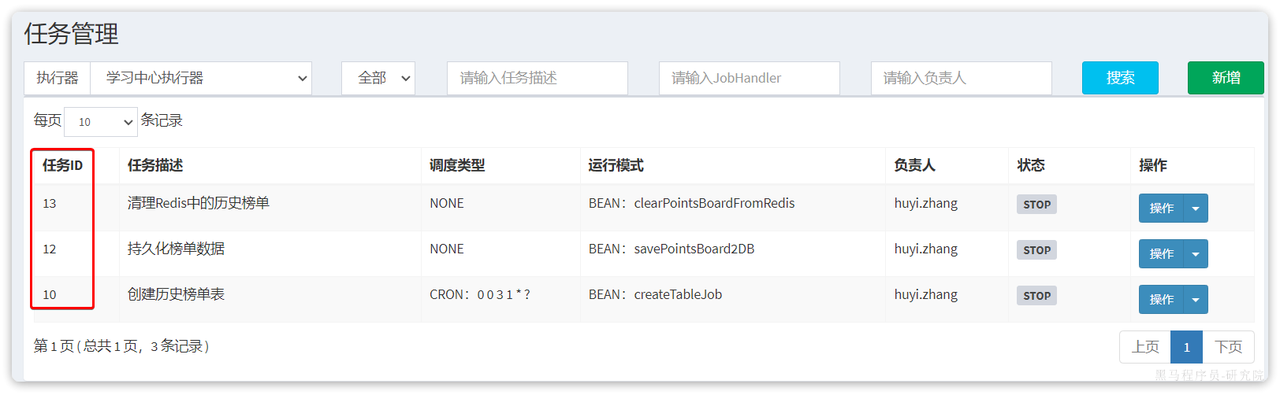
设置创建历史榜单表(ID = 10)的子任务是持久化榜单数据任务(ID = 12)
设置持久化榜单数据任务(ID = 12)的子任务是清理 Redis 中的历史榜单(ID = 13)
6.4.2.6 查询历史赛季积分榜
xxxxxxxxxxpackage com.tianji.learning.service.impl;
public class PointsBoardServiceImpl implements IPointsBoardService { // 查询用户历史指定赛季积分和排名,fromDB private PointsBoard queryMyHistoryPoints(Long seasonId, Long userId) { if(seasonId == null || userId == null){ throw new BadRequestException("错误参数"); } PointsBoard one = lambdaQuery() // select * from points_board .eq(PointsBoard::getSeason, seasonId) // where season = #{seasonId} .eq(PointsBoard::getUserId, userId).one(); // and season_id = #{seasonId} limit 1; return one; } // 分页查询历史赛季排行榜,fromDB private List<PointsBoard> queryHistoryPoints( Long seasonId, (value = 1, message = "页码不能小于1") Integer pageNo, (value = 1, message = "每页查询数量不能小于1") Integer pageSize) { if (seasonId == null) { throw new BadRequestException("查询历史赛季排行榜失败,赛季id不能为空"); } int offset = (pageNo - 1) * pageSize; List<PointsBoard> list = lambdaQuery() // select * from points_board .eq(PointsBoard::getSeason, seasonId) // where season = #{seasonId} .orderByAsc(PointsBoard::getPoints) // ordered by points .last("LIMIT " + pageSize + " OFFSET " + offset).list(); // limit #{pageSize} offset #{offset} return list; }}6.5 面试题
6.5.1 你负责积分功能的开发,那能不能讲讲是如何设计实现的?
答:因为签到功能数据量非常大,我们用了 BitMap 结构。
BitMap 是用 bit 位来表示签到数据,31bit 位就能表示 1 个月的签到记录,非常节省空间,而且查询效率也比较高。
你使用 Redis 保存签到记录,那如果 Redis 宕机怎么办?
答:对于 Redis 的高可用数据安全问题,有很多种方案。
可以给 Redis 添加数据持久化机制,比如使用 AOF 持久化。这样宕机后也丢失的数据量不多,可以接受。
可以搭建 Redis 主从集群,再结合哨兵。主节点把数据持续同步给从节点,宕机后会有哨兵重新选主,不用担心数据丢失问题。
如果对于数据的安全性要求非常高,还是要用数据库来实现。但是为了解决签到数据量较大的问题,可能就需要分表处理了。
6.5.2 你负责积分排行榜功能的开发,那能不能讲讲是如何设计实现的?
答:我们的排行榜功能分为两部分:一个是当前赛季排行榜,一个是历史排行榜。每个月为一个赛季,月初清零积分记录。
先说当前赛季榜单,我们采用了 Redis 的
SortedSet来实现。member 是用户id,score 是当月积分总值。 每当用户产生积分行为时、获取积分时,就会更新 score 值。这样 Redis 就会自动形成榜单了。再说历史赛季榜单,历史榜单肯定是保存到数据库了。不过由于数据过多,所以需要对数据做水平拆分。 我们目前的思路是按照赛季来拆分,也就是每一个赛季的榜单单独一张表。这样做有几个好处:
拆分数据时比较自然,无需做额外处理
查询数据时往往都是按照赛季来查询,这样一次只需要查一张表,不存在跨表查询问题。 因此我们就不需要分库分表了,直接在业务层利用 MybatisPlus 实现动态表名,进行动态插入。
利用一个定时任务在每月初生成上赛季的榜单表,一个定时任务持久化到数据库,一个定时任务清理 Redis 中的历史数据。 之所以要分开定义,是为了在部分任务失败时,可以单独重试。最终还要确保这三个任务的执行顺序,一定是依次执行的。
你们使用 Redis 的 SortedSet 来保存榜单数据,如果用户量非常多怎么办?
答:Redis 的 SortedSet 底层利用了跳表机制,性能还是非常不错的。即便有百万级别的用户量,也没什么问题。
当系统用户量规模达到数千万,乃至数亿时,我们可以采用分治的思想,将用户数据按照积分范围划分为多个桶。 然后为每个桶创建一个 SortedSet 类型的 key,这样就可以将数据分散,减少单个 KEY 的数据规模了。 要计算排名时,只需要按照范围查询出用户积分所在的桶,再累加分值范围比他高的桶的用户数量即可。
历史榜单采用的定时任务框架是?处理数百万的榜单数据时任务是如何分片的?你们是如何确保多个任务依次执行的呢?
答:我们采用的是 XXL-JOB 框架。XXL-JOB 自带任务分片广播机制,每一个任务执行器都能通过 API 得到自己的分片编号、分片总数量。
在做榜单数据批处理时,我们是按照分页查询的方式:
每个执行器的起始页是分片编号 + 1,跨度值是分片总数量。例如,第一个分片处理第 1、3、5 页,第二个分片处理第 2、4、6 页。
确保多个任务的执行顺序,可以利用 XXL-JOB 的子任务功能。
Day07 - 优惠券管理
7.1 产品原型分析
7.1.1 业务流程分析

7.1.2 接口统计
| 编号 | 接口简述 | |
|---|---|---|
| 优惠券管理 | 1 | 新增优惠券 |
| 2 | 修改优惠券 | |
| 3 | 删除优惠券 | |
| 4 | 查询优惠券 | |
| 5 | 分页查询优惠券 | |
| 优惠券发放 | 6 | 发放优惠券 |
| 7 | 停发优惠券 | |
| 8 | 生成兑换码 |
7.1.3 表结构设计
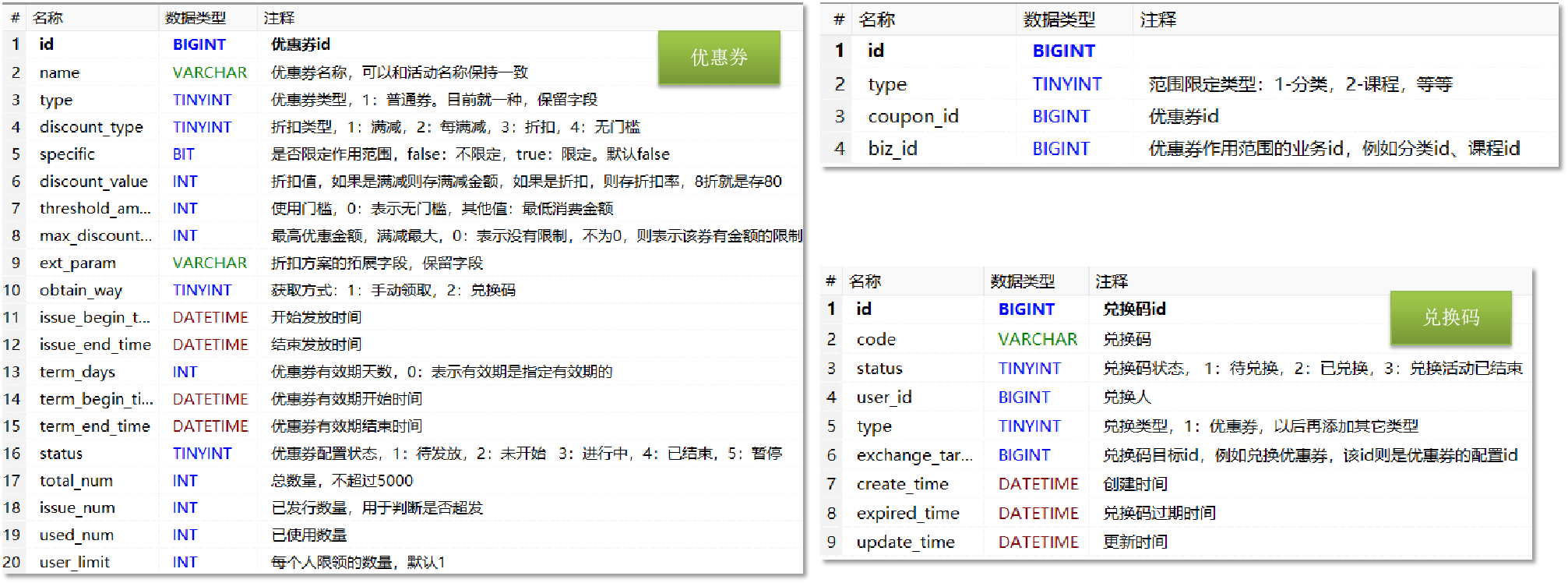
7.2 优惠券管理
7.2.1 新增优惠券
需求:管理员可以在控制台添加新的优惠券,经过审核后可以发放。
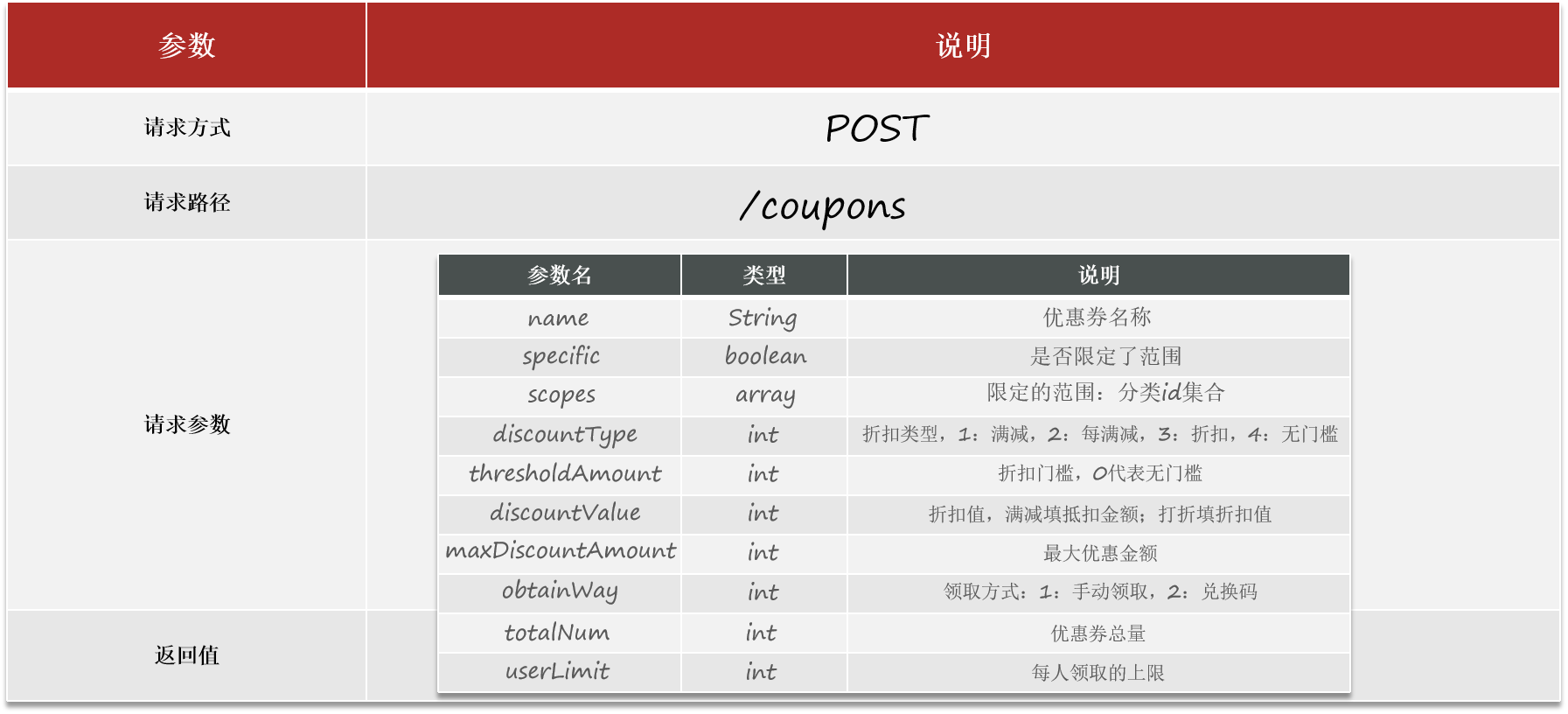
Controller 层:
xxxxxxxxxxpackage com.tianji.promotion.controller;
("/coupons")(tags = "优惠券相关接口")public class CouponController { ("新增优惠券") public void saveCoupon( CouponFormDTO dto){ couponService.saveCoupon(dto); }}Service 层:
xxxxxxxxxxprivate final ICouponScopeService scopeService;
public void saveCoupon(CouponFormDTO dto) { // 1. 保存优惠券 Coupon coupon = BeanUtils.copyBean(dto, Coupon.class); save(coupon); if (!dto.getSpecific()) return; Long couponId = coupon.getId(); // 2. 保存限定范围 List<Long> scopes = dto.getScopes(); if (CollUtils.isEmpty(scopes)) { throw new BadRequestException("限定范围不能为空"); } // 3. 封装 PO 并保存 List<CouponScope> list = scopes.stream() .map(bizId -> new CouponScope().setBizId(bizId).setCouponId(couponId)) .collect(Collectors.toList()); scopeService.saveBatch(list);}远程调用接口:
xxxxxxxxxxpublic interface ICouponScopeService extends IService<CouponScope> {}7.2.2 修改优惠券
需求:管理员可以在控制台的优惠券列表页,修改优惠券的信息。

Controller 层:
xxxxxxxxxxpackage com.tianji.promotion.controller;
("修改优惠券")("{id}")public void updateById( CouponFormDTO dto, ("id") Long id){ couponService.updateById(dto, id);}Service 层:
xxxxxxxxxxprivate final ICouponScopeService scopeService;
public void updateById(CouponFormDTO dto, Long id) { // 1. 校验参数 Long dtoId = dto.getId(); if((dtoId!=null && id!=null && !dtoId.equals(id)) || (dtoId==null && id==null)){ throw new BadRequestException("参数错误"); } // 2. 更新优惠券基本信息 Coupon coupon = BeanUtils.copyBean(dto, Coupon.class); // 2.1 只更新状态为1的优惠券基本信息,如果失败则是状态已修改 boolean update = lambdaUpdate().eq(Coupon::getStatus, 1).update(coupon); // 2.2 基本信息更新失败则无需更新优惠券范围信息 if(!update) return; // 3. 更新优惠券范围信息 List<Long> scopeIds = dto.getScopes(); // 3.1 优惠券不满减,或优惠券范围为空,则不更新优惠券范围信息 // 3.2 先删除优惠券范围信息,再重新插入 List<Long> ids = scopeService.lambdaQuery() .select(CouponScope::getId).eq(CouponScope::getCouponId, dto.getId()).list() .stream().map(CouponScope::getId).collect(Collectors.toList()); scopeService.removeByIds(ids); // 3.3 删除成功后,并且有范围再插入 if(CollUtils.isNotEmpty(scopeIds)){ List<CouponScope> lis = scopeIds.stream() .map(i -> new CouponScope().setCouponId(dto.getId()).setType(1).setBizId(i)) .collect(Collectors.toList()); scopeService.saveBatch(lis); }}7.2.3 删除优惠券
需求:在管理控制台的优惠券分页列表中,点击某个待发放优惠券后的删除按钮,实现根据 id 删除优惠券功能。
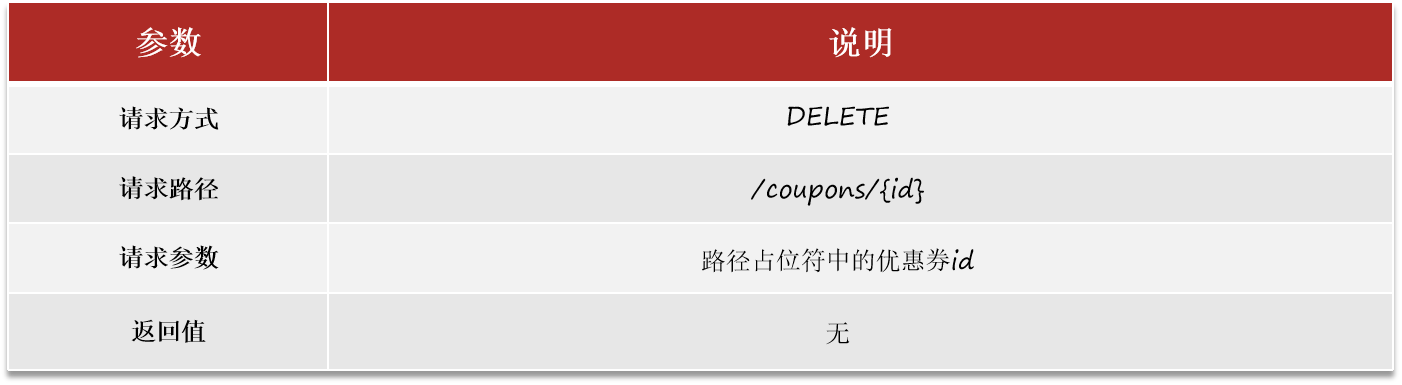
Controller 层:
xxxxxxxxxxpackage com.tianji.promotion.controller;
("删除优惠券") ("{id}") public void deleteById(("优惠券id") ("id") Long id){ couponService.deleteById(id); }Service 层:
xxxxxxxxxxprivate final ICouponScopeService scopeService;
public void deleteById(Long id) { // 1. 查询优惠券是否存在并删除: DELETE FROM coupon WHERE id = #{id} AND status = 1; boolean remove = lambdaUpdate().eq(Coupon::getId, id).eq(Coupon::getStatus, 1).remove(); if(!remove){ throw new BadRequestException("删除失败,当前优惠券状态非待发放状态"); } // 2. 查询优惠券范围信息并删除: DELETE FROM coupon_scope WHERE id = #{id}; scopeService.lambdaUpdate().eq(CouponScope::getCouponId, id).remove();}7.2.4 查询优惠券
需求:在管理控制台的优惠券分页列表中,点击某个优惠券或者修改某个优惠券时,都需要根据 id 查询优惠券的详细信息。
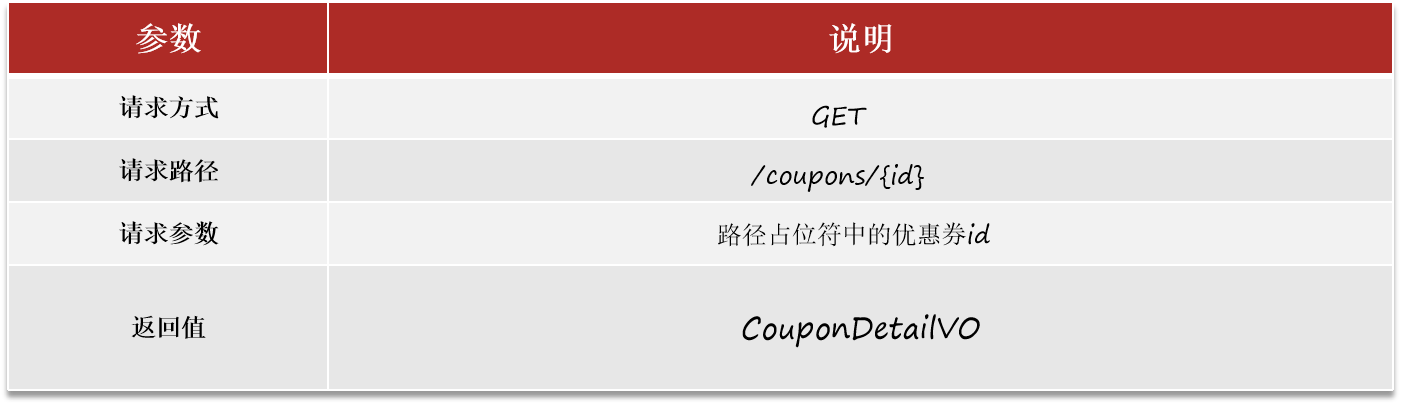
Controller 层:
xxxxxxxxxxpackage com.tianji.promotion.controller;
("查询优惠券接口")("{id}")public CouponDetailVO queryById(("优惠券id") ("id") Long id){ return couponService.queryById(id);}Service 层:
xxxxxxxxxxprivate final ICouponScopeService scopeService;private final CategoryClient categoryClient;
public CouponDetailVO queryById(Long id) { // 1. 查询优惠券基本信息: select * from coupon where id = #{id} limit 1; Coupon coupon = lambdaQuery().eq(Coupon::getId, id).one(); // 2. 查询优惠券范围列表: select * from coupon_scope where couponId = #{id}; List<CouponScope> couponScopes = scopeService .lambdaQuery().eq(CouponScope::getCouponId, coupon.getId()).list(); // 3. 查询范围信息<分类id,分类名称>: SELECT id, name FROM categories WHERE level = 1; Map<Long, String> cateMap = categoryClient.getAllOfOneLevel().stream() .collect(Collectors.toMap(CategoryBasicDTO::getId, CategoryBasicDTO::getName)); // 4. 封装范围信息到范围列表 List<CouponScopeVO> vos = couponScopes.stream() .map(i -> new CouponScopeVO().setName(cateMap.get(i.getBizId())).setId(i.getBizId())) .collect(Collectors.toList()); // 5. 封装优惠券详细信息 CouponDetailVO couponDetailVO = BeanUtils.copyBean(coupon, CouponDetailVO.class); couponDetailVO.setScopes(vos); return couponDetailVO;}远程调用接口:
xxxxxxxxxxpackage com.tianji.api.client.course;
("getAllOfOneLevel")List<CategoryBasicDTO> getAllOfOneLevel();7.2.5 分页查询优惠券
需求:管理员可以在管理后台分页查询优惠券信息,并且可以基于条件做过滤。

Controller 层:
xxxxxxxxxxpackage com.tianji.promotion.controller;
("分页查询优惠券")("/page")public PageDTO<CouponPageVO> queryCouponByPage(CouponQuery query){ return couponService.queryCouponByPage(query);}Service 层:
xxxxxxxxxxpublic PageDTO<CouponPageVO> queryCouponByPage(CouponQuery query) { Integer status = query.getStatus(); String name = query.getName(); Integer type = query.getType(); // 1. 分页查询 Page<Coupon> page = lambdaQuery() // SELECT * FROM coupon .eq(type != null, Coupon::getDiscountType, type) // WHERE (type IS NULL OR discount_type = #{type}) .eq(status != null, Coupon::getStatus, status) // AND (status IS NULL OR status = #{status}) AND .like(StringUtils.isNotBlank(name), Coupon::getName, name) // (name IS NULL OR name LIKE '%name%') .page(query.toMpPageDefaultSortByCreateTimeDesc()); // // ORDER BY create_time DESC; // 2. 封装 VO 并返回 List<Coupon> records = page.getRecords(); if (CollUtils.isEmpty(records)) { return PageDTO.empty(page); } List<CouponPageVO> list = BeanUtils.copyList(records, CouponPageVO.class); return PageDTO.of(page, list);}7.3 优惠券发放
7.3.1 发放优惠券
需求:管理员可以将待发放或暂停状态的优惠券重新发放,可以选择立即发放或定时发放。

Controller 层:
xxxxxxxxxxpackage com.tianji.promotion.controller;
("发放优惠券")("/{id}/issue")public void beginIssue( CouponIssueFormDTO dto) { couponService.beginIssue(dto);}Service 层:
xxxxxxxxxxpublic void beginIssue(CouponIssueFormDTO dto) { // 1. 查询优惠券 Coupon coupon = getById(dto.getId()); if (coupon == null) { throw new BadRequestException("优惠券不存在!"); } // 2. 判断优惠券状态,是否是 1: "待发放"、4: "暂停" if(coupon.getStatus() != CouponStatus.DRAFT && coupon.getStatus() != PAUSE){ throw new BizIllegalException("优惠券状态错误!"); } // 3. 判断是否是立刻发放 LocalDateTime issueBeginTime = dto.getIssueBeginTime(); LocalDateTime now = LocalDateTime.now(); boolean isBegin = issueBeginTime == null || !issueBeginTime.isAfter(now); // 4. 更新优惠券 Coupon c = BeanUtils.copyBean(dto, Coupon.class); if (isBegin) { c.setStatus(ISSUING); // 3: "发放中" c.setIssueBeginTime(now); } else { c.setStatus(UN_ISSUE); // 2: "未开始" } updateById(c); // 5. TODO 生成兑换码}7.3.2 停发优惠券
需求:管理员可以将一个发放中的优惠券状态修改为暂停, 暂停后学员无法领取或兑换该优惠券,用户端页面也不会展示。
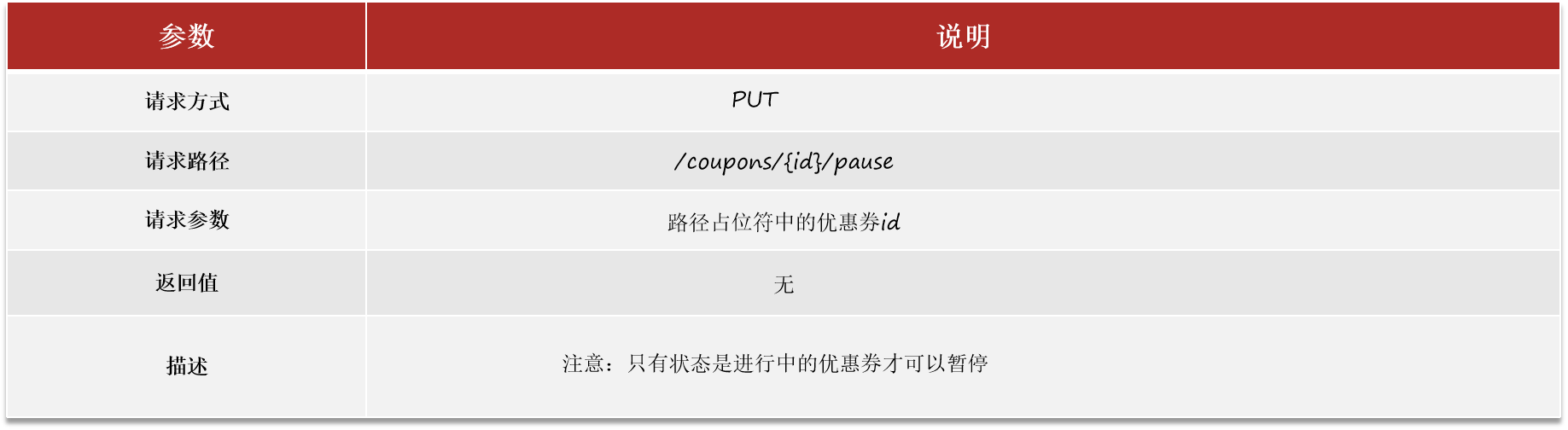
Controller 层:
xxxxxxxxxxpackage com.tianji.promotion.controller;
("停发优惠券")("/{id}/pause")public void pauseIssue(("优惠券id") ("id") long id) { couponService.pauseIssue(id);}Service 层:
xxxxxxxxxxpublic void pauseIssue(long id) { lambdaUpdate().eq(Coupon::getId, id).set(Coupon::getStatus, CouponStatus.PAUSE).update();}7.3.3 生成兑换码
7.3.3.1 兑换码生成算法
兑换码的需求:
可读性好:兑换码是要给用户使用的,因此可读性必须好:长度不超过 10 个字符,只能是 24 个大写字母和 8 个数字
数据量大:优惠活动比较频繁,必须有充足的兑换码,最好有 10 亿以上的量
唯一性:10 亿兑换码都必须唯一,不能重复,否则会出现兑换混乱的情况
不可重兑:兑换码必须便于校验兑换状态,避免重复兑换
防止爆刷:兑换码的规律性不能很明显,不能轻易被人猜测到其它兑换码
高效:兑换码生成、验证的算法必须保证效率,避免对数据库带来较大的压力
算法分析:
Base32 转码
角标 0 1 2 3 4 5 6 7 8 9 10 11 12 13 14 15 字符 A B C D E F G H J K L M N P Q R 角标 16 17 18 19 20 21 22 23 24 25 26 27 28 29 30 31 字符 S T U V W X Y Z 2 3 4 5 6 7 8 9 举例:假如我们经过自增 id 计算出一个复杂数字,转为二进制,并每 5 位一组,结果如下:
xxxxxxxxxx01001 00010 01100 10010 01101 11000 01101 00010 11110 11010 // K C N B P 2重兑校验算法
基于 BitMap:兑换或没兑换就是两个状态,对应 0 和 1,而兑换码使用的是自增 id。 我们如果每一个自增 id 对应一个 bit 位,可以用每一个 bit 位的状态表示兑换状态。
优点:简答、高效、性能好
缺点:依赖于 Redis
防刷校验算法
我们采用自增 id 的同时,还需要利用某种校验算法对 id 做加密验证,避免他人找出规律。
xxxxxxxxxx权重(密钥): 2 5 1 3 4 7 8 9自增序列: 0100 0010 1001 1010 1000 0010 0001 0110加权和: 4*2 + 2*5 + 9*1 + 10*3 + 8*4 + 2*7 + 1*8 + 6*9 = 165为了避免秘钥被人猜测出规律,我们可以准备 16 组秘钥。在兑换码自增 id 前拼接一个 4 位的新鲜值:
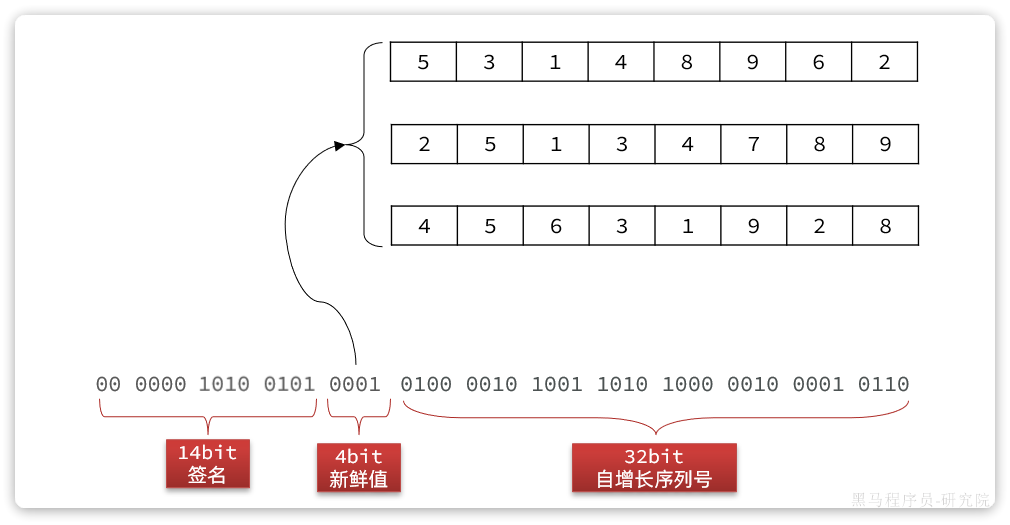
算法实现:(了解)
xxxxxxxxxxpackage com.tianji.promotion.utils;
public class CodeUtil {    // 序列号加权运算的 16 组秘钥    private final static int[][] PRIME_TABLE = {...};
    // 根据自增 id 生成兑换码。serialNum 是自增id,fresh 是新鲜值。    public static String generateCode(long serialNum, long fresh) {...}
    // 验证并解析兑换码,返回自增id    public static long parseCode(String code) {...}}
7.3.3.2 异步生成兑换码
判断是否需要生成兑换码,要同时满足两个要求:① 领取方式是兑换码方式;② 之前的状态是待发放,不能是暂停。 优惠券发放以后是可以暂停的,暂停之后还可以再次发放,再次生成兑换码时,就重复了。

而且,由于生成兑换码的数量较多,可能比较耗时,这里推荐基于线程池异步生成:
定义线程池:
xxxxxxxxxxpackage com.tianji.promotion.config;
public class PromotionConfig { public Executor generateExchangeCodeExecutor(){ ThreadPoolTaskExecutor executor = new ThreadPoolTaskExecutor(); executor.setCorePoolSize(2); // 1. 核心线程池大小 executor.setMaxPoolSize(5); // 2. 最大线程池大小 executor.setQueueCapacity(200); // 3. 队列大小 executor.setThreadNamePrefix("exchange-code-handler-"); // 4. 线程名称 executor.setRejectedExecutionHandler(new ThreadPoolExecutor.CallerRunsPolicy()); // 5. 拒绝策略 executor.initialize(); return executor; }}同时,在启动类添加 @EnableAsync 注解,开启异步功能。
xxxxxxxxxx改造
发放优惠券功能接口:
xxxxxxxxxxprivate final IExchangeCodeService codeService;
public void beginIssue(CouponIssueFormDTO dto) {    // 5. 生成兑换码: 发放方式是 "发放兑换码" 且状态是 "待发放"    if(coupon.getObtainWay() == ObtainType.ISSUE && coupon.getStatus() == CouponStatus.DRAFT){        coupon.setIssueEndTime(c.getIssueEndTime());        codeService.asyncGenerateCode(coupon);    }}
远程调用接口:
xxxxxxxxxxprivate final StringRedisTemplate redisTemplate;private final BoundValueOperations<String, String> serialOps;
public ExchangeCodeServiceImpl(StringRedisTemplate redisTemplate) { this.redisTemplate = redisTemplate; this.serialOps = redisTemplate.boundValueOps(COUPON_CODE_SERIAL_KEY);}
("generateExchangeCodeExecutor")public void asyncGenerateCode(Coupon coupon) { // 1. 获取发放数量 Integer totalNum = coupon.getTotalNum(); // 2. 获取 Redis 自增序列号 Long result = serialOps.increment(totalNum); if (result == null) return; int maxSerialNum = result.intValue(); List<ExchangeCode> list = new ArrayList<>(totalNum); for (int serialNum = maxSerialNum - totalNum + 1; serialNum <= maxSerialNum; serialNum++) { // 3. 生成兑换码 String code = CodeUtil.generateCode(serialNum, coupon.getId()); ExchangeCode e = new ExchangeCode(); e.setCode(code); e.setId(serialNum); e.setExchangeTargetId(coupon.getId()); e.setExpiredTime(coupon.getIssueEndTime()); list.add(e); } // 4. 保存数据库 saveBatch(list); // 5. 写入 Redis 缓存,member 是 couponId,score 是兑换码的最大序列号。 redisTemplate.opsForZSet().add(COUPON_RANGE_KEY, coupon.getId().toString(), maxSerialNum);}7.4 面试题
7.4.1 你们优惠券支持兑换码的方式是吧,哪兑换码是如何生成的呢?
答:要考虑兑换码的验证的高效性,最佳的方案肯定是用自增序列号。因为可以借助于 BitMap 验证兑换状态,完全不用查询数据库。
要满足 20 亿的兑换码需求,只需要 31 个 bit 位就够了,也就是在 Integer 的取值范围内,非常节省空间。
首先,需要设计一个加密验签算法。32 位的自增序列,每 4 位一组转为 10 进制,这样就有8个数字。 准备一个长度为 8 的加权数组,作为秘钥。对自增序列的 8 个数字按位加权求和,得到的结果作为签名。
然后,考虑到秘钥的安全性,准备 16 组加权数组。再随机生成一个 4 位的新鲜值,取值范围对应数组下标 0~15。
最后,把签名值的后 14 位、新鲜值 4 位 、自增序列 32 位拼接,得到一个 50 位二进制数。 将它与一个较大的质数做异或运算加以混淆,再基于 Base32 或 Base64 转码,即可得到兑换码。
7.4.2 你在项目中哪些地方用到过线程池?
答:很多地方,比如我在实现优惠券的兑换码生成的时候。
当我们在发放优惠券的时候,会判断优惠券的领取方式,可以页面手动领取,也可以兑换码兑换领取。
如果是兑换码领取,则会在发放的同时生成兑换码。但由于数量比较多,如果在发放的同时才生成,业务耗时会比较久。
因此,我们采用线程池异步生成兑换码的方式。
那你的线程池参数是怎么设置的?
答:线程池的常见参数包括:核心线程、最大线程、队列、线程名称、拒绝策略等。
核心线程数我们配置的是 2,最大线程数是 CPU 核数。 因为发放优惠券并不是高频业务,我们基于线程池做异步处理仅仅是为了减少业务耗时,所以线程数无需特别高。
队列大小设置的是 200,而拒绝策略采用的是交给调用线程处理的方式。 由于业务访问频率较低,所以基本不会出现线程耗尽的情况。就算真的耗尽了,就交给调用线程处理,让客户稍微等待一下也行。
Day08 - 领取优惠券
8.1 领取优惠券
8.1.1 产品原型分析
8.1.1.1 原型分析
查询优惠券列表(C 端):
领取优惠券(C 端):
优惠券:是用来封装优惠信息的实体,不属于任何人,因此不能在消费时使用。
用户券:是某个优惠券发放给某个用户后得到的实体,属于某一个用户,可以在消费时使用。
用户券表:用来保存用户和券的关系、使用状态等信息。用户券可以看做是用户和券的关系,即谁领了哪张券。
兑换优惠券(C 端):

查询我的优惠券(C 端):
8.1.1.2 数据结构
xxxxxxxxxxCREATE TABLE IF NOT EXISTS `user_coupon` ( `id` bigint NOT NULL AUTO_INCREMENT COMMENT '用户券id', `user_id` bigint NOT NULL COMMENT '优惠券的拥有者', `coupon_id` bigint NOT NULL COMMENT '优惠券模板id', `term_begin_time` datetime DEFAULT NULL COMMENT '优惠券有效期开始时间', `term_end_time` datetime NOT NULL COMMENT '优惠券有效期结束时间', `used_time` datetime DEFAULT NULL COMMENT '优惠券使用时间(核销时间)', `status` tinyint NOT NULL DEFAULT '1' COMMENT '优惠券状态,1:未使用,2:已使用,3:已失效', `create_time` datetime NOT NULL DEFAULT CURRENT_TIMESTAMP COMMENT '创建时间', `update_time` datetime NOT NULL DEFAULT CURRENT_TIMESTAMP ON UPDATE CURRENT_TIMESTAMP COMMENT '更新时间', PRIMARY KEY (`id`) USING BTREE, KEY `idx_coupon` (`coupon_id`), KEY `idx_user_coupon` (`user_id`,`coupon_id`) USING BTREE) ENGINE=InnoDB AUTO_INCREMENT=4 DEFAULT CHARSET=utf8mb4 COLLATE=utf8mb4_0900_ai_ci COMMENT='用户领取优惠券的记录,是真正使用的优惠券信息';8.1.2 领取优惠券
8.1.2.1 查询优惠券列表(C 端)
Controller 层:
xxxxxxxxxxpackage com.tianji.promotion.controller;
("查询优惠券列表")("/list")public List<CouponVO> queryIssuingCoupons(){ return couponService.queryIssuingCoupons();}Service 层:
xxxxxxxxxxpublic List<CouponVO> queryIssuingCoupons() { // 1. 查询发放中的优惠券列表 List<Coupon> coupons = lambdaQuery() // SELECT * FROM coupon .eq(Coupon::getStatus, ISSUING) // WHERE status = 3 (发放中) .eq(Coupon::getObtainWay, ObtainType.PUBLIC).list(); // AND obtainWay = 1 (手动领取); if (CollUtils.isEmpty(coupons)) { return CollUtils.emptyList(); } // 2. 统计当前用户已经领取的优惠券的信息 List<Long> couponIds = coupons.stream().map(Coupon::getId).collect(Collectors.toList()); // 2.1 查询当前用户已经领取的优惠券的数据 List<UserCoupon> userCoupons = userCouponService.lambdaQuery() // SELECT * FROM user_coupon .eq(UserCoupon::getUserId, UserContext.getUser()) // WHERE id = #{userId} .in(UserCoupon::getCouponId, couponIds).list(); // AND coupon_id in (#{couponIds}); // 2.2 统计当前用户对优惠券的已经领取数量 Map<Long, Long> issuedMap = userCoupons.stream() .collect(Collectors.groupingBy(UserCoupon::getCouponId, Collectors.counting())); // 2.3 统计当前用户对优惠券的已经领取并且未使用的数量 Map<Long, Long> unusedMap = userCoupons.stream() .filter(uc -> uc.getStatus() == UserCouponStatus.UNUSED) .collect(Collectors.groupingBy(UserCoupon::getCouponId, Collectors.counting())); // 3. 封装 VO 集合并返回 List<CouponVO> list = new ArrayList<>(coupons.size()); for (Coupon c : coupons) { // 3.1 拷贝 PO 属性到 VO CouponVO vo = BeanUtils.copyBean(c, CouponVO.class); list.add(vo); // 3.2 是否可以领取:已经被领取的数量 < 优惠券总数量 && 当前用户已经领取的数量 < 每人限领数量 vo.setAvailable( c.getIssueNum() < c.getTotalNum() && issuedMap.getOrDefault(c.getId(), 0L) < c.getUserLimit() ); // 3.3 是否可以使用:当前用户已经领取并且未使用的优惠券数量 > 0 vo.setReceived(unusedMap.getOrDefault(c.getId(), 0L) > 0); } return list;}8.1.2.2 领取优惠券(C 端)
Controller 层:
xxxxxxxxxxpackage com.tianji.promotion.controller;
("领取优惠券")("/{couponId}/receive")public void receiveCoupon(("couponId") Long couponId){ userCouponService.receiveCoupon(couponId);}Service 层:
xxxxxxxxxxprivate final CouponMapper couponMapper;
public void receiveCoupon(Long couponId) { // 1. 查询优惠券 Coupon coupon = couponMapper.selectById(couponId); if (coupon == null) { throw new BadRequestException("优惠券不存在"); } // 2. 校验发放时间 LocalDateTime now = LocalDateTime.now(); if (now.isBefore(coupon.getIssueBeginTime()) || now.isAfter(coupon.getIssueEndTime())) { throw new BadRequestException("优惠券发放已经结束或尚未开始"); } // 3. 校验库存 if (coupon.getIssueNum() >= coupon.getTotalNum()) { throw new BadRequestException("优惠券库存不足"); } Long userId = UserContext.getUser(); // 4. 校验每人限领数量 // 4.1 统计当前用户对当前优惠券的已经领取的数量 Integer count = lambdaQuery() // SELECT COUNT(*) FROM user_coupon .eq(UserCoupon::getUserId(), userId) // WHERE user_id = #{userId} .eq(UserCoupon::getCouponId(), couponId).count(); // AND coupon_id = #{couponId}; // 4.2 校验限领数量 if(count != null && count >= coupon.getUserLimit()){ throw new BadRequestException("超出领取数量"); } // 5. 更新优惠券的已经发放的数量 + 1 couponMapper.incrIssueNum(coupon.getId()); // 6. 新增一个用户券 saveUserCoupon(coupon, userId);}xxxxxxxxxxprivate void saveUserCoupon(Coupon coupon, Long userId) { // 1. 基本信息 UserCoupon uc = new UserCoupon(); uc.setUserId(userId); uc.setCouponId(coupon.getId()); // 2. 有效期信息 LocalDateTime termBeginTime = coupon.getTermBeginTime(); LocalDateTime termEndTime = coupon.getTermEndTime(); if (termBeginTime == null) { termBeginTime = LocalDateTime.now(); termEndTime = termBeginTime.plusDays(coupon.getTermDays()); } uc.setTermBeginTime(termBeginTime); uc.setTermEndTime(termEndTime); save(uc);}Mapper 层:
xxxxxxxxxx("UPDATE coupon SET issue_num = issue_num + 1 WHERE id = #{couponId}")void incrIssueNum(("couponId") Long couponId);8.1.2.3 兑换优惠券(C 端)
Controller 层:
xxxxxxxxxxpackage com.tianji.promotion.controller;
("兑换优惠券")("/{code}/exchange")public void exchangeCoupon(("code") String code){ userCouponService.exchangeCoupon(code);}Service 层:
xxxxxxxxxxprivate final CouponMapper couponMapper;private final IExchangeCodeService codeService;
public void exchangeCoupon(String code) { // 1. 校验并解析兑换码 long serialNum = CodeUtil.parseCode(code); // 2. 校验是否已经兑换 SETBIT KEY 4 1, 通过返回值来判断是否兑换过 boolean exchanged = codeService.updateExchangeMark(serialNum, true); if (exchanged) { throw new BizIllegalException("兑换码已经被兑换过了"); } try { // 3. 查询兑换码对应的优惠券 id ExchangeCode exchangeCode = codeService.getById(serialNum); if (exchangeCode == null) { throw new BizIllegalException("兑换码不存在!"); } // 4. 是否过期 LocalDateTime now = LocalDateTime.now(); if (now.isAfter(exchangeCode.getExpireTime())) { throw new BizIllegalException("兑换码已经过期"); } // 5. 校验并生成用户券 // 5.1 查询优惠券 Coupon coupon = couponMapper.selectById(exchangeCode.getCouponId()); // 5.2 查询用户 Long userId = UserContext.getUser(); // 5.3 校验并生成用户券,更新兑换码状态 checkAndCreateUserCoupon(coupon, userId, serialNum); } catch (Exception e) { // 重置兑换的标记 0 codeService.updateExchangeMark(serialNum, false); throw e; }}修改 领取优惠券 实现类代码:
xxxxxxxxxxpublic void receiveCoupon(Long couponId) { // 4. 校验并生成用户券 checkAndCreateUserCoupon(coupon, userId, null);}xxxxxxxxxxprivate void checkAndCreateUserCoupon(Coupon coupon, Long userId, Integer serialNum){ // 1. 校验每人限领数量 // 1.1 统计当前用户对当前优惠券的已经领取的数量 Integer count = lambdaQuery() // SELECT COUNT(*) FROM user_coupon .eq(UserCoupon::getUserId, userId) // WHERE user_id = #{userId} .eq(UserCoupon::getCouponId, coupon.getId()).count(); // AND coupon_id = #{id}; // 1.2 校验限领数量 if(count != null && count >= coupon.getUserLimit()){ throw new BadRequestException("超出领取数量"); } // 2. 更新优惠券的已经发放的数量 + 1 couponMapper.incrIssueNum(coupon.getId()); // 3. 新增一个用户券 saveUserCoupon(coupon, userId); // 4. 更新兑换码状态 if (serialNum != null) { codeService.lambdaUpdate() // UPDATE ExchangeCode .set(ExchangeCode::getUserId, userId) // SET user_id = #{userId}, .set(ExchangeCode::getStatus, ExchangeCodeStatus.USED) // status = 2 .eq(ExchangeCode::getId, serialNum).update(); // WHERE id = #{serialNum}; }}远程调用接口:
xxxxxxxxxxpublic boolean updateExchangeMark(long serialNum, boolean mark) { // SETBIT coupon:code:map serialNum false; Boolean boo = redisTemplate.opsForValue().setBit(COUPON_CODE_MAP_KEY, serialNum, mark); return boo != null && boo;}8.1.2.4 查询优惠券(C 端)
Controller 层:
xxxxxxxxxxpackage com.tianji.promotion.controller;
("查询我的优惠券")("/available")public List<CouponDiscountDTO> findDiscountSolution( List<OrderCourseDTO> orderCourses){ return userCouponService.findDiscountSolution(orderCourses);}Service 层:
xxxxxxxxxxpublic List<CouponDiscountDTO> findDiscountSolution(List<OrderCourseDTO> orderCourses) { // 1. 查询用户可用的优惠券 List<Coupon> coupons = baseMapper.queryMyCoupons(UserContext.getUser()); // 2. 过滤掉优惠券规则不满足的优惠券,条件:优惠券门槛不超过订单总价 // 2.1 计算订单总价 int totalNum = orderCourses.stream().mapToInt(OrderCourseDTO::getPrice).sum(); // 2.2 筛选出该订单可用券 List<Coupon> availableCoupons = coupons.stream() .filter(c -> DiscountStrategy.getDiscount(c.getDiscountType()).canUse(totalNum, c)) .collect(Collectors.toList()); if(CollUtils.isEmpty(availableCoupons)){ return CollUtils.emptyList(); } // 3.筛选出优惠券的全排列组合,组合包含单券和多券两种组合,多券组合为某张优惠券下可用的课程id列表,单券组合为所有优惠券集合 // 3.1 获取到每一张可用的优惠券可用课程集合的集合 Map<Coupon, List<OrderCourseDTO>> availableCouponsMap = findAvailableCoupons(availableCoupons, orderCourses); if(CollUtils.isEmpty(availableCouponsMap)){ return CollUtils.emptyList(); } // 3.2 从map取出keys即优惠券Set,转换为优惠券List,并覆盖初筛的可用券集合 availableCoupons = new ArrayList<>(availableCouponsMap.keySet()); // 3.3 获得方案集合,即对细筛优惠券集合进行全排列组合 List<List<Coupon>> solutions = PermuteUtil.permute(availableCoupons); // 3.4 将所有单券也加入到全排列中,因为页面除了展示优惠券组合,还要展示单券 for (Coupon availableCoupon : availableCoupons) { solutions.add(CollUtils.toList(availableCoupon)); } // 4. 计算每一种方案的优惠情况 List<CouponDiscountDTO> list = new ArrayList<>(); for (List<Coupon> couponList : solutions) { list.add(calculateSolutionDiscount(availableCouponsMap, orderCourses, couponList)); } // 5. 筛选出方案中最优解并返回 return findBestSolution(list);}xxxxxxxxxxprivate CouponDiscountDTO calculateSolutionDiscount(Map<Coupon, List<OrderCourseDTO>> availableCouponsMap, List<OrderCourseDTO> orderCourses, List<Coupon> couponList) { CouponDiscountDTO discountDTO = new CouponDiscountDTO(); // 1. 建立优惠明细映射Map<课程id,优惠金额> Map<Long, Integer> courseDiscountMap = orderCourses.stream() .collect(Collectors.toMap(OrderCourseDTO::getId, orderCourseDTO -> 0)); //初始化每个商品的已优惠金额为0 // 2. 计算该方案明细 // 2.1 循环方案中的优惠券 for (Coupon coupon : couponList) { // 2.2 得到该优惠券可优惠的课程集合 List<OrderCourseDTO> courses = availableCouponsMap.get(coupon); // 2.3 计算目前【剩余】的可优惠课程的总价(课程原价-对应优惠明细) int price = courses.stream().mapToInt( course.getPrice() - courseDiscountMap.get(course.getId())).sum(); // 2.4 判断总价是否符合该优惠券门槛 Discount discount = DiscountStrategy.getDiscount(coupon.getDiscountType()); //得到该优惠券的策略 if(!discount.canUse(price, coupon)) continue; //如果不满足门槛则判断下一张优惠券 // 2.5 计算总优惠金额 int discountPrice = discount.calculateDiscount(price, coupon); // 2.6 将总优惠金额分摊到每个可优惠课程的优惠明细中 calculateDetailDiscount(courseDiscountMap, orderCourses, discountPrice, price); // 2.7 保存该优惠券id到本方案中 discountDTO.getIds().add(coupon.getId()); // 2.8 保存该优惠券规则到本方案中(从策略中取出该优惠券的规则) discountDTO.getRules().add(discount.getRule(coupon)); // 2.9 保存该方案的优惠金额(累加每张优惠券的优惠总金额) discountDTO.setDiscountAmount(discountDTO.getDiscountAmount() + discountPrice); } return discountDTO;}Mapper 层:
xxxxxxxxxx("SELECT c.id, c.discount_type, c.`specific`," + "c.discount_value, c.threshold_amount, c.max_discount_amount, uc.id AS creater" + "FROM coupon c INNER JOIN user_coupon uc ON c.id = uc.coupon_id" + "WHERE uc.`status` = 1 AND uc.user_id = #{userId};")List<Coupon> queryMyCoupons(("userId") Long userId);8.1.3 并发安全问题
8.1.3.1 超卖问题
分析原因:
我们对于优惠券库存的处理逻辑是这样的:先查询,再判断,再更新,而以上三步操作并不具备原子性。
超卖问题产生原因:① 多线程并行运行;② 多行代码操作共享资源,但不具备原子性。这就是典型的线程并发安全问题。
解决方案:
悲观锁:一种独占和排他的锁机制,悲观地认为数据会被其他事务修改,在整个数据处理过程中将数据处于锁定状态。
优点:安全性高
缺点:性能较差
乐观锁:一种较为乐观的控制机制,乐观地认为多用户并发不会产生安全问题,因此无需独占和锁定资源。 但在更新数据前,会先检查是否有其他线程修改了该数据,如果有则认为可能有风险,会放弃修改操作。
优点:安全性高、性能较好
缺点:并发较高时,更新成功率低
针对更新成功率低的问题,有一个改进方案:无需判断
issue_num是否与原来一致,只要判断是否小于total_num即可:xxxxxxxxxxUPDATE coupon SET issue_num = issue_num + 1 WHERE id = 1 AND issue_num < total_num实现方案:
修改更新库存的 SQL 语句:
xxxxxxxxxxpackage com.tianji.promotion.mapper;("UPDATE coupon SET issue_num = issue_num + 1 WHERE id = #{couponId} AND issue_num < total_num")int incrIssueNum(("couponId") Long couponId);修改 checkAndCreateUserCoupon 方法:
xxxxxxxxxxpackage com.tianji.promotion.service.impl;private void checkAndCreateUserCoupon(Coupon coupon, Long userId, Integer serialNum){// 2. 更新优惠券的已经发放的数量 + 1int r = couponMapper.incrIssueNum(coupon.getId());// 如果超卖,则应该抛出异常,触发回滚。if (r == 0) throw new BizIllegalException("优惠券库存不足");}
8.1.3.2 锁失效问题
分析原因:
除了优惠券库存判断,领券时还有对于用户限领数量的判断:先查询,再判断,再新增,以上三步也不具备原子性。
乐观锁常用在更新,所以这里只能采用悲观锁方案,也就是大家熟悉的
Synchronized或者Lock。用户限领数量判断是针对单个用户的,因此锁的范围不需要是整个方法,只要锁定某个用户即可:
xxxxxxxxxxprivate void checkAndCreateUserCoupon(Coupon coupon, Long userId, Integer serialNum){Synchronized(userId.toString()) {// ...}}测试发现并发问题依然存在,锁失效。原来是因为 userId 是 Long 类型,其中
toString()采用的是 new String() 的方式。 也就是说,哪怕是同一个用户 id,但toString()得到的也是多个不同对象,也就是多把不同的锁。
解决方案:
String 类中提供了
intern()方法,只要两个字符串 equals 的结果为 true,那么就能保证得到的结果用 == 判断也是 true:xxxxxxxxxxprivate void checkAndCreateUserCoupon(Coupon coupon, Long userId, Integer serialNum){Synchronized(userId.toString().intern()) {// ...}}
8.1.3.3 事务边界问题
分析原因:
经过同步锁的改造,理论上问题已经是解决了。不过经过测试后,发现问题依然存在,用户还是会超领。
这是由于事务的隔离导致的,整个领券发放加了事务,而在内部我们加锁:
xxxxxxxxxx// 外部加事务public void receiveCoupon(Long couponId) {checkAndCreateUserCoupon(coupon, userId, null); // 内部加锁}整体业务流程是这样的:
开启事务 -> 获取锁 -> 执行业务 -> 释放锁 -> 提交事务假设此时有两个线程并行执行这段逻辑:
线程 1 执行完业务释放锁,线程 2 立刻获取锁成功,开始执行业务
线程 1 尚未提交事务,于是线程 2 也新增一条券,安全问题就发生了
解决方案:
解决方法很简单,调整事务边界和锁边界:
获取锁 -> 开启事务 -> 执行业务 -> 提交事务 -> 释放锁xxxxxxxxxxpublic void receiveCoupon(Long couponId) {synchronized(userId.toString().intern()){ // 外部加锁checkAndCreateUserCoupon(coupon, userId, null); // 内部加事务}}public void checkAndCreateUserCoupon(Coupon coupon, Long userId, Integer serialNum){// ...}
8.1.3.4 事务失效问题
分析原因:
事务失效的原因有很多,接下来我们就逐一分析一些常见的原因:
事务方法非 public 修饰:
xxxxxxxxxxprivate void A() { }非事务方法调用事务方法:(此次失效原因)
xxxxxxxxxxpublic void A() { B(); }public void B() { }事务方法的异常被捕获了:
xxxxxxxxxxpublic void A() { B(); }private void B() {try {} catch (Exception e) {}}事务异常类型不对:
xxxxxxxxxx(rollbackFor = RuntimeException.class)public void A() throws IOException {throw new IOException();}事务传播行为不对:
xxxxxxxxxxpublic void A(){ B(); C(); throw new RuntimeException("业务异常");}public void B() {}(propagation = Propagation.REQUIRES_NEW)public void C() {}没有被 Spring 管理:
xxxxxxxxxx// @Servicepublic class TestService {public void A() { }}解决方案:
既然事务失效的原因是方法内部调用走的是
this,而不是代理对象,那想办法获取代理对象就可以了:引入 AspectJ 依赖:
xxxxxxxxxx<dependency><groupId>org.aspectj</groupId><artifactId>aspectjweaver</artifactId></dependency>在启动类上加注解,暴露代理对象:
xxxxxxxxxx(exposeProxy = true)使用代理对象:
xxxxxxxxxxpublic void receiveCoupon(Long couponId) {synchronized(userId.toString().intern()){ // 外部加锁IUserCouponService userCouponService = (IUserCouponService) AopContext.currentProxy();userCouponService.checkAndCreateUserCoupon(user, coupon, null); // 内部加事务}}
8.2 领取优惠券优化 // TODO
8.2.1 分布式锁
8.2.1.1 集群下的锁失效问题
8.2.1.2 简单分布式锁
8.2.1.3 分布式锁的问题
8.2.1.4 Redisson
8.2.1.5 通用分布式锁组件
8.2.2 异步领券
8.2.2.1 优化思路分析
8.2.2.2 优惠券缓存
8.2.2.3 异步领券
8.2.2.4 异步的兑换码领券
8.2.2.5 基于 lua 脚本的异步领券
8.3 面试题
8.3.1 你做的优惠券功能如何解决券超发的问题?
答:券超发问题常见的有两种场景:① 券库存不足导致超发;② 发券时超过了每个用户限领数量;
这两种问题产生的原因都是高并发下的线程安全问题。往往需要通过加锁来保证线程安全。不过在处理细节上,会有一些差别。
首先,针对库存不足导致的超发问题,也就是典型的库存超卖问题,我们可以通过乐观锁来解决。 也就是在库存扣减的 SQL 语句中添加对于库存余量的判断,直接判断库存是否小于 0 即可,这样提高了库存扣减的成功率。
其次,对于用户限领数量超出的问题,无法采用乐观锁。因为需要先查询已领数量,再判断是否超限,再新增领取记录。 这就导致后续的新增操作会影响超发的判断,只能利用悲观锁将几个操作封装为原子操作。
你这里聊到悲观锁,是用什么来实现的呢?
答:由于优惠券服务是多实例部署形成的负载均衡集群。因此考虑到分布式下 JVM锁失效问题,采用了基于 Redisson 的分布式锁。
不过 Redisson 分布式锁的加锁和释放对业务侵入比较多,因此我就对其做了二次封装: 利用自定义注解,AOP,以及 SPEL 表达式实现了基于注解的分布式锁。
我在封装的时候用
工厂模式来选择不同的锁类型,用策略模式来选择锁失败重试策略,用SPEL表达式来实现动态锁名称。综合来说包含 5 种失败重试策略:直接结束、直接抛异常、重试一段时间后结束、重试一段时间后抛异常、一直重试。
8.3.2 加锁以后性能会比较差,有什么好的办法吗?
答:针对领券问题,我们采用了 MQ 来做异步领券,起到一个流量削峰和整型的作用,降低数据库压力。
具体来说,我们可以将优惠券的关键信息缓存到 Redis 中,用户请求进入后先读取缓存,做好优惠券库存、领取数量的校验。 如果校验不通过,则返回失败结果,如果校验通过,则通过 MQ 发送消息,异步去写数据库,然后告诉用户领取成功即可。
但是其中可能需要多次与 Redis 交互,因此利用 Redis 的 LUA 脚本代替 java 的校验逻辑,这样只有一次交互即可完成校验。
8.3.3 事务失效的情况碰到过吗?哪些情况会导致事务失效?
答:非事务方法调用、方法不是 public、方法的异常被捕获、抛出的异常类型不对、传播行为使用错误、Bean 没有被 Spring 管理。
Day09 - 使用优惠券
9.1 优惠券规则定义
9.1.1 业务流程分析
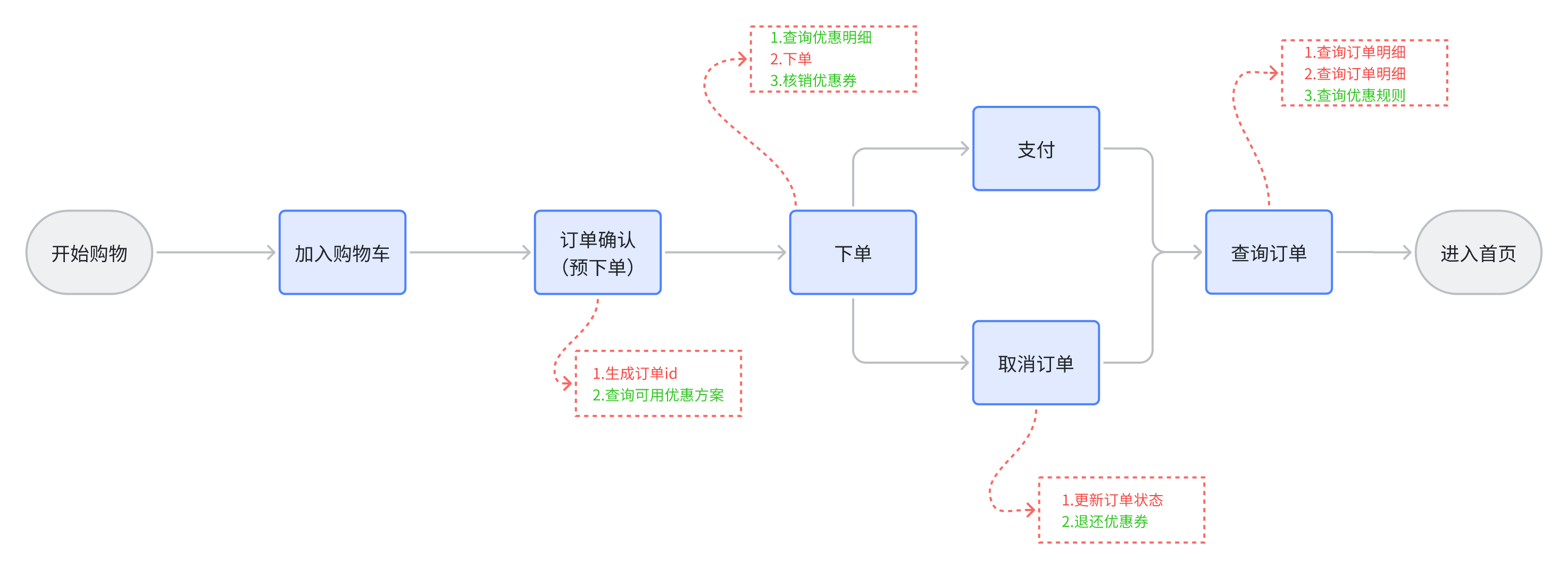
| 编号 | 接口简述 |
|---|---|
| 1 | 根据订单查询可用优惠方案(C 端) // TODO |
| 2 | 根据券方案计算订单优惠明细(C 端) |
| 3 | 核销优惠券(C 端) |
| 4 | 退还优惠券(C 端) |
| 5 | 查询优惠券(C 端) |
9.1.2 优惠券规则定义
所谓的优惠券方案推荐,就是从用户的所有优惠券中筛选出可用的优惠券,并且计算哪种优惠方案用券最少,优惠金额最高。
canUse:判断一个优惠券是否可用,也就是检查订单金额是否达到优惠券使用门槛calculateDiscount:按照优惠规则计算优惠金额,能够计算才能比较并找出最优方案getRule:生成优惠券规则描述,目的是在页面直观的展示各种方案,供用户选择
我们抽象一个接口来标示优惠券规则:
xxxxxxxxxxpackage com.tianji.promotion.strategy.discount;
public interface Discount {    boolean canUse(int totalAmount, Coupon coupon);    int calculateDiscount(int totalAmount, Coupon coupon);    String getRule(Coupon coupon);}
数据库表结构如下:

9.2 优惠券智能推荐 // TODO
9.2.1 思路分析
9.2.2 定义接口
9.2.3 查询用户券并初步筛选
9.2.4 细筛
9.2.5 优惠方案全排列组合
9.2.6 计算优惠明细
9.2.7 CompleteableFuture 并发计算
9.2.8 筛选最优解
9.3 优惠券使用
9.3.1 根据券方案计算订单优惠明细(C 端)
| 参数 | 说明 |
|---|---|
| 请求方式 | POST |
| 请求路径 | /user-coupons/discount |
| 请求参数 | userCouponIds、courseList |
| 返回值 | discountAmount、discountDetail |
Controller 层:
xxxxxxxxxxpackage com.tianji.promotion.controller;
("根据券方案计算订单优惠明细")("/discount")public CouponDiscountDTO queryDiscountDetailByOrder( OrderCouponDTO orderCouponDTO){ return discountService.queryDiscountDetailByOrder(orderCouponDTO);}Service 层:
xxxxxxxxxxprivate final UserCouponMapper userCouponMapper;
public CouponDiscountDTO queryDiscountDetailByOrder(OrderCouponDTO orderCouponDTO) { // 1. 查询用户优惠券 List<Long> userCouponIds = orderCouponDTO.getUserCouponIds(); List<Coupon> coupons = userCouponMapper .queryCouponByUserCouponIds(userCouponIds, UserCouponStatus.UNUSED); if (CollUtils.isEmpty(coupons)) { return null; } // 2. 查询优惠券对应课程 Map<Coupon, List<OrderCourseDTO>> availableCouponMap = findAvailableCoupon(coupons, orderCouponDTO.getCourseList()); if (CollUtils.isEmpty(availableCouponMap)) { return null; } // 3. 查询优惠券规则 return calculateSolutionDiscount(availableCouponMap, orderCouponDTO.getCourseList(), coupons);}修改 calculateSolutionDiscount 方法:
xxxxxxxxxxprivate CouponDiscountDTO calculateSolutionDiscount(...) { discountDTO.setDiscountDetail(courseDiscountMap); // 2. 计算该方案明细}Mapper 层:
xxxxxxxxxx("SELECT c.id, c.discount_type, c.`specific`, c.discount_value," + "c.threshold_amount, c.max_discount_amount, uc.id AS creater" + "FROM user_coupon uc INNER JOIN coupon c ON uc.coupon_id = c.id " + "WHERE uc.id IN (:userCouponIds) AND uc.STATUS = #{status}")List<Coupon> queryCouponByUserCouponIds(("userCouponIds") List<Long> userCouponIds, ("status") UserCouponStatus status);定义 FeignClient 方法:
xxxxxxxxxxpackage com.tianji.api.client.promotion.fallback;
public PromotionClient create(Throwable cause) { log.error("查询促销服务出现异常,", cause); return new PromotionClient() { // 添加接口的降级逻辑 public CouponDiscountDTO queryDiscountDetailByOrder(OrderCouponDTO orderCouponDTO) { return null; } };}改造交易服务接口:
xxxxxxxxxxpackage com.tianji.trade.service.impl;
public PlaceOrderResultVO placeOrder(PlaceOrderDTO placeOrderDTO) { // 2.2 计算优惠金额 order.setDiscountAmount(0); List<Long> couponIds = placeOrderDTO.getCouponIds(); CouponDiscountDTO discount = null; if (CollUtils.isNotEmpty(couponIds)) { List<OrderCourseDTO> orderCourses = courseInfos.stream() .map(c -> new OrderCourseDTO() .setId(c.getId()).setCateId(c.getThirdCateId()).setPrice(c.getPrice())) .collect(Collectors.toList()); discount = promotionClient // 远程调用 queryDiscountDetailByOrder .queryDiscountDetailByOrder(new OrderCouponDTO(couponIds, orderCourses)); if(discount != null) { order.setDiscountAmount(discount.getDiscountAmount()); order.setCouponIds(discount.getIds()); } } // 3.封装订单详情 List<OrderDetail> orderDetails = new ArrayList<>(courseInfos.size()); for (CourseSimpleInfoDTO courseInfo : courseInfos) { Integer discountValue = discount == null ? 0 : discount.getDiscountDetail().getOrDefault(courseInfo.getId(), 0); orderDetails.add(packageOrderDetail(courseInfo, order, discountValue)); }}xxxxxxxxxxpublic PlaceOrderResultVO enrolledFreeCourse(Long courseId) { // 3. 订单详情 OrderDetail detail = packageOrderDetail(courseInfo, order, 0);}xxxxxxxxxxprivate OrderDetail packageOrderDetail(CourseSimpleInfoDTO courseInfo, Order order, Integer discountValue) { // ... detail.setDiscountAmount(discountValue);}9.3.2 核销优惠券(C 端)
| 参数 | 说明 |
|---|---|
| 请求方式 | PUT |
| 请求路径 | /user-coupons/use |
| 请求参数 | couponIds |
| 返回值 | 无 |
Controller 层:
xxxxxxxxxxpackage com.tianji.promotion.controller;
("核销优惠券")("/use")public void writeOffCoupon(("用户优惠券id集合") ("couponIds") List<Long> userCouponIds){ userCouponService.writeOffCoupon(userCouponIds);}Service 层:
xxxxxxxxxxpublic void writeOffCoupon(List<Long> userCouponIds) { // 1. 查询优惠券 List<UserCoupon> userCoupons = listByIds(userCouponIds); if (CollUtils.isEmpty(userCoupons)) return; // 2. 处理数据 List<UserCoupon> list = userCoupons.stream() // 过滤无效券 .filter(coupon -> { if (coupon == null) return false; if (UserCouponStatus.UNUSED != coupon.getStatus()) return false; LocalDateTime now = LocalDateTime.now(); return !now.isBefore(coupon.getTermBeginTime()) && !now.isAfter(coupon.getTermEndTime()); }).map(coupon -> { // 组织新增数据 UserCoupon c = new UserCoupon(); c.setId(coupon.getId()); c.setStatus(UserCouponStatus.USED); return c; }).collect(Collectors.toList()); // 3. 核销,修改优惠券状态 boolean success = updateBatchById(list); if (!success) return; // 4.更新已使用数量 List<Long> couponIds = userCoupons.stream().map(UserCoupon::getCouponId).collect(Collectors.toList()); int c = couponMapper.incrUsedNum(couponIds, 1); if (c < 1) { throw new DbException("更新优惠券使用数量失败!"); }}定义 FeignClient 方法:
xxxxxxxxxxpackage com.tianji.api.client.promotion.fallback;
public PromotionClient create(Throwable cause) { log.error("查询促销服务出现异常,", cause); return new PromotionClient() { // 添加接口的降级逻辑 public void writeOffCoupon(List<Long> userCouponIds) { throw new BizIllegalException(500, "核销优惠券异常", cause); } };}改造交易服务接口:
xxxxxxxxxxpackage com.tianji.trade.service.impl;
public PlaceOrderResultVO placeOrder(PlaceOrderDTO placeOrderDTO) {    // 6. 核销优惠券(远程调用 writeOffCoupon)    promotionClient.writeOffCoupon(couponIds);}
9.3.3 退还优惠券(C 端)
| 参数 | 说明 |
|---|---|
| 请求方式 | PUT |
| 请求路径 | /user-coupons/refund |
| 请求参数 | couponIds |
| 返回值 | 无 |
Controller 层:
xxxxxxxxxxpackage com.tianji.promotion.controller;
("退还优惠券")("/refund")public void refundCoupon(("用户优惠券id集合") ("couponIds") List<Long> userCouponIds){ userCouponService.refundCoupon(userCouponIds);}Service 层:
xxxxxxxxxxpublic void refundCoupon(List<Long> userCouponIds) { // 1. 查询优惠券 List<UserCoupon> userCoupons = listByIds(userCouponIds); if (CollUtils.isEmpty(userCoupons)) { return; } // 2. 处理优惠券数据 List<UserCoupon> list = userCoupons.stream() // 过滤无效券 .filter(coupon -> coupon != null && UserCouponStatus.USED == coupon.getStatus()) // 更新状态字段 .map(coupon -> { UserCoupon c = new UserCoupon(); c.setId(coupon.getId()); // 3. 判断有效期,是否已经过期,如果过期则状态为已过期,否则状态为未使用 LocalDateTime now = LocalDateTime.now(); UserCouponStatus status = now.isAfter(coupon.getTermEndTime()) ? UserCouponStatus.EXPIRED : UserCouponStatus.UNUSED; c.setStatus(status); return c; }).collect(Collectors.toList()); // 4. 修改优惠券状态 boolean success = updateBatchById(list); if (!success) return; // 5. 更新已使用数量 List<Long> couponIds = userCoupons.stream() .map(UserCoupon::getCouponId).collect(Collectors.toList()); int c = couponMapper.incrUsedNum(couponIds, -1); if (c < 1) { throw new DbException("更新优惠券使用数量失败!"); }}定义 FeignClient 方法:
xxxxxxxxxxpackage com.tianji.api.client.promotion.fallback;
public PromotionClient create(Throwable cause) { log.error("查询促销服务出现异常,", cause); return new PromotionClient() { // 添加接口的降级逻辑 public void refundCoupon(List<Long> userCouponIds) { throw new BizIllegalException(500, "退还优惠券异常", cause); } };}改造交易服务接口:
xxxxxxxxxxpackage com.tianji.trade.service.impl;
public void cancelOrder(Long orderId) {    // 6. 退还优惠券(远程调用 refundCoupon)    promotionClient.refundCoupon(order.getCouponIds());}
9.3.4 查询优惠券(C 端)
| 参数 | 说明 |
|---|---|
| 请求方式 | GET |
| 请求路径 | /user-coupons/rules |
| 请求参数 | couponIds |
| 返回值 | rules |
Controller 层:
xxxxxxxxxxpackage com.tianji.promotion.controller;
("查询优惠券")("/rules")public List<String> queryDiscountRules( ("用户优惠券id集合") ("couponIds") List<Long> userCouponIds){ return userCouponService.queryDiscountRules(userCouponIds);}Service 层:
xxxxxxxxxxpublic List<String> queryDiscountRules(List<Long> userCouponIds) { // 1. 查询优惠券信息 List<Coupon> coupons = baseMapper .queryCouponByUserCouponIds(userCouponIds, UserCouponStatus.USED); if (CollUtils.isEmpty(coupons)) { return CollUtils.emptyList(); } // 2. 转换规则 return coupons.stream() .map(c -> DiscountStrategy.getDiscount(c.getDiscountType()).getRule(c)) .collect(Collectors.toList());}定义 FeignClient 方法:
xxxxxxxxxxpackage com.tianji.api.client.promotion.fallback;
public PromotionClient create(Throwable cause) { log.error("查询促销服务出现异常,", cause); return new PromotionClient() { // 添加接口的降级逻辑 public List<String> queryDiscountRules(List<Long> userCouponIds) { return Collections.emptyList(); } };}改造交易服务接口:
xxxxxxxxxxpackage com.tianji.trade.service.impl;
public OrderVO queryOrderById(Long id) { // 3.4 优惠明细(远程调用 queryDiscountRules) List<String> rules = promotionClient.queryDiscountRules(order.getCouponIds()); vo.setCouponDesc(String.join("/", rules));}9.4 面试题
9.4.1 你们的优惠券规则是如何编码实现的?
答:在初期做调研的时候也考虑过规则引擎,不过考虑到我们的优惠规则并不复杂,最终选择了基于策略模式来自定义规则。
9.4.2 你在项目中有没有使用到设计模式?
答:在优惠券功能中使用了策略模式来定义优惠规则。还有基于注解的通用分布式锁组件,也使用到了策略模式、工厂模式。
9.4.3 你在项目中有没有使用到线程池或者并发编程?
答:在实现优惠券的推荐算法时,我们采用的是排列组合多种优惠方案,然后分别计算,最终筛选出最优解的思路。
由于需要计算的优惠方案可能较多,为了提高计算效率,我们利用了 CompletableFuture 来实现多方案的并行计算。
并且由于要筛选最优解,那就需要等待所有方案都计算完毕,再来筛选。因此就使用了 CountdownLatch 来做多线程的并行控制。
9.4.4 使用优惠券的订单如果部分退货,如何操作?优惠券如何处理?
答:基于产品的需求,我们采用的是退款不退券的方案。
具体来说,就是在一开始下单时,就会根据优惠券本身的使用范围,筛选出订单中可以参与优惠的商品。 然后计算出每一个被优惠的商品具体的优惠金额分成,以及对应的实付金额。
如果用户选择只退部分商品,就可以根据每个商品的实付金额来退款,同时也满足退款不退券的原则。
当然,如果订单未支付、取消订单或者超时关闭,是可以退券的。